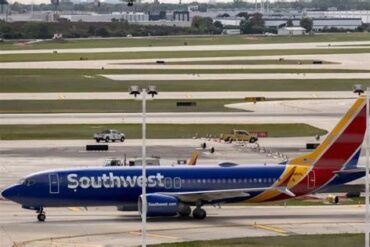
Chicago’s aviation landscape is shifting again as Southwest Airlines concludes a short but closely watched chapter at Chicago O’Hare International Airport. The Dallas-based carrier confirmed it will end all O’Hare operations on June 4, 2026, moving every affected route back to Chicago Midway International Airport, where the airline has built one of its largest and most influential operational bases in the United States.
The decision effectively closes a strategic experiment that began during the volatile early recovery period of the COVID-19 pandemic. At the time, shifting travel demand and newly available gate capacity created an unusual opportunity for Southwest to enter one of the world’s busiest aviation hubs. Five years later, operational realities have pushed the airline back toward its long-standing formula: concentrate operations where efficiency, scale, and scheduling flexibility are easier to maintain.
Southwest Airlines Concludes Its O’Hare Operations
Southwest’s O’Hare presence will officially disappear in early June, ending a relatively small but symbolically significant footprint at Chicago’s largest airport. The airline stated that operating conditions at O’Hare proved more complex than anticipated, while its long-established infrastructure at Midway allows for smoother operations and stronger network connectivity.
Although the airline will withdraw physically from O’Hare, travelers will not lose destinations. Southwest confirmed that all 15 routes currently served from O’Hare will continue operating, but departures will move to Midway instead. From a passenger perspective, the primary change will simply be the airport of departure within the Chicago region rather than the loss of flight options.
The airline also addressed workforce concerns. Employees currently tied to the O’Hare operation will be offered opportunities to transition into roles elsewhere in the network, including positions at Midway, where Southwest continues to operate hundreds of flights daily.
Operational scale plays a crucial role in the decision. Southwest already runs up to 244 daily departures from Midway, making the airport one of its busiest focus cities nationwide. Concentrating flights there reinforces a hub-like structure that improves aircraft utilization, simplifies crew scheduling, and strengthens connection opportunities for passengers traveling across the airline’s domestic network.
A Pandemic-Era Expansion That Challenged Tradition
Southwest’s arrival at O’Hare in 2021 surprised many aviation analysts because it deviated from a philosophy the airline had followed for decades. Historically, Southwest preferred secondary or less congested airports where turnaround times are faster, fees are lower, and gate availability is easier to manage.
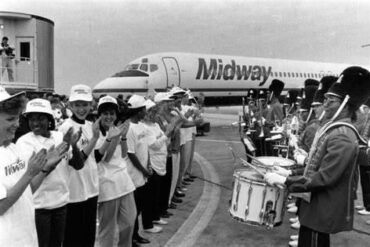
Chicago perfectly illustrated that strategy. Since launching service at Chicago Midway in 1985, Southwest steadily transformed the airport into one of its most important bases. Midway’s layout, operational costs, and relative simplicity compared with mega-hubs aligned neatly with Southwest’s point-to-point operating model.
The pandemic temporarily disrupted that equation. Travel demand collapsed, major airlines cut schedules, and gate space opened at airports that were normally packed. In that environment, Southwest saw an opportunity to broaden its Chicago presence and capture new travelers who preferred O’Hare’s location or global connectivity.
From its O’Hare base, Southwest launched nonstop flights to several key cities, including Baltimore/Washington, Dallas Love Field, Denver, Nashville, and Phoenix. These routes placed the airline directly alongside dominant O’Hare incumbents such as United Airlines and American Airlines, two carriers whose massive hub operations define the airport’s traffic flows.
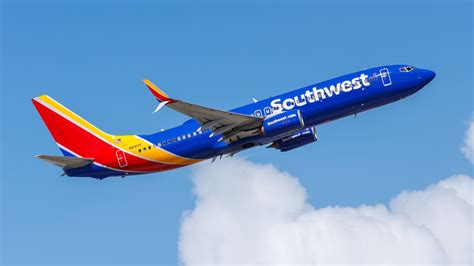
Yet the expansion remained modest. Southwest’s schedule at O’Hare never approached the scale necessary to replicate its Midway dominance. Over time, the imbalance became clear: while the airline experimented at O’Hare, the overwhelming majority of Chicago-area flights continued operating from Midway.
Operational Pressure at One of the World’s Busiest Airports
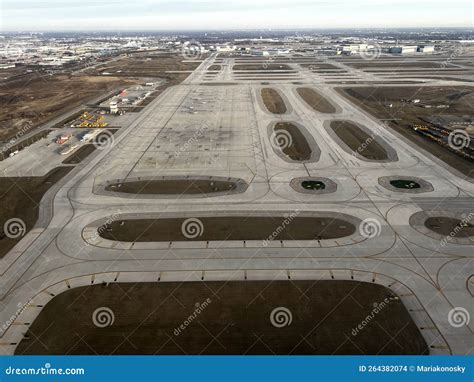
Running flights at O’Hare presents a unique set of challenges that go far beyond simple route planning. The airport consistently ranks among the busiest aviation hubs on Earth, with dense airline schedules, complex runway configurations, and significant air traffic congestion during peak travel periods.
Federal aviation authorities have recently warned that flight volumes at O’Hare may exceed the airport’s operational capacity, particularly during busy seasonal travel windows. The Federal Aviation Administration has even considered limiting daily flight totals to reduce congestion and improve on-time performance.
These structural pressures create a difficult environment for airlines without massive hub operations at the airport. Carriers like United and American maintain huge infrastructures—gates, maintenance bases, crew pools, and connecting traffic—that help absorb delays and disruptions. A smaller operator entering the system can find scheduling flexibility much harder to achieve.
Southwest’s network philosophy amplifies that challenge. The airline relies on fast aircraft turnarounds and tightly choreographed scheduling to keep its large fleet of Boeing 737 aircraft moving efficiently. Congestion, taxi delays, and gate bottlenecks at a mega-hub can disrupt that rhythm quickly.
In contrast, Midway offers a more controlled environment where Southwest’s operational style fits naturally. The airline controls a significant share of the airport’s traffic, which allows greater predictability in gate usage and departure timing.
Midway Reaffirmed as Southwest’s Chicago Stronghold
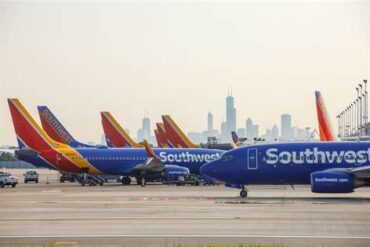
With the O’Hare chapter closing, Southwest’s Chicago strategy returns to its familiar foundation: consolidated operations at Midway International Airport. The airport has effectively served as a cornerstone of the airline’s network for nearly forty years, linking Chicago travelers to dozens of destinations across the United States.
This consolidation strengthens the advantages of scale that Southwest has cultivated there over decades. A dense flight schedule enables smoother passenger connections, while centralized ground operations improve efficiency in aircraft maintenance, crew rotations, and gate management.
For passengers, the shift may feel modest. Flights that once departed from O’Hare will continue operating under the same routes and schedules, simply relocated to Midway. Yet strategically, the move represents a clear reaffirmation of Southwest’s long-standing playbook: focus resources where operational control is strongest and network density produces the greatest return.
The O’Hare experiment was born from a moment of unusual disruption in the aviation industry. Its conclusion demonstrates how airline strategies often return to fundamentals once market conditions stabilize. For Southwest Airlines, those fundamentals still point decisively toward Chicago Midway as the carrier’s enduring home in the Windy City.