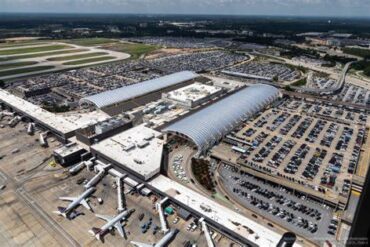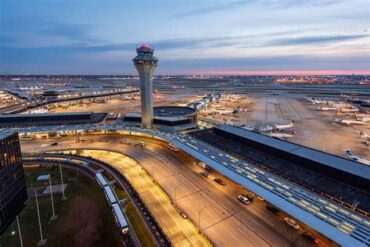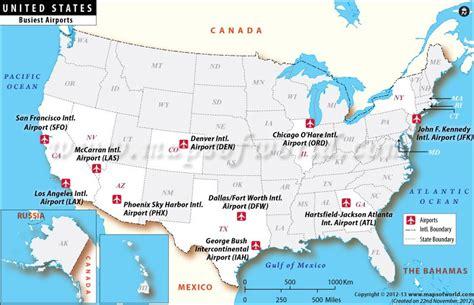
Airports compete with a quiet intensity that rivals professional sports. The scoreboard is not goals or touchdowns but flights per day, seat capacity, and the scale of global connectivity. When asking what is the busiest airport in North America, the answer depends on which metric defines “busiest.” By aircraft movements, Chicago O’Hare International Airport (ORD) takes the crown. By total available seats, Hartsfield–Jackson Atlanta International Airport (ATL) stands firmly on top.
Both airports are giants. Both anchor powerful airline hubs. And both represent different philosophies of operational dominance—one built on frequency and global diversity, the other on sheer passenger volume and capacity density.
Chicago O’Hare: The Busiest Airport in North America by Number of Flights
Measured by daily aircraft movements, Chicago O’Hare International Airport leads North America. Recent schedule data shows approximately 1,045 passenger flights per day, excluding freight and charter operations. That translates into an average of 43 to 44 takeoffs or landings per hour, sustained throughout operational peaks.
This relentless tempo is not accidental. It is enabled by a massive airfield footprint that includes eight runways, allowing simultaneous arrivals and departures even during Chicago’s notoriously challenging weather conditions. Snowstorms and crosswinds are not theoretical possibilities in Illinois; they are annual certainties. O’Hare’s runway layout and advanced air traffic control systems are designed precisely to prevent weather from crippling throughput.
Beyond flight movements, O’Hare ranks among the top U.S. airports for annual seat capacity, with more than 50 million seats available in 2025. On the global stage, it consistently places within the world’s top ten airports by seat supply during peak months.
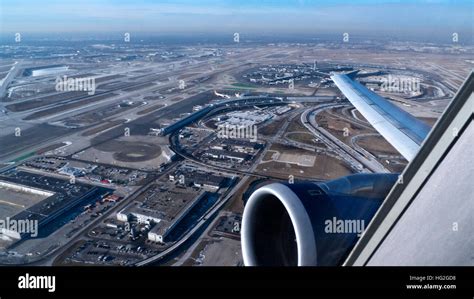
This level of activity requires orchestration on a scale most travelers never notice. Aircraft taxi with choreographed precision, gates rotate efficiently, and ground crews operate in tightly timed cycles. At O’Hare, minutes matter. Delay propagation can ripple across the country because this airport is a national connective artery.
A Global Route Network Anchored in the Midwest
O’Hare’s power lies not only in volume but in route diversity. Domestically, it connects to nearly every major U.S. market, with particularly dense coverage across the Eastern and Midwestern United States. Smaller regional airports feed into Chicago, creating a hub-and-spoke network that channels passengers onward to long-haul destinations.
Internationally, ORD’s footprint stretches across five continents. Europe is strongly represented, with nonstop service to major cities including London, Frankfurt, Paris, and Madrid. East Asia connectivity is especially notable, including flights to Tokyo, Seoul, and multiple destinations in China. Services extend to Hong Kong via Cathay Pacific and to Delhi through Air India, illustrating the airport’s importance in transpacific and South Asian corridors.
Africa, while more limited, is served through Addis Ababa via Ethiopian Airlines, linking Chicago directly to the African continent. The Middle East sees several routes as well, strengthening connectivity between North America and Gulf hubs.
This global spread gives O’Hare a strategic advantage: it functions not merely as a domestic transfer point but as an intercontinental gateway.
United Airlines: The Dominant Force at O’Hare
Any discussion of Chicago O’Hare must address United Airlines, which maintains one of its largest hubs here. United and its regional brand, United Express, account for well over half of ORD’s daily departures.
The airline bases a diverse fleet at Chicago, ranging from narrowbody aircraft such as the Boeing 737 and Airbus A320 family to widebody jets including the Boeing 787 Dreamliner and 777. This fleet diversity allows United to operate high-frequency domestic routes while simultaneously maintaining extensive long-haul international service.
O’Hare also acts as a key Star Alliance hub in North America. Alliance members such as Lufthansa, Turkish Airlines, Air Canada, ANA, Air India, and Ethiopian Airlines reinforce global connectivity. For international travelers within the alliance ecosystem, Chicago is a critical interchange node.
The result is a layered operational structure: high domestic frequency feeding into long-haul global routes, all coordinated through one of the most complex airfields on the continent.
Atlanta Hartsfield–Jackson: The Busiest Airport in North America by Seat Capacity
If aircraft movements define Chicago’s dominance, seat capacity defines Atlanta’s. Hartsfield–Jackson Atlanta International Airport offers approximately 63.1 million seats in 2025, surpassing Chicago by more than 12 million seats despite handling fewer total daily flights.
This difference reveals a structural contrast. Atlanta relies more heavily on larger-capacity aircraft, meaning each departure carries more passengers on average. While ORD emphasizes frequency, ATL maximizes per-flight volume.
Globally, Atlanta is frequently ranked among the top two airports worldwide by seat capacity, underscoring its extraordinary passenger throughput. In peak months, ATL can exceed 4.5 million seats available, placing it firmly in the top tier of international aviation hubs.

Infrastructure plays a major role. Although ATL operates with five runways, fewer than Chicago’s eight, it compensates through highly optimized scheduling and gate utilization. The airport’s midfield terminal layout, connected by an efficient underground train system, streamlines passenger transfers on a massive scale.
Atlanta’s Route Network: Dense, Efficient, and Demand-Driven
Atlanta’s domestic reach is formidable. The airport connects to a vast array of U.S. cities, particularly across the Eastern United States and Southeast. Its geographic location gives it natural advantages for east-west and north-south connections, making it an ideal transfer hub.
Within the Americas, ATL maintains strong connectivity to Canada, Central America, and South America. In fact, Atlanta serves more destinations in parts of Latin America and Africa than Chicago does.
However, in Asia and the Middle East, Atlanta’s network is comparatively narrower. It maintains service to select destinations in Japan and South Korea but does not match Chicago’s broader East Asian footprint. Connectivity to India is absent, and Middle Eastern routes are limited in number.
This difference reflects strategic emphasis rather than weakness. Atlanta’s network prioritizes markets where sustained passenger demand supports larger aircraft and high load factors. The model favors efficiency over geographic breadth.
Delta Air Lines: Atlanta’s Engine of Scale
Atlanta’s scale would be impossible without Delta Air Lines, whose corporate headquarters are located in the city. Delta operates the overwhelming majority of flights at ATL, commanding more than half of the airport’s total market share.
In a single month, Delta can offer over four million seats across nearly 25,000 flights from Atlanta. Competing carriers such as Southwest and Frontier operate meaningful schedules, but their seat counts are dwarfed by Delta’s presence.

Delta’s dominance transforms ATL into a SkyTeam Alliance hub, welcoming international partners including Air France, KLM, Virgin Atlantic, Korean Air, and SAS. The synergy between Delta’s domestic feed and alliance long-haul services strengthens Atlanta’s position as a global connector.
The relationship between Delta and ATL is symbiotic. As Delta expands routes, Atlanta grows in capacity. As Atlanta invests in infrastructure, Delta benefits from improved operational efficiency.
Infrastructure: The Silent Determinant of “Busiest”
The concept of the busiest airport is incomplete without infrastructure analysis. Chicago’s eight-runway configuration supports simultaneous independent operations, enabling high aircraft movement counts even during peak congestion. Atlanta’s five-runway layout, though smaller in number, is engineered for smooth sequencing and quick turnarounds.
Passenger processing systems further differentiate the two. Atlanta participates in the TSA One Stop Security (OSS) program, simplifying international-to-domestic connections for certain flights. This reduces redundant screening and shortens transfer times, improving the passenger experience in measurable ways.
Capacity does not automatically equal passenger numbers, but it reveals potential. Seat supply indicates how many travelers an airport can theoretically handle. Aircraft movements demonstrate operational tempo. Each metric captures a different dimension of scale.
So, What Is the Busiest Airport in North America?
The answer depends on the lens applied.
If “busiest” means most flights per day, then Chicago O’Hare International Airport leads the continent. Its 1,045 daily passenger movements reflect unmatched operational frequency.
If “busiest” means highest seat capacity, then Hartsfield–Jackson Atlanta International Airport takes the title with over 63 million available seats annually.
Both airports dominate in their own way. Chicago represents global diversity and flight frequency powered by United Airlines and Star Alliance connectivity. Atlanta embodies capacity density and passenger throughput driven by Delta Air Lines and SkyTeam reach.
In the end, the competition itself tells a larger story about North American aviation. One hub thrives on multiplicity and international breadth. The other thrives on volume and efficiency at scale. Together, they illustrate how “busiest” is not a single crown but a multifaceted measure of modern air transport power.