The U.S. Air Force is accelerating the development and deployment of next-generation Aircrew Laser Eye Protection (ALEP) as laser strikes against aircraft climb to unprecedented levels. With more than 10,000 incidents reported by the Federal Aviation Administration (FAA) in 2025, nearly 48 percent higher than in 2020, what was once dismissed as a nuisance has evolved into a persistent operational threat. The new initiative, led by engineers and Airmen at Robins Air Force Base, reflects a decisive shift in how the Air Force protects pilot vision, mission continuity, and long-term readiness.
Laser illumination of cockpits is not an abstract hazard. Directed beams can cause immediate glare, flash blindness, and visual disorientation, especially during critical phases such as takeoff, final approach, and landing. Even brief exposure can disrupt instrument scanning and spatial awareness. In rare but serious cases, high-intensity beams pose a risk of retinal injury. For military aircrews flying in dense urban airspace, near international airports, or in contested environments, these disruptions carry cascading consequences—diversions, aborted missions, or degraded operational tempo. The growing frequency of laser incidents underscores how low-cost technology can generate high-impact operational friction.
In response, the Air Force Life Cycle Management Center’s Human Systems Division has structured the ALEP–Technology Insertion (ALEP-TI) program as an evolutionary acquisition pathway. Managed by AFLCMC/ROU at Wright-Patterson Air Force Base and supported operationally at Robins AFB, the program replaces and upgrades protective eyewear every five to seven years. This approach treats laser eye protection not as static personal equipment, but as a living capability that evolves alongside emerging wavelengths, increased laser power outputs, and real-world operational feedback.
The Escalating Laser Threat to Military Aviation
The scale of laser strikes has reshaped risk calculations across both civilian and military aviation sectors. According to FAA data, more than 10,000 laser incidents were recorded in 2025 alone, marking one of the highest annual totals on record. While many exposures do not result in permanent injury, the unpredictability and timing of such events amplify their danger. A laser beam directed into a cockpit during short final can temporarily wash out vision at precisely the moment a pilot must judge glide path, runway alignment, and aircraft configuration.
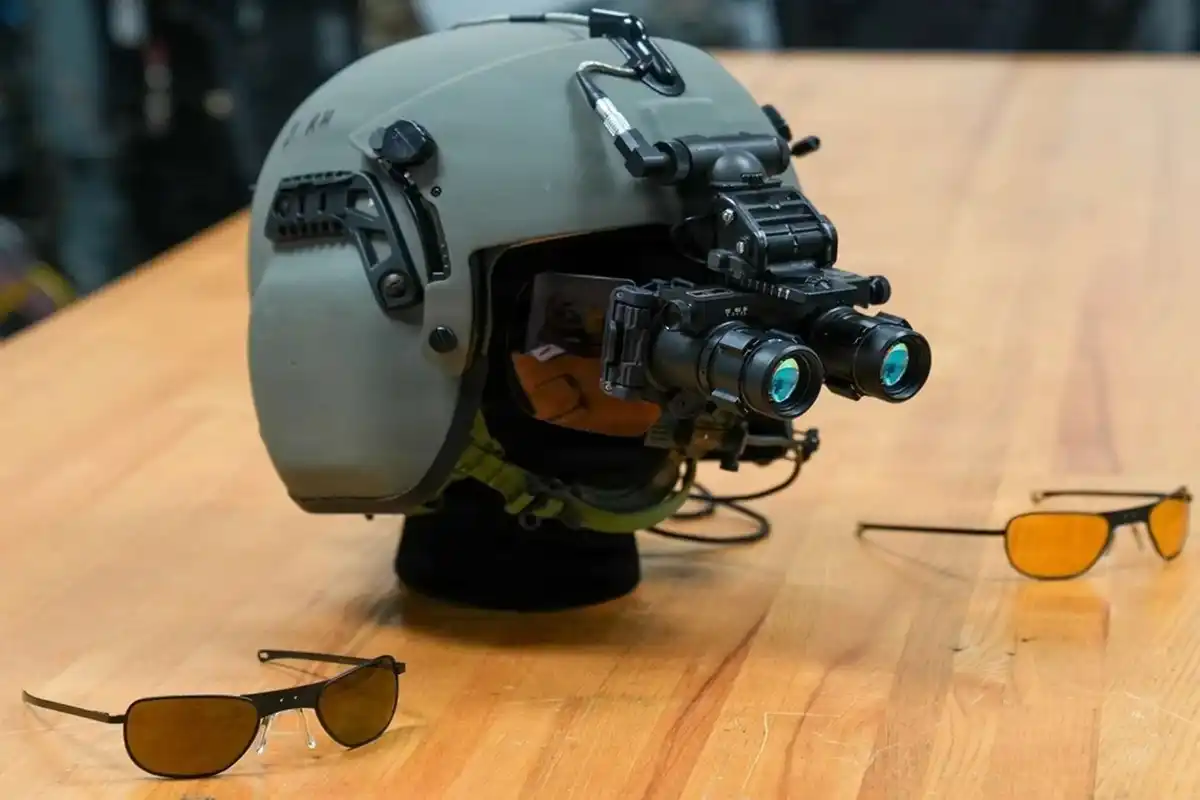
Military operations introduce additional complexity. Aircrews may operate at night with night vision goggles (NVGs), which amplify available light to enhance situational awareness in low-illumination environments. However, NVGs can also intensify the disruptive effects of certain laser wavelengths. This intersection of emerging commercial laser devices and advanced military optics has created a technical challenge that demands more sophisticated countermeasures.
Beyond the physical hazard, laser strikes exert psychological pressure. Sudden exposure can trigger startle responses, increase workload, and divert cognitive bandwidth during already demanding flight regimes. In high-tempo operations, even temporary grounding due to precautionary medical evaluation affects sortie generation and overall readiness. The Air Force’s new protective strategy recognizes that preserving pilot vision is inseparable from sustaining mission assurance.
Block 3 ALEP: Modular Protection for Modern Missions
The latest iteration of the program, known as the Block 3 ALEP family, introduces a modular kit concept designed for specific operational contexts. Rather than a single universal lens, the Block 3 system includes six configurations tailored for day operations, night operations, ballistic protection, and integration with NVGs. Visors are engineered to maintain peripheral awareness while shielding against targeted wavelengths.
At the core of Block 3’s advancement is an updated dye formulation capable of filtering a broader spectrum of laser wavelengths than the previous Block 2 equipment. This enhancement reflects the proliferation of commercially available lasers emitting across varied bands of the visible and near-infrared spectrum. By expanding filtering capability, the system anticipates not only current threats but those likely to emerge as laser technology becomes more powerful and accessible.
Crucially, the new lenses are engineered to maintain optical clarity. Overly darkened eyewear can degrade instrument readability and depth perception, especially in low-light conditions. Block 3 night spectacles allow increased transmission of natural light compared to earlier versions, supporting improved visual acuity and color recognition. The balance between attenuation of harmful wavelengths and preservation of cockpit visibility is central to operational viability. Protective equipment that compromises situational awareness defeats its own purpose; Block 3 seeks to eliminate that trade-off.
Engineering Integration and Human Systems Design
The development of next-generation laser eye protection highlights the Air Force’s emphasis on human systems engineering. Specialists at AFLCMC/ROU collaborate directly with maintainers and operational Airmen to validate technical orders, user manuals, and sustainment procedures. Instead of assuming documentation clarity, engineers observe maintainers working through instructions unassisted, identifying ambiguities and friction points in real time.
This feedback loop ensures compatibility with helmets, oxygen masks, NVG mounts, and cockpit ergonomics. Fit and comfort are not secondary concerns; extended sorties demand eyewear that can be worn for hours without inducing fatigue or pressure points. Small design refinements—adjusted frame geometry, improved seal contours, optimized lens curvature—translate into measurable improvements in usability.
By embedding engineers within operational units, the program reduces adoption risk and accelerates iteration cycles. Field observations feed directly into design refinements, reinforcing a continuous improvement model rather than episodic procurement. This approach mirrors broader Department of Defense efforts to shorten capability development timelines while preserving rigorous testing standards.
Strategic Implications for Aircrew Survivability and Readiness
The Air Force plans to field more than 45,000 Block 3 devices by 2029, signaling a fleet-wide commitment to enhanced eye protection. This scale of distribution positions ALEP as a standard component of aircrew survivability equipment rather than a niche solution reserved for specific platforms.
The implications extend beyond immediate safety. Retention of experienced pilots remains a strategic priority, and long-term ocular health is a non-trivial factor in career longevity. Even minor retinal injuries can result in temporary grounding, medical evaluation, and reduced flight currency. By reducing exposure risk, ALEP contributes directly to sustaining the human capital at the heart of airpower.
Operationally, improved protection supports mission continuity in high-density airspace and contested environments. Laser harassment has been documented near major metropolitan areas and in proximity to sensitive facilities. In overseas theaters, non-state actors can employ inexpensive handheld lasers as asymmetric tools to disrupt air operations. Enhanced protective capability denies adversaries an easy method of imposing operational friction.
Moreover, the technological insights generated through Block 3 development may inform joint service standards and allied interoperability. Coalition operations demand common baselines for protective equipment to ensure consistent safety margins across multinational aircrews. As laser threats expand globally, standardized protective measures could become a defining feature of modern aircrew gear.
Adapting to a Persistent, Low-Cost Threat Environment
The evolution of Aircrew Laser Eye Protection reflects a broader reality in contemporary defense: not all threats are high-tech or high-cost. A commercially purchased laser pointer can impose disproportionate disruption on advanced aircraft systems if unmitigated. Addressing such vulnerabilities requires agility, engineering rigor, and sustained collaboration between developers and operators.
The work underway at Robins and Wright-Patterson Air Force Bases demonstrates how iterative technology insertion, modular design, and human-centered engineering converge to counter emerging hazards. By reframing protective eyewear as a dynamic capability rather than static gear, the Air Force is building resilience into the very interface between pilot and cockpit.
As laser incidents continue to rise, the deployment of Block 3 ALEP stands as a decisive measure to safeguard vision, protect mission integrity, and preserve the operational edge of U.S. airpower. In an era where inexpensive technologies can challenge sophisticated systems, proactive investment in human protection remains one of the most strategic decisions an air force can make.