JetBlue’s new four-cabin strategy is about to change the way passengers think about premium travel. Beginning with selected flights, the airline plans to introduce BlueFirst, a conventional domestic first-class product designed for aircraft that do not carry the carrier’s better-known Mint cabin. On paper, the move looks straightforward: passengers will soon be able to choose among Main, EvenMore, BlueFirst, and Mint. In practice, the fare structure underneath those four experiences is considerably more complicated.
The biggest surprise is not BlueFirst itself. It is the arrival of BlueFirst Base, a fare that puts passengers in JetBlue’s new first-class cabin while stripping away several benefits normally associated with a premium ticket. Customers can receive the first-class seat and onboard experience, yet lose advance seat selection, flexible changes, same-day switching, and a significant portion of their TrueBlue earnings. The result is a product that looks premium from the cabin door but behaves much more like a restrictive economy fare when plans change.
That distinction matters because premium travel has become increasingly segmented across North American airlines. Carriers are discovering that passengers who want a better seat do not always want to pay for every traditional premium benefit. JetBlue’s new system therefore follows a broader industry movement toward unbundling premium cabins, allowing travelers to buy the physical seat while deciding separately how much flexibility, loyalty value, and convenience they actually need.
JetBlue BlueFirst Introduces a Fourth Cabin Experience
JetBlue has traditionally occupied an unusual position in the U.S. airline market. It has offered a more comfortable economy product than many low-cost competitors while using Mint to compete directly for premium long-haul customers. What it lacked was a conventional domestic first-class cabin for aircraft that were not equipped with Mint.
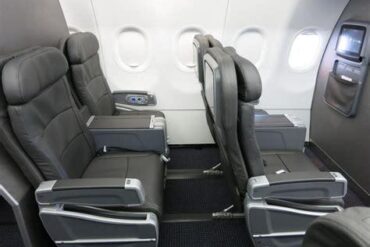
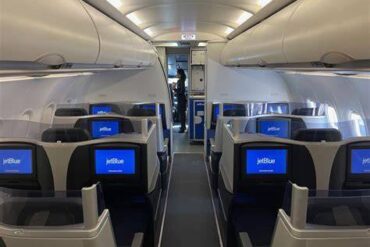
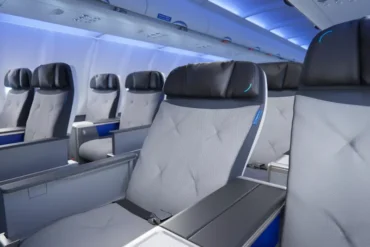
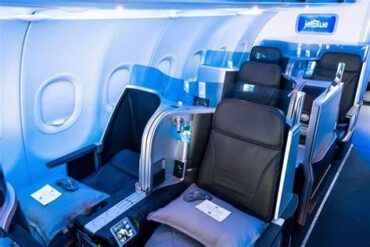
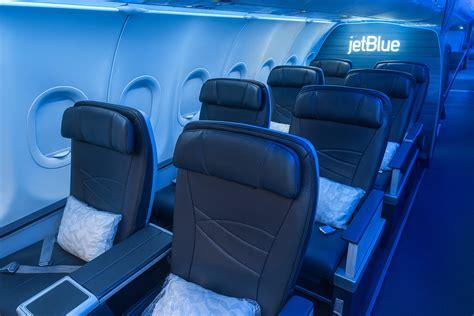
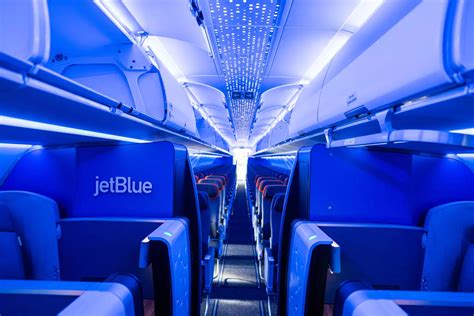
BlueFirst is intended to fill precisely that gap. Rather than installing lie-flat suites, JetBlue is expected to use a Collins Aerospace MiQ recliner-style seat, giving passengers approximately 36 to 37 inches of pitch. That puts the product firmly in the domestic first-class category rather than making it a miniature version of Mint.
The change is significant because JetBlue will effectively operate four distinct onboard experiences. Main will remain the standard economy product, while EvenMore continues to provide extra-legroom seating. BlueFirst becomes the new conventional first-class option, and Mint remains the carrier’s flagship premium product on aircraft and routes configured for it.
The fare system then adds another layer. Passengers will not simply choose a cabin and pay a corresponding price. Instead, they select an experience first and a fare type second. The three fare categories are Base, Standard, and Flex, although Mint is restricted to Standard and Flex.
That creates a structure in which the same BlueFirst seat can represent very different value depending on the fare attached to it.
What BlueFirst Base Actually Gets You
The central attraction of BlueFirst Base is easy to understand: passengers can access JetBlue’s new first-class seat without purchasing the more expensive Standard or Flex version of the fare.
That means the customer still travels in the BlueFirst cabin. The physical seat is the major benefit, and the onboard experience is expected to include upgraded service compared with Main. JetBlue also plans to introduce cold-catered meals on aircraft without ovens, although the exact details of the food and beverage offering have not yet been fully disclosed.
The seat itself should provide a meaningful comfort advantage over Main. With approximately 36–37 inches of pitch, BlueFirst offers considerably more personal space than the post-retrofit Main cabin, where seat pitch is expected to fall to approximately 30 inches.
However, passengers buying BlueFirst Base need to understand that the ticket is not simply a cheaper version of BlueFirst Standard. It is deliberately designed with fewer benefits.
BlueFirst Base passengers are expected to lose advance seat selection, meaning the ability to choose their preferred first-class seat is not included. They also face penalties for changing or canceling travel, while same-day switches and standby are not included as free benefits.
The distinction becomes especially important for travelers whose plans are uncertain. A passenger who knows the itinerary will not change may find BlueFirst Base appealing. Someone traveling for business, attending an event, or connecting through another city may find the restrictions considerably more expensive.
The $430 Question Behind BlueFirst Base
The headline fare price does not tell the entire story. The more revealing calculation involves the potential penalties attached to the Base category.
A $150 change fee, a $100 same-day switch or standby fee, and a $150 cancellation fee can create as much as $400 in direct charges before other considerations are included. If a passenger also wants to select a preferred seat, additional charges can push the potential exposure toward approximately $430.
That does not mean every BlueFirst Base passenger will pay $430. Most will not. The point is that the cheapest advertised fare can become substantially more expensive when a passenger needs flexibility or wants to control the seating assignment.
This is the fundamental economic question surrounding BlueFirst Base. How much cheaper will it be than BlueFirst Standard?
JetBlue’s pricing difference will ultimately determine whether Base represents genuine value or merely an attractive headline price. If BlueFirst Base is dramatically cheaper, travelers with fixed schedules may rationally accept the restrictions. If the price gap is small, Standard could become the obvious choice.
This is where the fare structure becomes less about cabin class and more about risk management. Passengers are effectively deciding how much uncertainty they are willing to absorb in exchange for a lower initial fare.
BlueFirst Base Slashes TrueBlue Earnings
The restrictions do not stop with flexibility. BlueFirst Base also carries a substantial TrueBlue earning penalty.
Base fares earn only one TrueBlue point per dollar spent, while Standard and Flex fares earn three points per dollar. That represents a reduction of roughly 66% in points earned.
For an inexpensive ticket, the difference might not matter much. On a premium itinerary, however, the lost points can become meaningful.
Consider a $600 BlueFirst fare. A passenger earning three points per dollar would receive approximately 1,800 base TrueBlue points. A BlueFirst Base passenger would receive only 600. The difference is 1,200 points.
The actual monetary value of those points varies according to how and when they are redeemed, so they should not be treated as a fixed cash loss. Nevertheless, frequent JetBlue travelers should consider the opportunity cost, particularly when the traveler is purchasing several premium tickets throughout the year.
The loyalty penalty makes BlueFirst Base unusual. The passenger is already paying for a premium cabin, yet JetBlue gives the traveler a lower earning rate than the higher fare versions of the same product.
BlueFirst Standard May Be the Sweet Spot
For many travelers, BlueFirst Standard is likely to make more sense than BlueFirst Base.
Standard retains the BlueFirst cabin while removing the most significant financial penalties associated with Base. Changes are permitted without a change fee, subject to any fare difference, and cancellations can generally result in travel credit rather than a heavily penalized outcome.
Standard also earns three TrueBlue points per dollar. That immediately eliminates one of the biggest disadvantages of BlueFirst Base.
Same-day switching and standby still carry a $100 per-person fee under the standard structure, although Mosaic members can have those charges waived. Travelers who value maximum flexibility can move up again to Flex.
The logic is therefore relatively clear. Base is designed around the passenger who prioritizes the lowest upfront price. Standard is aimed at passengers who want the premium cabin without accepting the most restrictive conditions. Flex is designed for customers willing to pay more for maximum freedom.
The interesting part is that all three customers may occupy essentially the same BlueFirst cabin.
How BlueFirst Fits Between Main and Mint
BlueFirst is not intended to replace Mint. The two products serve different purposes.
Mint is JetBlue’s premium flagship and is associated with lie-flat seating and long-haul premium travel. BlueFirst, by contrast, is designed for domestic and other flights where a conventional recliner-style first-class product makes more commercial sense.
That creates a clearer hierarchy within JetBlue’s network. Main remains the basic experience. EvenMore offers additional space. BlueFirst provides a recognizable first-class product, while Mint sits at the top of the premium ladder.
For travelers who previously had only Main or EvenMore on a non-Mint route, BlueFirst gives them another reason to pay for a premium seat.
The strategy also allows JetBlue to compete more directly with the domestic first-class cabins offered by American Airlines, Delta Air Lines, and United Airlines. The seat, service, and food details will determine how closely BlueFirst ultimately resembles those products, but the commercial positioning is unmistakable.
BlueFirst Comes With a Hidden Cost for Main Cabin Passengers
The BlueFirst retrofit also creates a less obvious change for economy travelers.
JetBlue’s existing Main seats have generally offered around 32 inches of pitch, but the reconfigured aircraft are expected to reduce Main cabin pitch to approximately 30 inches. The additional space is being used partly to create the new premium cabin.
That means the introduction of BlueFirst is not simply an upgrade at the front of the aircraft. It also changes the economics of the rest of the cabin.
EvenMore passengers are expected to retain their existing seat pitch, making the product potentially more attractive relative to Main. Meanwhile, Main passengers will continue to receive JetBlue’s familiar core amenities, including snacks, beverages, and live DirecTV entertainment on seatback screens.
The result is a cabin ecosystem in which the premium product becomes more valuable partly because the standard cabin becomes slightly tighter.
For frequent JetBlue customers, that could become one of the most noticeable consequences of the overhaul.
JetBlue Is Reconfiguring Its Fleet for BlueFirst
The rollout is expected to be substantial. JetBlue plans to reconfigure approximately 20 aircraft per month starting in August 2026, with the goal of reaching near-fleetwide completion by late 2027.
Different aircraft will receive different numbers of BlueFirst seats. The Airbus A220 is expected to feature eight first-class seats, while A320 and A321 variants are expected to carry 12.
The scale of the retrofit suggests that BlueFirst is not a niche experiment. JetBlue is building the product into its broader fleet strategy.
Yet many details remain unresolved. The airline has not fully disclosed every element of the soft product, including the precise beverage selection, meals, bedding, amenity items, and other first-class touches. Those details will ultimately determine whether BlueFirst feels like a genuine premium cabin or simply a larger domestic recliner.
The physical seat is only one part of first class. What happens after the passenger sits down will shape the product’s reputation.
Why BlueFirst Base Could Appeal to Leisure Travelers
Despite its restrictions, BlueFirst Base is not automatically a bad fare.
A traveler with a fixed schedule may have little need for free changes or same-day flexibility. Someone flying to a vacation destination on a carefully planned itinerary might know the departure and return dates months in advance.
For that passenger, paying less to occupy a first-class seat can make perfect sense.
The same applies to travelers who care primarily about the onboard experience rather than airline flexibility. If the price difference between Main and BlueFirst Base is attractive enough, the additional space, upgraded service, and first-class environment could justify the purchase even with fewer fare benefits.
The danger appears when passengers assume that the word “first” automatically means the traditional package of first-class privileges.
It does not.
BlueFirst Base demonstrates how modern airline pricing is separating the seat from the benefits traditionally bundled with that seat.
The Bigger Shift in North American Airline Pricing
JetBlue is not operating in isolation. Delta has already experimented with restricted premium fares, including Delta One Basic, while airlines such as British Airways and American Airlines have used fare structures that restrict selected benefits without necessarily changing the physical premium seat.
The broader trend reflects a changing airline industry. Premium travel demand has remained strong, particularly among leisure travelers and so-called bleisure travelers combining business and personal trips.
Airlines have therefore discovered an attractive opportunity: sell premium seats to customers who cannot justify the full traditional premium fare.
BlueFirst Base is effectively an extension of that strategy. Instead of asking whether a passenger wants first class, JetBlue asks a more detailed question: Which parts of first class are worth paying for?
That is a very different philosophy from the traditional airline model.
Is JetBlue BlueFirst Base Worth Buying?
The answer depends heavily on the passenger.
For travelers who require flexibility, BlueFirst Base is difficult to recommend. The combination of change fees, cancellation penalties, restricted seat selection, same-day limitations, and reduced TrueBlue earnings can quickly erase an apparently attractive upfront saving.
For travelers with fixed plans, however, Base could be compelling if JetBlue prices it significantly below Standard.
The key variable remains the fare gap between BlueFirst Base and BlueFirst Standard. Without that number, no definitive value judgment can be made.
A $30 saving may make Base difficult to justify. A $150 or $200 saving could make the restrictions much easier to accept. The economics change again for travelers who value TrueBlue points or expect their plans to change.
BlueFirst Base is therefore best understood as a calculated trade-off rather than a straightforward discount.
What JetBlue Passengers Should Watch
The introduction of BlueFirst represents a major evolution in JetBlue’s cabin strategy, but the fare rules may ultimately matter more than the seat itself.
Passengers should pay particular attention to the final pricing, seat-selection rules, checked baggage allowance, onboard catering, and the exact terms attached to changes and cancellations. JetBlue has yet to reveal every detail, and checked baggage rules for BlueFirst Base had not been fully established in the available information.
The airline’s final product will also determine whether BlueFirst can successfully bridge the gap between EvenMore and Mint.
For now, the basic message is straightforward: BlueFirst Base gets passengers into JetBlue’s new first-class cabin, but it does not give them the complete first-class package.
That distinction is the entire story.
JetBlue is selling the premium seat separately from the freedom traditionally associated with premium travel. For passengers who know exactly what they are buying, that could be an excellent way to save money. For everyone else, the word “Base” deserves much more attention than the word “BlueFirst.”