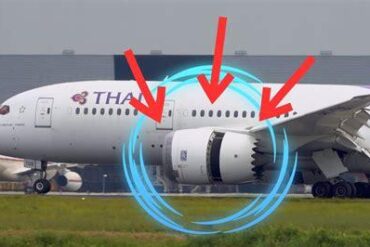
Boeing’s decision to embrace engine chevrons was never about aesthetics. The jagged, saw-tooth edges that appeared on the nacelles of modern Boeing jets represented a calculated bet: trade a small slice of aerodynamic purity for a measurable reduction in noise. In an industry ruled by fractions of a percent and razor-thin margins, that bet would eventually reveal a problem Boeing could not ignore. Chevrons worked—but not without consequences.
At the turn of the century, aircraft noise had become more than a nuisance. Communities surrounding major airports were pushing back, regulators were tightening standards, and manufacturers were running out of room to hide behind older certification rules. Boeing’s answer was bold, experimental, and deeply collaborative, drawing on NASA research and cutting-edge aeroacoustic theory. What emerged reshaped the look of several Boeing aircraft—and quietly reshaped the performance math behind them.
The story of engine chevrons is not about a failed idea. It is about a successful technology that imposed costs serious enough to change Boeing’s long-term design philosophy. Understanding that tension explains why chevrons spread across the 787, 747-8, and 737 MAX—and why they vanished from the 777X before it ever entered service.
The Regulatory Pressure That Made Silence Mandatory
By the early 2000s, aircraft noise regulation had entered a new era. The FAA Stage 4 noise standards, which came into force in 2006, significantly tightened allowable noise levels during takeoff, sideline, and approach phases. These were not cosmetic changes. Stage 4 effectively forced manufacturers to rethink how engines interacted with the surrounding air, especially at high thrust settings.
For airlines, compliance was existential. Aircraft that failed to meet noise standards faced restricted airport access, higher landing fees, or outright bans at noise-sensitive hubs. Boeing, keenly aware that its next-generation widebody would define its competitive position for decades, could not afford to launch the 787 Dreamliner with a noise profile that risked future obsolescence.
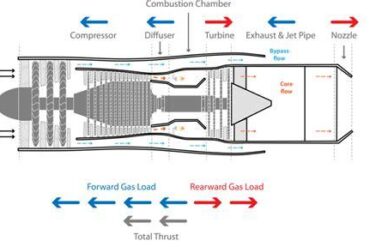
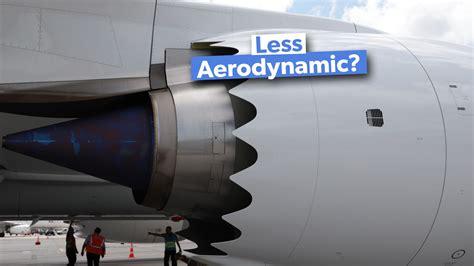
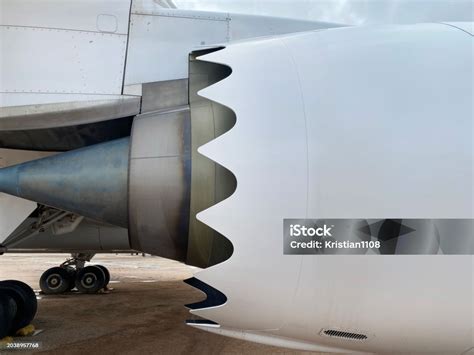
Chevrons emerged as an elegant solution on paper. By reshaping the trailing edge of the engine nacelle into a serrated pattern, engineers could encourage smoother mixing between the hot exhaust stream and the cooler bypass air. Smoother mixing meant less turbulence. Less turbulence meant less noise. The physics was sound. The execution, however, proved far more complicated.
NASA, Boeing, and the Search for a Quiet Edge
The chevron concept did not originate on Boeing’s drawing boards. NASA had been studying serrated exhaust geometries for years, identifying the V-shaped pattern as especially promising for suppressing jet noise. Boeing partnered with NASA to translate theory into hardware, a process that exposed just how sensitive aeroacoustic systems can be.
Early testing revealed an uncomfortable truth: some design tweaks intended to reduce noise actually made it worse. The instrumentation available at the time struggled to explain why. NASA researcher James Bridges later acknowledged that the team lacked the diagnostic resolution to fully understand how subtle geometric changes altered airflow behavior.
This uncertainty slowed progress and forced repeated redesigns. Noise reduction is not linear. A millimeter-scale change in edge shape can alter vortex formation, shift frequency spectra, and amplify sound in unexpected directions. The chevrons that eventually flew on the 787 were the result of years of trial, error, and recalibration.
When Durability Became a Design Crisis
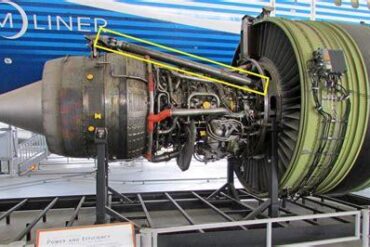
Noise was only part of the problem. Chevrons sit at the trailing edge of the nacelle, directly exposed to extreme heat, pressure fluctuations, and continuous vibration. Early prototypes suffered from cracking and fatigue, raising serious concerns about long-term durability and maintenance costs.
These were not academic issues. A cracked nacelle component is a grounding event, and grounding events are poison to airline economics. Boeing brought engine manufacturers into the effort, most notably Rolls-Royce, which collaborated on the Quiet Technology Demonstrator program. Using a Boeing 777-300ER as a flying laboratory, engineers mounted more than 100 microphones on the aircraft and another 200 on the ground.
The data confirmed that chevrons could deliver meaningful noise reductions, but only if structural integrity could be guaranteed over tens of thousands of flight cycles. Materials were refined, attachment methods strengthened, and inspection protocols developed. By the time chevrons entered service, they were robust—but the effort required to make them so hinted at deeper compromises ahead.
The Thrust Penalty Boeing Could Not Ignore
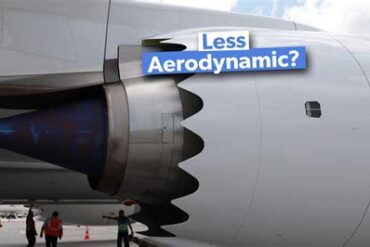
The most serious problem with engine chevrons was also the simplest to state: they reduced thrust. By intentionally disrupting the exhaust flow to reduce noise, chevrons created small vortices that increased drag. The result was a measurable loss in aerodynamic efficiency.
Independent analysis and industry commentary, including from experienced pilots and engineers, converged on a figure of roughly 0.5% thrust loss. On paper, half a percent sounds trivial. In practice, it is enormous. Aircraft performance is optimized to the decimal. Fuel burn, climb gradients, payload limits, and range calculations all assume minimal losses.
For long-haul aircraft like the 787, the penalty was tolerable. The Dreamliner’s composite structure and advanced systems delivered efficiency gains large enough to absorb the hit. For short-haul workhorses like the 737 MAX, the impact was more acute. These aircraft perform multiple takeoffs and climbs per day—the very phases where chevrons impose the greatest efficiency cost.
Over thousands of cycles, that lost thrust translates into higher fuel burn and lower margins. Airlines noticed. Boeing noticed more.
Why Boeing Accepted the Trade-Off Anyway
Despite the drawbacks, Boeing moved forward. The reason was strategic. Noise compliance is not optional, and chevrons offered a certifiable, predictable path to meeting regulations without redesigning entire engines. They also delivered an unexpected secondary benefit: weight reduction.
By reducing external noise at the source, chevrons allowed engineers to remove heavy acoustic insulation from inside the fuselage. On the 787, this translated into a weight saving of approximately 600 pounds (272 kg). Weight savings cascade through aircraft design, improving fuel efficiency, range, and payload capability.
For Boeing, the calculation made sense. Accept a small thrust penalty in exchange for regulatory certainty, lower cabin noise, and a lighter airframe. For a time, chevrons represented the best available compromise.
The Boeing Aircraft That Carried Chevrons
Chevrons ultimately appeared on three Boeing families: the 787 Dreamliner, 747-8, and 737 MAX. Their implementation varied by aircraft and engine type.
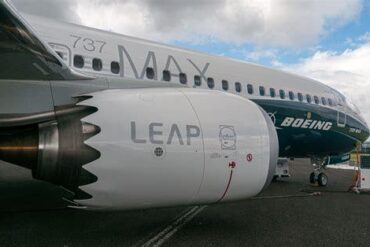
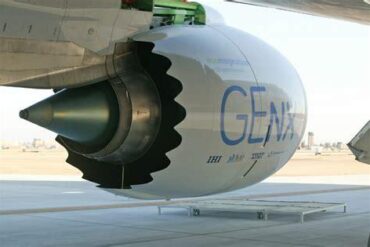
The 787 featured chevrons on all variants, regardless of whether the aircraft was powered by the GEnx-1B or Rolls-Royce Trent 1000. The 747-8 went further, incorporating chevrons on both the nacelle and the exhaust nozzle of its GEnx-2B67 engines. The 737 MAX adopted nacelle chevrons as part of its broader effort to meet modern noise and emissions standards.
Visually, chevrons became a signature. The jagged trailing edge distinguished these aircraft instantly from older designs with smooth, circular nacelles. Today, more than 3,000 Boeing aircraft in active service feature chevrons, a testament to how widely the technology was adopted.
Why the 777X Broke With the Chevron Tradition
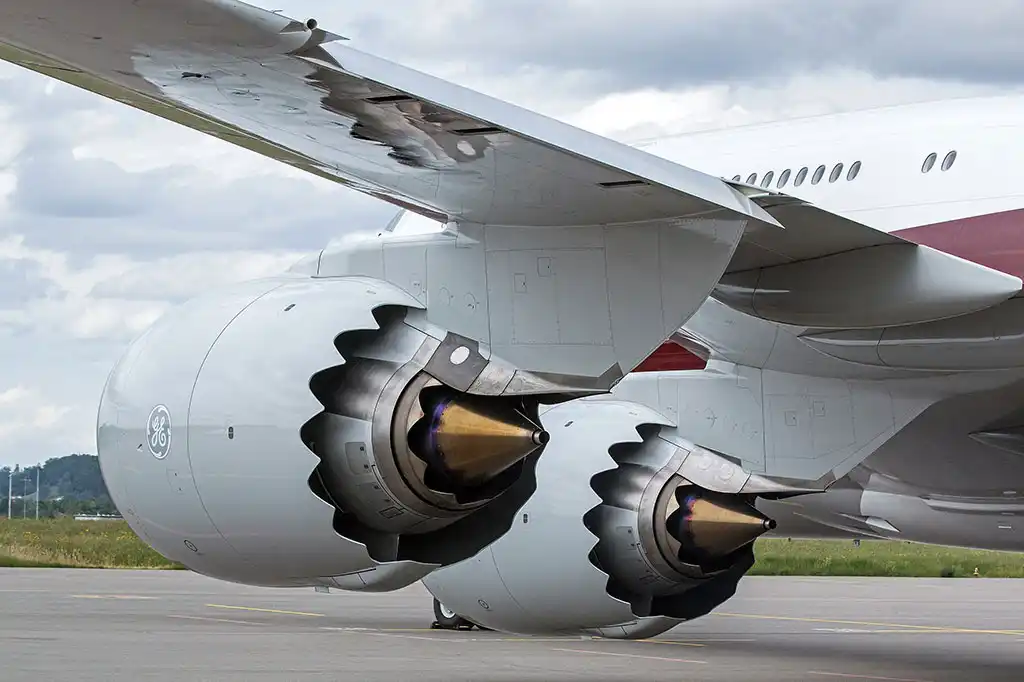
The turning point came with the Boeing 777X. By the time its design was finalized, Boeing and its engine partner GE Aerospace had better tools, better materials, and a clearer understanding of aeroacoustic trade-offs. The conclusion was blunt: chevrons were no longer the optimal solution.
Instead, the GE9X engine adopted an advanced low-drag nozzle design that delivered comparable noise reduction without the thrust penalty. The nozzle was also around 20% lighter, further improving efficiency. According to program leadership, the new design achieved equivalent community and cabin noise levels while reducing drag—a direct answer to the chevron problem.
The GE9X would go on to claim the title of the quietest jet engine ever built per pound of thrust, even as it set world records for raw power during testing. Chevrons, once cutting-edge, had been outpaced by better aerodynamics.
Are Chevrons Obsolete or Just Specialized?
Chevrons are not a dead technology. They remain effective, proven, and reliable. What changed is the availability of alternatives. High bypass ratio engines, advanced acoustic linings, and optimized nozzle geometries now offer designers more flexibility. Noise reduction no longer has to come at the cost of thrust.
NASA’s early simulations correctly identified serrated edges as powerful noise suppressors. What those models could not fully capture was the long-term economic impact of even tiny efficiency losses. Boeing learned that lesson in service, not in theory.
The Meaning Behind the Name
The word chevron comes from French, originally meaning “rafter” or “roof beam,” a reference to the V-shape formed by two beams meeting at an angle. The term later migrated into military insignia, where it still denotes rank. Its adoption in aviation fits a long tradition of French-derived terminology, from nacelle to fuselage.
In that sense, chevrons are linguistically appropriate. They are structural, directional, and quietly symbolic of engineering compromise.
A Quiet Lesson in Aerospace Trade-Offs
The problem Boeing ran into after designing engine chevrons was not a failure of innovation. It was a reminder that aerospace engineering is an ecosystem of trade-offs. Reducing noise reshapes airflow. Reshaping airflow affects thrust. Affecting thrust alters economics.
Chevrons solved a pressing regulatory problem and helped usher in a new generation of quieter aircraft. They also exposed the hidden costs of aerodynamic disruption. Boeing adapted, learned, and moved on—without erasing chevrons from the sky.
Their legacy is visible on runways worldwide, etched into the trailing edges of engines that whisper more than they roar. In aviation, even silence has a price.