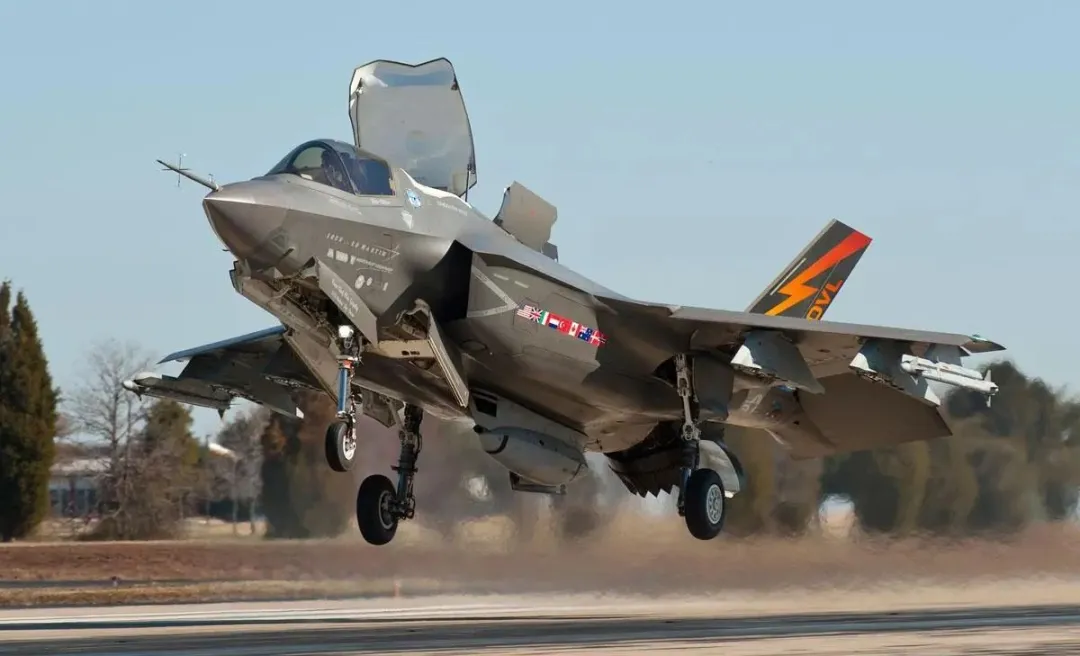
The F-35 Lightning II, a hallmark of American aerospace dominance, owes its combat superiority and multirole flexibility to one defining feature — the Pratt & Whitney F135 engine. This turbofan marvel powers all three variants of the F-35: the F-35A (Conventional Takeoff and Landing), F-35B (Short Takeoff and Vertical Landing), and F-35C (Carrier-based operations). Central to the jet’s battlefield capabilities is its thrust performance, which directly affects range, maneuverability, payload, and survivability.
At the heart of this propulsion system is raw, refined power, delivering afterburner thrust levels of up to 43,000 pounds-force (lbf). The F135 not only matches but surpasses most modern fighter engines in output and reliability, making it a defining force multiplier for NATO and allied nations.
Core Thrust Capabilities of the F-135 Engine
Standard Maximum Thrust Across Variants
The baseline F135 engine provides the F-35A and F-35C with an impressive 43,000 lbf of maximum thrust when in afterburner mode, equivalent to approximately 19.5 metric tons. The F-35B, due to the integration of its unique lift-fan system for STOVL operations, operates at a slightly reduced afterburning thrust of 41,000 lbf (18.6 metric tons). These distinctions, though subtle, are rooted in variant-specific structural modifications designed to optimize for mission type and launch environment.
Military Thrust Without Afterburner
Even without afterburner engagement — in what’s termed military thrust — the F135 delivers ~125 to 130 kilonewtons (kN), translating to roughly 12.7 to 13.3 metric tons. This non-afterburning output is crucial for fuel economy, low observability, and reduced infrared signature during cruise operations.
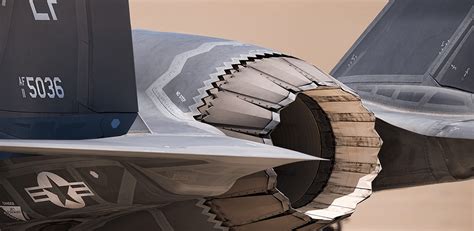
Engineering Excellence: Growth Options and Future Expansion
F135 “Growth Option 2”
The Growth Option 2 initiative represents a mid-life upgrade under testing, intended to push the engine’s capabilities to 47,000 to 48,500 lbf (21.3–22 metric tons). This is accomplished through:
- Advanced turbine materials that tolerate higher thermal loads
- Redesigned compressor stages to optimize pressure ratios
- Improved combustion efficiency, supporting greater sustained thrust
This iteration also focuses on addressing logistical demands, improving fuel efficiency, and extending the mean time between overhauls (MTBO) — crucial factors in global deployment scenarios.
F135 “Growth Option 3” and the Adaptive Engine Transition Program (AETP)
Set for introduction around 2030, the Growth Option 3 will transition to an adaptive three-stream engine architecture, building on Pratt & Whitney’s research under the AETP. Expected to generate up to 66,000 lbf (≈30 metric tons) of thrust, this revolutionary leap will allow:
- Adaptive bypass airflow, balancing thrust vs. efficiency in real time
- Thermal management for high-performance onboard systems
- True supercruise potential for sustained supersonic speeds without afterburner
This technological edge positions the F-35 to maintain air dominance well into the mid-21st century.
Technical Deep Dive: Variants and Metrics
Engine Variants Explained
- F135-PW-100: Powers the F-35A, optimized for conventional takeoff and landings, primarily in U.S. Air Force deployments.
- F135-PW-400: Reinforced for the F-35C, enabling carrier deck operations with increased saltwater corrosion resistance.
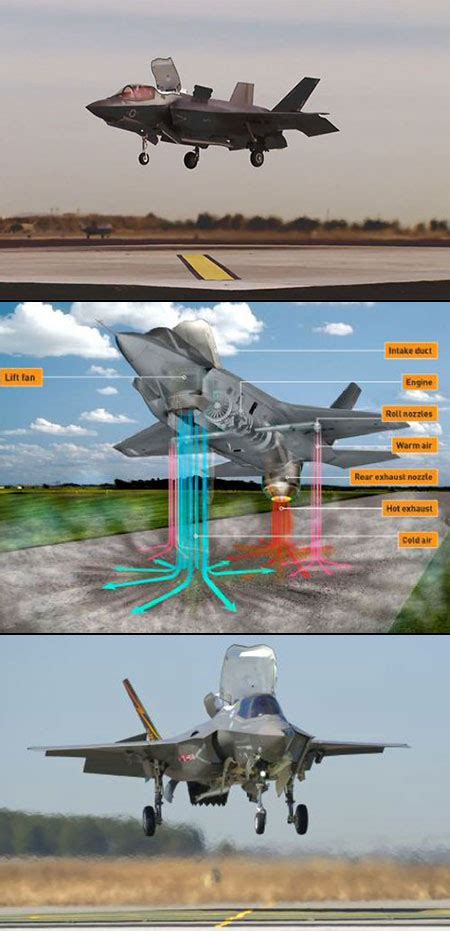
- F135-PW-600: Integrates a vertically-mounted lift fan, unique to the F-35B, enabling short takeoff and vertical landing, especially critical for Marine Corps forward-deployment strategies.
Performance Highlights
- Thrust-to-Weight Ratio: ~7.47:1 dry and ~11.47:1 with afterburner
- Maximum Speed: Up to Mach 1.6, depending on variant and loadout
- Fuel Efficiency: Enhanced in upgraded versions, addressing early concerns about the F-35’s combat radius and loiter time
Digital Engine Control
The Full Authority Digital Engine Control (FADEC) system ensures continuous optimization of engine parameters under dynamic flight conditions. By reducing pilot workload and automating critical adjustments, FADEC enhances mission reliability and allows for diagnostic feedback, which is pivotal for predictive maintenance.
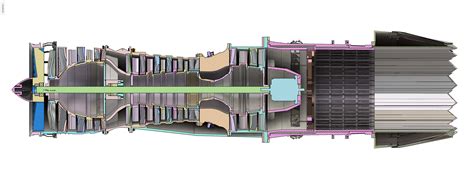
Innovations in Maneuverability and Vectoring
One of the F135’s most significant features is its thrust vectoring system, especially prominent in the F-35B’s vertical lift configuration. Through a 360-degree rotating nozzle and shaft-driven Rolls-Royce LiftFan, the F-35B can perform vertical landings, hover, and short takeoffs from amphibious assault ships and unprepared runways.
This system significantly enhances the aircraft’s tactical flexibility, enabling deployment in austere environments where traditional airstrips are unavailable.
How the F135 Stacks Against Global Rivals
Versus the F-22’s F119 Engine
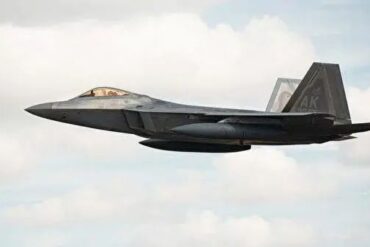
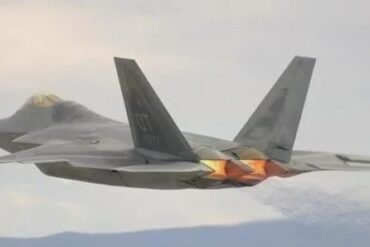
The F119 engine in the F-22 Raptor, while capable of 35,000 lbf, was optimized for supercruise rather than raw thrust. The F135, derived from the F119 lineage, exceeds it in sheer output — achieving 43,000 lbf in standard configurations — though at the cost of slightly higher infrared signature and fuel burn when using afterburners.
Versus China’s WS-15 Engine
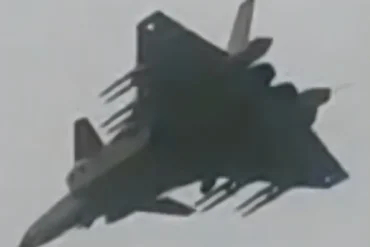
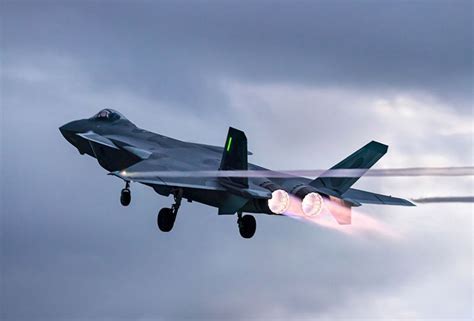
China’s fifth-generation ambitions are embodied in the WS-15 engine, intended for the J-20 Mighty Dragon. Reports suggest it delivers up to 18 metric tons of thrust — falling short of the F135 Growth Option 2’s 22 metric tons. Moreover, the WS-15 reportedly struggles with overheating and material durability, placing it a technological generation behind the F135’s matured performance metrics.
Operational Influence on Combat Effectiveness
Despite its heavy internal loadout capacity — up to 8,160 kg — the F-35 maintains respectable combat agility. However, its wing loading is relatively high: about 526 kg/m² for the F-35A. This results in less nimble turns than lighter fourth-gen fighters like the F-16, which benefits from lower loading and higher thrust-to-weight ratios when clean.
That said, the F-35’s integrated sensor fusion, radar stealth, and vertical launch capability (in the F-35B) offer strategic offsets to raw dogfighting agility. The F135’s power ensures that even with high drag and full internal payload, the F-35 retains superior mission survivability and first-look, first-kill capability.
Looking Ahead: Sustaining Dominance with Propulsion Innovation
The F135 engine stands not merely as a mechanical core, but as the enabling system behind the F-35’s multirole designation. With current output reaching 43,000 lbf, and upgrades pointing toward 66,000 lbf by 2030, the engine’s evolution reflects an ongoing strategic propulsion arms race. Countries investing in fifth and sixth-generation air power increasingly understand that engine thrust capacity and adaptability define future dominance more than radar or avionics alone.
As we approach an era of manned-unmanned teaming, AI-integrated controls, and hypersonic platforms, engines like the F135 — with adaptive architecture and digital control — are poised to serve as cornerstones of aerial combat capability for decades to come.
Frequently Asked Questions
How much thrust does the F-35 engine produce at full power?
At maximum afterburner, the F135 engine produces 43,000 lbf (approximately 19.5 metric tons) for the F-35A and F-35C, and 41,000 lbf (18.6 metric tons) for the F-35B. Upgraded versions are being tested to reach up to 48,500 lbf.
What makes the F135 engine different from the F-22’s F119 engine?
While both engines share a common design heritage, the F135 is optimized for thrust and stealth integration, offering higher output (43,000 lbf) compared to the F119’s 35,000 lbf, and includes variant-specific designs for carrier and STOVL operations.
Is the F135 the most powerful fighter engine in the world?
Currently, the F135 is among the most powerful operational fighter jet engines, especially when considering the upcoming adaptive three-stream upgrades which may push its performance beyond 66,000 lbf, eclipsing all rivals in the fifth-generation category.