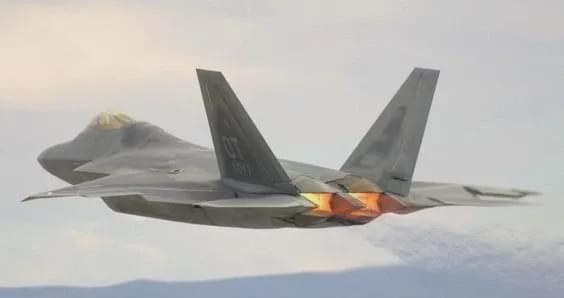
The Lockheed Martin F-22 Raptor is one of the most advanced fifth-generation fighter jets, known for its stealth, supercruise, advanced avionics, and extreme maneuverability. A critical component of its unmatched air dominance is its thrust vectoring technology, which provides exceptional aerodynamic control and allows for extreme post-stall maneuvers. This article delves into the mechanics, advantages, and tactical significance of thrust vectoring in the F-22.
Thrust Vectoring: Core Principles and Nozzle Design
Two-Dimensional Thrust Vector Control (2D TVC)
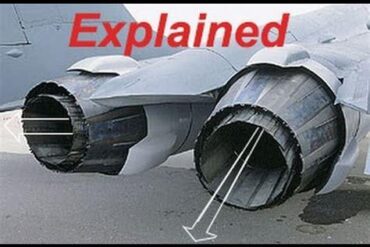
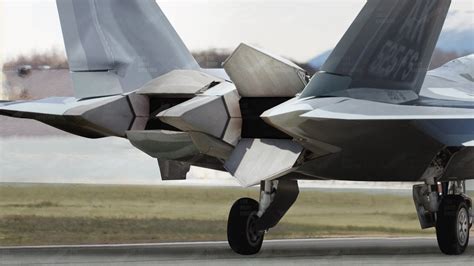
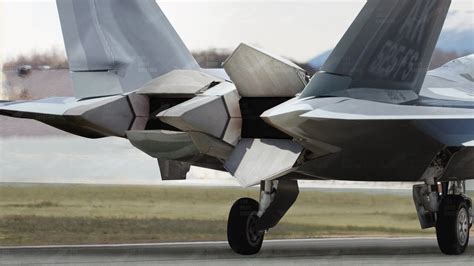
Unlike conventional jet engines that rely solely on aerodynamic surfaces for control, the F-22 incorporates a unique two-dimensional (2D) thrust vectoring system. Its rectangular nozzles can deflect up and down by ±20 degrees, allowing for precise control over the aircraft’s pitch without relying entirely on aerodynamic control surfaces.
This rectangular nozzle design has several key advantages:
- Stealth Enhancement: Unlike traditional circular nozzles, rectangular nozzles reduce the aircraft’s radar cross-section (RCS), making it harder for enemy radar to detect.
- Improved Aerodynamic Efficiency: The design integrates smoothly with the F-22’s airframe, reducing drag and improving its ability to maintain supersonic speeds.
- Reduced Infrared Signature: The shape helps manage the heat signature, making it more difficult for infrared-guided missiles to track the aircraft.
Fly-By-Wire Integration
The F-22’s flight control system (FLCS) fully integrates thrust vectoring, meaning that nozzle deflections are automatically controlled by the aircraft’s onboard flight computers. Pilots do not need to manually adjust nozzle positions—the system dynamically coordinates the thrust vectoring with the aircraft’s aerodynamic control surfaces.
When performing high-angle-of-attack maneuvers, the FLCS adjusts the engine thrust to maintain aircraft stability and prevent stalls. This is particularly useful when engaging in close-range dogfights, where agility is key.
Performance Advantages and Tactical Edge
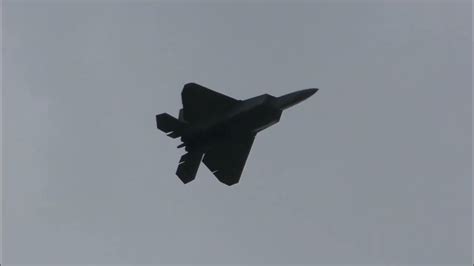
Post-Stall Maneuverability
Thrust vectoring enables the F-22 to maintain control beyond traditional stall limits, allowing it to execute post-stall maneuvers that would be impossible for non-vectoring aircraft. Examples of these maneuvers include:
- Pugachev’s Cobra: The aircraft pitches up to a near-vertical attitude before smoothly recovering.
- Herbst Maneuver (J-Turn): A quick reversal that allows for fast repositioning against an enemy aircraft.
- Kulbit Maneuver: A full backflip in midair, which is useful for extreme dogfighting scenarios.
These maneuvers allow the F-22 to quickly change direction and get behind an opponent, increasing its kill probability in dogfights.
Short Takeoff and Landing (STOL) Capabilities
By deflecting the nozzles downward during takeoff, the F-22 can generate additional vertical thrust components, reducing the distance needed for takeoff and landing. This capability enhances its operational flexibility, especially when operating from shorter runways or makeshift airstrips.
Additionally, during landing, thrust vectoring can be used to reduce landing speeds, decreasing the reliance on aerodynamic braking and extending the lifespan of the aircraft’s brake system.
Sustained Supersonic Cruise
Unlike conventional fighters that rely on afterburners for supersonic speeds, the F-22’s thrust vectoring system enhances its supercruise capability, allowing it to maintain speeds of Mach 1.5+ without afterburners. This increases fuel efficiency, extends combat range, and enables the aircraft to engage or disengage at will.
Comparison to Russian Thrust Vectoring Systems
F-22 vs. Su-35 and Su-57
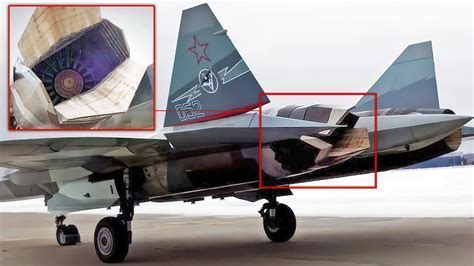
Russia’s Su-35 and Su-57 fighters also employ thrust vectoring technology, but with significant differences:
| Feature | F-22 | Su-35/Su-57 |
|---|---|---|
| Nozzle Type | Rectangular (2D) | Circular (3D) |
| Vectoring Range | ±20° (Pitch Only) | ±15° (Pitch & Yaw) |
| Stealth Optimization | Yes | Limited |
| Control Mechanism | Fully Integrated with FLCS | Pilot-Assisted |
| Thrust Efficiency Loss | ~2% | Higher due to complex mechanics |
While the Su-35 and Su-57’s 3D thrust vectoring allows for some degree of yaw control, it comes at the cost of reduced stealth, increased weight, and higher mechanical complexity. The F-22’s 2D system is optimized for stealth and efficiency, maintaining the aircraft’s ability to dominate aerial combat.
Challenges and Future Development
Engineering Constraints
Developing thrust vectoring nozzles involves several engineering challenges, such as:
- High Thermal Stress: The F-22’s nozzles endure temperatures exceeding 1,500°C, requiring advanced heat-resistant materials.
- Structural Reinforcement: The added complexity increases weight (~130-150 kg per engine) and requires additional mechanical reliability measures.
- Software Coordination: The flight control software must seamlessly integrate thrust vectoring inputs to avoid destabilizing the aircraft during high-G maneuvers.
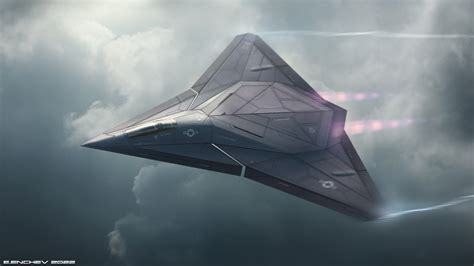
Future Applications in Sixth-Generation Fighters
Thrust vectoring is expected to evolve in next-generation fighters, integrating with:
- Artificial Intelligence (AI) for predictive maneuvering
- Adaptive nozzle designs for even greater efficiency
- Unmanned Combat Aerial Vehicles (UCAVs) for extreme agility
Frequently Asked Questions (FAQ)
1. How does thrust vectoring improve dogfighting capabilities?
Thrust vectoring allows the F-22 to execute maneuvers beyond aerodynamic limits, making it significantly more agile in close-range air combat. It enables rapid changes in direction and quick target acquisition, increasing its kill probability.
2. Does thrust vectoring impact the F-22’s stealth characteristics?
Unlike 3D circular nozzles, the F-22’s rectangular 2D nozzles are designed to minimize radar reflection and infrared emissions, ensuring the aircraft maintains its low observability.
3. Why don’t all fighter jets have thrust vectoring?
Thrust vectoring requires complex mechanical and electronic integration, increasing weight and cost. While it significantly improves maneuverability, not all aircraft require it—modern missiles and sensors often reduce the need for extreme agility in some platforms.
The F-22’s thrust vectoring technology is a game-changer, reinforcing its status as the most advanced air superiority fighter of its generation. By seamlessly integrating power, stealth, and agility, it continues to set the benchmark for future fighter aircraft development.