The F-35 Lightning II, a fifth-generation multirole stealth fighter, stands at the pinnacle of aerospace innovation. Central to its unmatched capabilities is its exhaust system, a complex and refined assembly that goes far beyond simply expelling combustion gases. The exhaust mechanism of the F-35 plays a defining role in ensuring stealth, maneuverability, and operational versatility, particularly in its Short Takeoff/Vertical Landing (STOVL) configuration. Across its three variants—F-35A, F-35B, and F-35C—the exhaust architecture reflects an intricate dance between engineering excellence and combat survivability.
The Three-Bearing Swivel Duct (3BSD): Redefining STOVL Flight
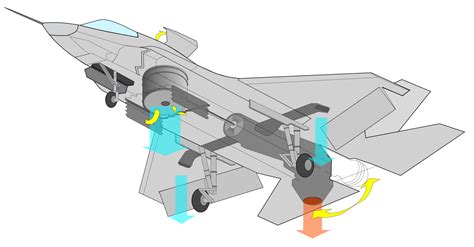
In the F-35B, the Three-Bearing Swivel Duct (3BSD) is a revolutionary component enabling Short Takeoff and Vertical Landing. It allows the rear exhaust nozzle to rotate downward by up to 95 degrees, diverting thrust to support vertical lift.
Unlike rudimentary vectored thrust designs, the 3BSD features a multi-axis rotation mechanism that maintains exhaust stability while rotating, crucial for keeping the aircraft aerodynamically balanced during hover and transition. Paired with the lift fan, located forward of the main engine and driven by a shaft connected to the low-pressure turbine, this system generates a combined vertical thrust of approximately 161.1 kN—71.1 kN from the exhaust and 90 kN from the lift fan.
The roll-control nozzles, located near the wingtips, distribute cold air laterally to maintain roll authority. Together, these elements deliver a stable, vectored-thrust platform unmatched in Western aviation.
Infrared Signature Suppression: Engineered Invisibility
In modern aerial warfare, infrared (IR) visibility is a deadly vulnerability. Heat-seeking missiles often target the 3–5 μm wavelength range, where hot jet exhaust is most visible. The F-35’s exhaust system integrates a layered defense against IR detection, utilizing:
Cooled Exhaust Structures
Turbine blades, nozzle flaps, and internal linings of the exhaust are actively cooled using bleed air from the engine’s compressor stage. This reduces surface temperatures enough to significantly suppress thermal radiation.
S-Shaped Ducting
The exhaust flow path is cleverly designed using serpentine ducts, ensuring that no direct line of sight exists between the turbine face and external observers. This technique not only limits IR emissions but also reduces the radar cross-section (RCS) by hiding reflective engine parts.
Low-Emissivity Coatings and RAM
Advanced radar-absorbent materials (RAM) and low-emissivity metallic coatings on nozzle surfaces scatter and absorb both radar waves and IR radiation. These materials maintain performance under extreme thermal loads, ensuring stealth isn’t compromised even during afterburner use.
Low-Observable Axisymmetric Nozzle (LOAN): Precision Meets Stealth
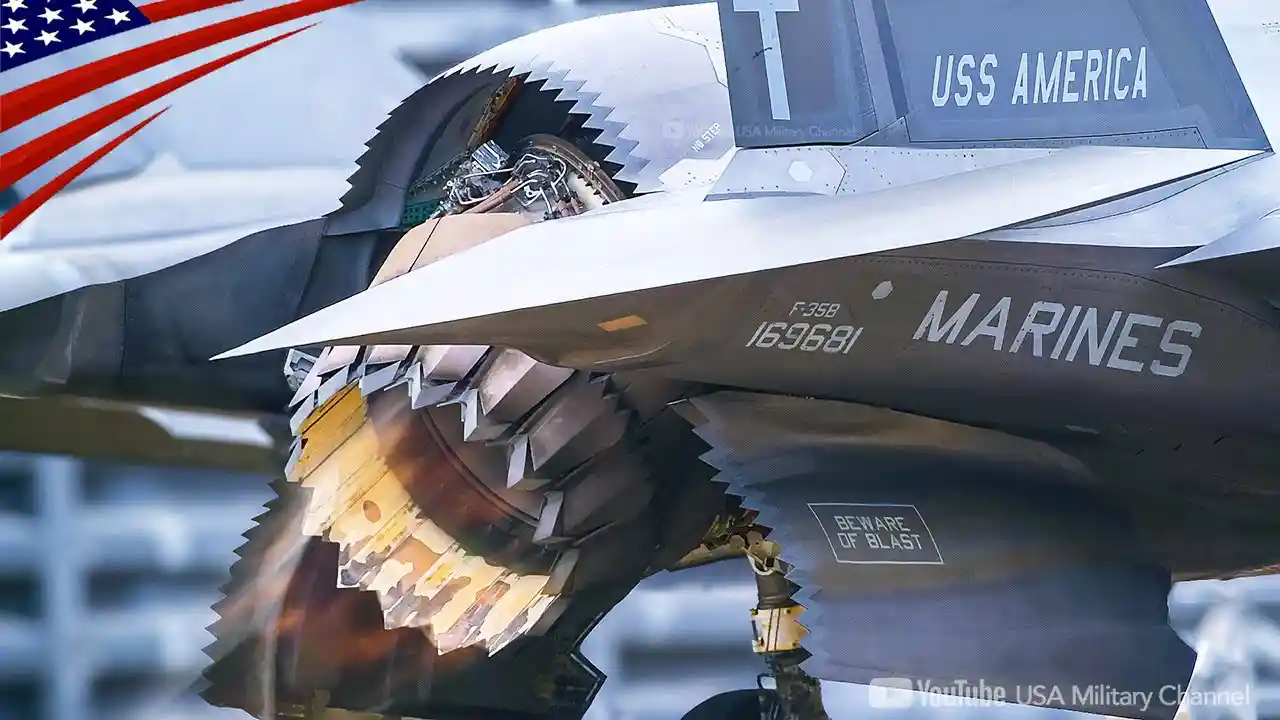
The F-35A and F-35C do not incorporate STOVL features, but they do boast the Low-Observable Axisymmetric Nozzle (LOAN)—a hallmark of fifth-generation stealth design. Its circular geometry, as opposed to traditional flat nozzles, contributes to better aerodynamics and reduced drag during supersonic flight.
What truly defines LOAN is:
- Serrated nozzle edges (also known as chevrons), which disperse heat plumes into multiple directions to minimize IR detectability.
- Tight tolerances and gap control, ensuring radar waves do not reflect between nozzle components.
- High-temperature alloys and composite linings, capable of withstanding exhaust temperatures exceeding 1,000°C without warping or compromising stealth.
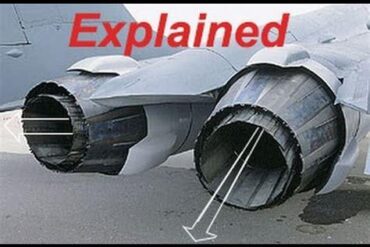
Unlike legacy platforms like the F-15 or Su-27, the F-35’s nozzle does not rely on brute force. Instead, it uses engineered shape and surface science to evade detection.
Exhaust System Integration in the F-35B: Harmonizing Lift Fan and Nozzle Dynamics
In the STOVL-configured F-35B, the integration between the lift fan, 3BSD, and roll-post nozzles forms a coordinated vertical lift system with unparalleled precision. During vertical flight, the shaft-driven lift fan mounted vertically in the forward fuselage delivers cool air thrust, balancing the hot rear exhaust flow from the 3BSD.
This system eliminates the need for complex engine articulation used in older aircraft such as the Harrier AV-8B, simplifying maintenance and increasing reliability. When transitioning to level flight, the 3BSD gradually reorients rearward while the roll posts close, handing full thrust control back to the engine.
Performance Trade-Offs: Balancing Stealth and Thrust
Despite its innovations, the F-35 exhaust system embodies a set of performance compromises, carefully weighed against mission demands:
- Thrust Efficiency: The inclusion of serpentine ducts and active cooling systems leads to a 2–3% loss in net thrust, compared to conventional exhaust systems without stealth constraints.
- Weight Penalties: The lift fan gearbox alone adds over 180 kg, not including ducting and vectoring control systems. This results in reduced internal fuel capacity in the F-35B compared to its A and C variants.
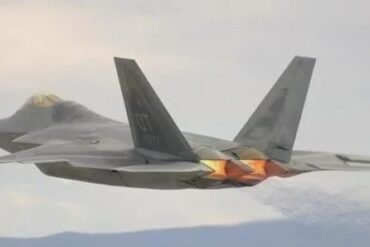
- Supersonic Speed Limitations: The aircraft is limited to Mach 1.6, slower than the F-22 Raptor’s Mach 2.25, due in part to the axisymmetric nozzle’s optimized design for stealth rather than maximum acceleration.
Yet, these compromises are justified by the F-35’s operational philosophy: first-look, first-shot, first-kill. Stealth and survivability outweigh marginal performance differences in a beyond-visual-range (BVR) combat paradigm.
Global Comparison: F-35 vs Su-57 and J-35A
Against foreign peers, the F-35’s exhaust system holds decisive advantages in IR suppression and integrated lift control.
- China’s J-35A, a naval stealth aircraft, features a more enclosed rear fuselage with fewer exposed components. While this reduces radar reflectivity, the lack of thrust vectoring and absence of a vertical lift system limits its versatility in carrier operations.
- Russia’s Su-57 Felon, although boasting supermaneuverability through 3D thrust vectoring, employs conventional axisymmetric nozzles with minimal IR shielding. The resulting thermal trail makes it susceptible to IR-guided weapons, especially at low altitudes.
The F-35B remains the only fifth-generation STOVL aircraft in operational service, underlining the sophistication of its exhaust and propulsion integration.
Future Pathways: Adaptive Nozzles and Smart Cooling
Looking ahead, future upgrades to the F135 engine powering the F-35 may include adaptive cycle technologies, already under development for the Next Generation Air Dominance (NGAD) program. These systems could dynamically switch between high-thrust and fuel-efficient modes, reducing heat signatures without compromising speed.
Likewise, hybrid thermal management systems using phase-changing materials or embedded heat exchangers may reduce reliance on bleed air cooling, thereby improving thrust-to-weight ratios. Variable geometry nozzles, capable of re-shaping exhaust flow based on mission profile, represent another potential leap in exhaust design.
These innovations would not only enhance survivability in contested airspaces but also expand the aircraft’s mission envelope in high-temperature, high-altitude environments.
Conclusion
The F-35’s exhaust system is a technological landmark in military aviation, harmonizing stealth, vertical lift, and supersonic capability into a cohesive design. From the 3BSD swivel duct to the LOAN architecture, each component is shaped by a singular goal: maintaining dominance in contested environments.
While certain performance sacrifices exist in terms of weight and thrust, the trade-offs are precisely engineered to favor operational survivability and mission effectiveness. As aerial threats evolve, the F-35’s exhaust architecture offers a glimpse into the future of multidomain air power, where infrared suppression and propulsion control define the next battlespace.
FAQ
What is the main function of the F-35’s Three-Bearing Swivel Duct (3BSD)?
The 3BSD enables the F-35B to perform short takeoffs and vertical landings by rotating the rear exhaust nozzle up to 95 degrees downward. It works in concert with the lift fan and roll-control nozzles to maintain aircraft balance during hover and transition phases.
How does the F-35 reduce its infrared signature?
The F-35 uses a combination of active cooling, serpentine ducting, and specialized coatings to lower infrared emissions. These features obscure heat sources and minimize the aircraft’s vulnerability to IR-guided missiles.
Why does the F-35 exhaust system limit its top speed?
The stealth-optimized design of the exhaust system, including the LOAN nozzle and internal ducting, introduces aerodynamic drag and thrust losses, capping the F-35’s speed at Mach 1.6. This limitation is accepted in favor of enhanced stealth and survivability.