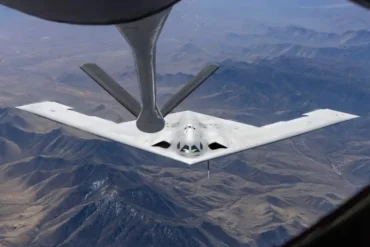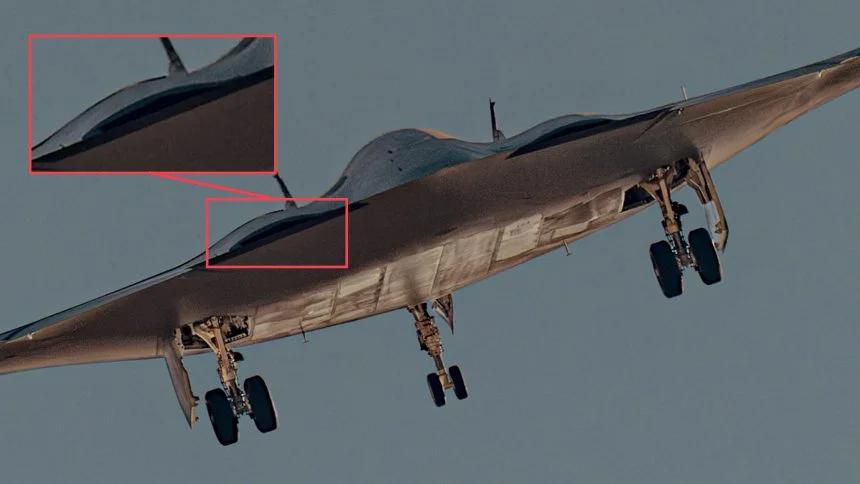
The Northrop Grumman B-21 Raider is often described as the successor to the legendary B-2 Spirit, but recent imagery and technical analysis suggest it is far more than a simple evolution. Among the most intriguing differences between the two stealth bombers is a seemingly subtle feature that has generated enormous attention among military analysts: the shape and placement of the B-21’s engine exhaust system.
To casual observers, the exhaust outlets may appear to be a minor design alteration. In reality, they may represent one of the most significant advances in stealth technology developed in decades. Modern air warfare has changed dramatically since the B-2 first entered service in the 1990s. While radar avoidance remains critical, the growing sophistication of infrared search-and-track (IRST) systems means aircraft must now hide not only from radio waves but also from heat-detecting sensors.
The B-21’s redesigned aft section suggests that Northrop Grumman has fundamentally rethought how a stealth bomber survives in a world where thermal detection has become just as dangerous as radar tracking. The visible changes may be only the tip of a much deeper classified effort to reduce the aircraft’s infrared signature and maintain its ability to penetrate heavily defended airspace for decades to come.
Why Engine Exhaust Is the Greatest Weakness of Any Stealth Aircraft
Most discussions about stealth focus on radar cross-section. Aircraft such as the F-22 Raptor, F-35 Lightning II, B-2 Spirit, and B-21 Raider are designed with carefully shaped surfaces, radar-absorbing materials, and concealed engine components that minimize radar reflections.
However, radar is only one method of detection.
Modern military powers increasingly deploy infrared search-and-track systems capable of locating aircraft by detecting heat emissions. Unlike radar, IRST systems are passive. They do not emit signals that can reveal their location. Instead, they simply observe the thermal energy produced by aircraft engines and aerodynamic heating.
This creates a major challenge for stealth bombers.
Jet engines generate extraordinary temperatures. Inside the combustion chamber, temperatures can exceed thousands of degrees Fahrenheit. Even after passing through turbines and exhaust ducts, the escaping gases remain extremely hot compared with the surrounding atmosphere.
For a bomber operating at high altitude, the contrast becomes even more pronounced. Against the cold backdrop of the upper atmosphere, a hot exhaust plume can stand out like a beacon.
The rear section of any aircraft therefore becomes a critical vulnerability. An adversary looking upward from below and behind may have a direct line of sight into the hottest parts of the propulsion system. This region contains components that are not only thermal emitters but also significant radar reflectors.
Engine fans, compressor blades, turbines, and exhaust structures all present potential detection opportunities. Reducing these signatures simultaneously is one of the most difficult engineering challenges in military aviation.
The Revolutionary Exhaust System of the B-2 Spirit
When the B-2 Spirit entered service, its exhaust design was unlike anything previously seen on an operational aircraft.
Instead of traditional circular nozzles, Northrop engineers buried the aircraft’s four General Electric F118-GE-100 engines deep within the flying-wing structure. The hot exhaust gases traveled through elongated internal pathways before exiting through broad slots positioned on the upper surface of the aircraft.
This arrangement delivered several major stealth benefits.
First, observers below the aircraft could not directly view the engine’s hottest components. The aircraft itself blocked the line of sight.
Second, the unusual exhaust geometry encouraged rapid mixing between hot exhaust gases and cooler ambient air. This process reduced thermal contrast and made infrared detection more difficult.
Third, the exhaust passed across specially engineered surfaces on the aft deck that helped dissipate heat before it could accumulate and create a strong infrared signature.
The design was a remarkable technological achievement. During the late Cold War, it enabled the B-2 to penetrate heavily defended airspace while remaining exceptionally difficult to detect.
Yet the solution carried significant costs.
The complex structures required extensive maintenance. Specialized materials experienced thermal stress after repeated flight cycles. Repairs often demanded significant labor and highly trained technicians. What worked brilliantly from a stealth perspective became expensive and time-consuming from an operational standpoint.
As the Air Force planned the next generation of stealth bombers, reducing maintenance requirements became almost as important as improving survivability.
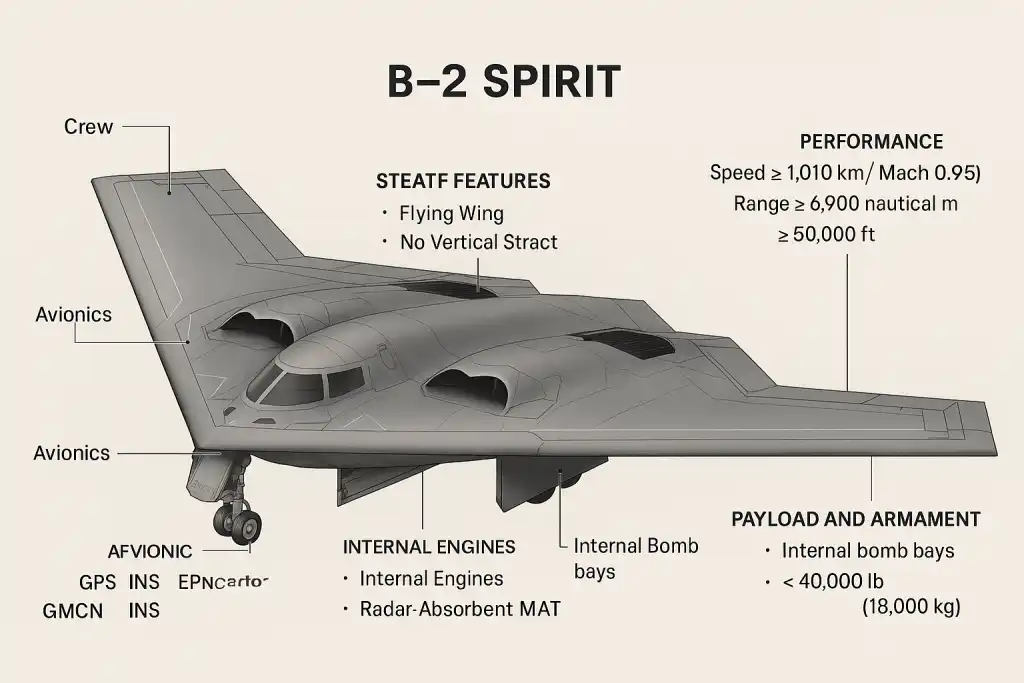
The B-21 Raider’s Unexpected Exhaust Configuration
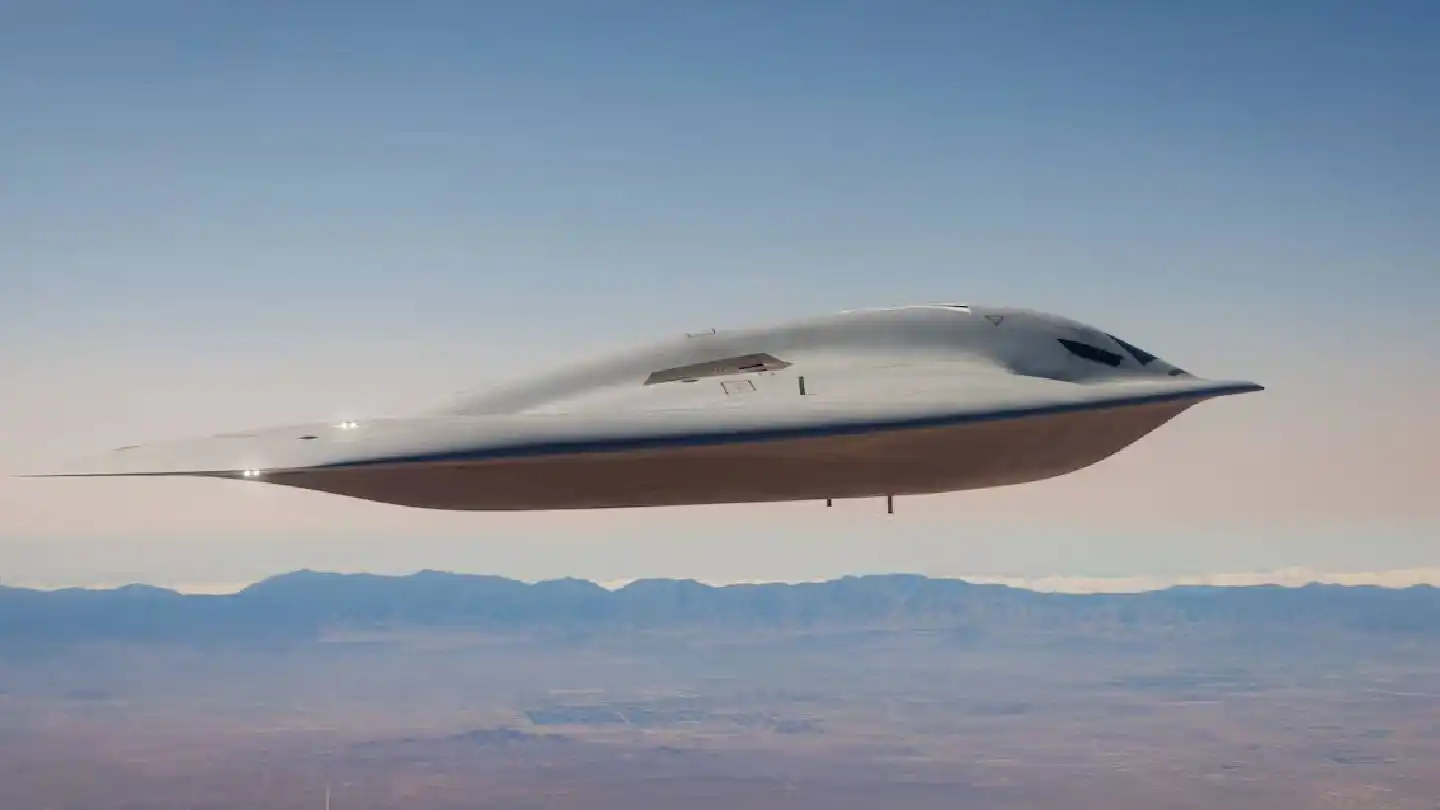
The release of new B-21 imagery in 2026 offered analysts their clearest view yet of the aircraft’s rear section.
The photographs revealed a fundamentally different exhaust arrangement compared with the B-2.
One of the most notable changes is the forward positioning of the exhaust outlets. Rather than sitting near the trailing edge as they do on the B-2, the B-21’s outlets appear significantly farther forward within the wing structure.
Although this may seem like a minor relocation, it carries substantial implications.
By increasing the distance between the exhaust plume and the rear edge of the aircraft, designers create additional opportunities for heat dissipation before thermal emissions become visible from vulnerable viewing angles.
This means infrared sensors positioned below and behind the bomber may observe a weaker thermal signature.
The new configuration also alters airflow behavior around the aircraft. Hot gases can disperse more effectively before leaving the aerodynamic shielding provided by the airframe.
Such changes indicate that infrared suppression was a primary design objective from the earliest stages of development.
Why the Exhaust Shape Matters More Than the Exhaust Itself
Many observers initially focused on the external appearance of the B-21’s exhaust outlets. However, the visible geometry likely tells only part of the story.
The shape of an exhaust opening influences several critical factors simultaneously.
- It affects how quickly hot gases mix with cooler air.
- It influences turbulence generation.
- It determines plume dispersion characteristics.
- It can also alter radar reflections from the rear hemisphere.
Military aircraft designers increasingly treat the exhaust system as an integrated stealth component rather than merely a propulsion feature.
The B-21’s modified exhaust geometry suggests Northrop engineers sought to disrupt the formation of concentrated thermal plumes. Instead of allowing heat to remain concentrated in a narrow stream, the design likely encourages rapid spreading and cooling.
The result is not necessarily the elimination of thermal emissions. Physics makes that impossible.
Instead, the objective is to reduce detectability by lowering temperature contrast and making the plume more difficult for sensors to distinguish from background conditions.
How High-Bypass Engines Could Be Transforming B-21 Stealth
One of the most fascinating aspects of the Raider program involves its propulsion system.
Although Northrop Grumman has not publicly disclosed the exact engine specifications, numerous analysts believe the aircraft utilizes a significantly more efficient propulsion architecture than the B-2.
The B-2’s F118 engines were based on fighter-derived technology and featured relatively low bypass ratios.
That approach made sense during the 1980s because stealth inlet requirements imposed severe airflow constraints.
At the time, computational modeling tools lacked the sophistication necessary to optimize highly complex airflow pathways for larger, more efficient engines.
The B-21 was developed in a completely different technological era.
Advanced computational fluid dynamics now allows engineers to model airflow with extraordinary precision. This capability may have enabled designers to integrate higher-bypass engines while maintaining stealth requirements.
Higher-bypass engines offer multiple advantages.
- They consume less fuel.
- They increase operational range.
- They improve efficiency.
Most importantly for stealth, they produce cooler exhaust streams.
A larger percentage of airflow bypasses the hot engine core, reducing average exhaust temperatures before gases even reach the nozzle.
Rather than relying exclusively on downstream cooling technologies, the B-21 may begin suppressing its infrared signature at the source.
The Simpler Trailing Edge May Actually Be More Advanced
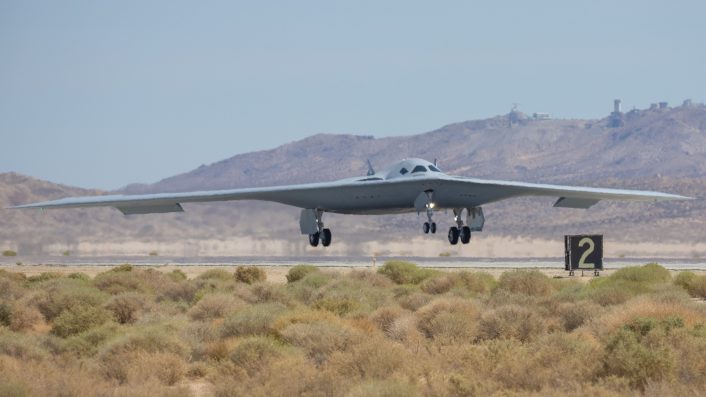
The B-2 Spirit featured a distinctive trailing edge characterized by complex sawtooth geometry.
This design helped manage radar reflections while meeting demanding aerodynamic requirements associated with low-altitude penetration missions.
The B-21 appears different.
Its trailing edge exhibits a cleaner and less complicated arrangement.
At first glance, simplification might appear to represent a compromise.
In reality, it likely reflects a more refined optimization strategy.
The Raider was designed primarily for high-altitude operations. Without the same low-level penetration requirements imposed on the B-2, engineers gained additional freedom to optimize for radar stealth, thermal suppression, manufacturability, and maintenance efficiency.
Fewer geometric complexities can reduce radar hot spots while simultaneously lowering production costs.
This aligns closely with the Air Force’s broader objective of fielding a larger bomber fleet.
Instead of producing only a few dozen aircraft, the service intends to acquire well over one hundred B-21s. Such scale requires a design that balances stealth performance with long-term affordability.
The Classified Technologies Hidden Behind the Photographs
Public photographs reveal only external features.
The truly important technologies remain hidden.
Analysts continue debating whether the visible B-21 images accurately represent the aircraft’s operational configuration. It is entirely possible that sensitive details have been altered, obscured, or removed before public release.
Military programs frequently modify photographs to protect critical capabilities.
If the most advanced thermal suppression technologies reside within internal ducts, composite structures, or proprietary materials, there would be little reason to expose them publicly.
The absence of visible cooling structures similar to those used on the B-2 has fueled significant speculation.
Several possibilities exist.
The structures may have been eliminated entirely.
They may have been replaced with more advanced solutions.
Or they may simply be concealed from view.
What remains certain is that the Air Force continues treating the Raider’s thermal management architecture as one of its most closely guarded secrets.
The Spy Case That Changed Stealth Engineering
The B-21’s redesign may have been influenced by more than technological progress alone.
One of the most damaging espionage cases in American aerospace history involved former Northrop engineer Noshir Gowadia, who worked on aspects of the B-2’s propulsion and exhaust systems.
Federal prosecutors later accused Gowadia of providing classified information related to low-observable exhaust technologies to foreign entities, including China.
His conviction raised troubling questions about how much information regarding the B-2’s thermal suppression architecture may have been compromised.
For military planners, such concerns carry significant consequences.
A stealth technology that remains secret possesses substantial strategic value.
A stealth technology that has been studied by adversaries becomes progressively less effective over time.
Even if foreign engineers cannot replicate a system perfectly, understanding its operating principles may help them develop sensors and weapons specifically designed to counter it.
From this perspective, creating an entirely new exhaust architecture for the B-21 would provide strategic benefits beyond performance improvements alone.
It would force potential adversaries to begin their analysis from scratch.
Why Infrared Stealth Will Define Future Air Warfare
The evolution of air defense technology is steadily shifting the balance between radar stealth and thermal stealth.
Radar systems continue improving, but infrared sensors are advancing rapidly as well.
Modern IRST networks can detect aircraft at increasingly greater distances. Improvements in sensor resolution, processing power, and data fusion allow military operators to identify subtle thermal signatures that would have been impossible to track only a decade ago.
Future conflicts may involve integrated detection networks that combine radar, infrared sensors, satellites, artificial intelligence, and electronic surveillance systems.
In such an environment, reducing heat emissions becomes essential.
The B-21 appears designed specifically for this reality.
Its propulsion system, exhaust placement, trailing-edge geometry, and overall airframe configuration suggest a comprehensive effort to minimize detection across multiple domains simultaneously.
Rather than treating infrared suppression as a secondary consideration, the Raider appears to integrate thermal stealth into the aircraft’s fundamental architecture.
The Real Classified Reason Behind the B-21’s Different Exhaust Shape
The exact reason for the B-21 Raider’s unusual exhaust configuration remains classified.
However, publicly available evidence points toward a compelling conclusion.
The aircraft’s exhaust system appears designed to address threats that barely existed when the B-2 entered service. Modern infrared search-and-track systems have transformed the detection landscape, forcing stealth aircraft designers to think beyond radar cross-section alone.
By positioning exhaust outlets farther forward, employing likely higher-bypass propulsion technology, simplifying trailing-edge geometry, and incorporating unknown thermal suppression techniques, Northrop Grumman has created a bomber optimized for the sensor environment of the twenty-first century.
The visible shape changes are therefore not merely aesthetic differences.
They are physical evidence of a larger transformation in stealth philosophy.
The B-2 focused heavily on avoiding radar detection.
The B-21 appears engineered to avoid detection across multiple sensing domains simultaneously.
That distinction may ultimately define the Raider’s strategic value. As the aircraft moves closer to operational deployment at Ellsworth Air Force Base and eventually becomes the backbone of America’s long-range strike force, its exhaust system will remain one of the most scrutinized—and most mysterious—elements of its design.
The world can see that the exhaust is different.
What remains hidden is exactly how much harder that difference may make the aircraft to find.