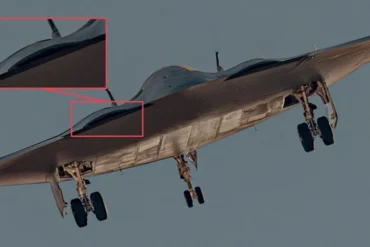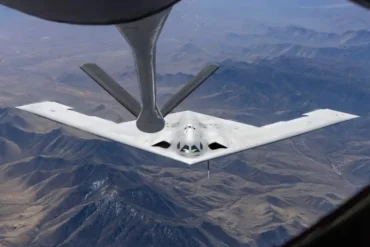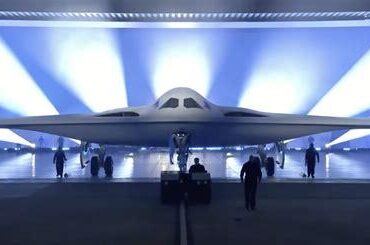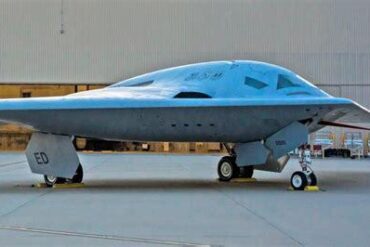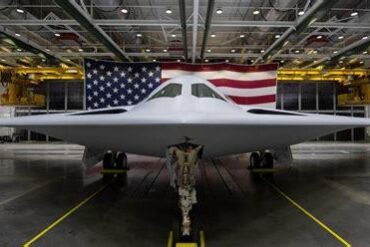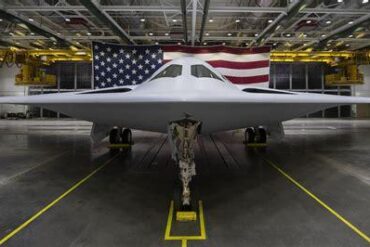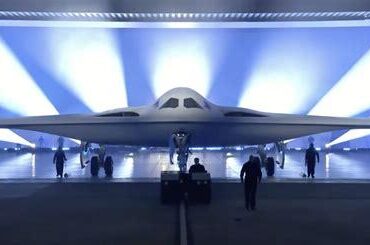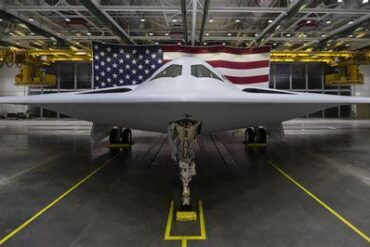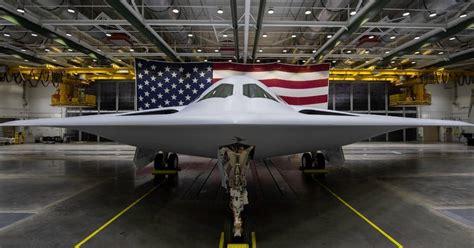
The unveiling of the Northrop Grumman B-21 Raider has triggered a wave of fascination across the military aviation world, but few details have generated as much curiosity as the mysterious black panels scattered across the bomber’s underside. In photographs released by the United States Air Force and Northrop Grumman, these dark square-like sections stand out sharply against the aircraft’s pale gray skin. To casual observers they resemble unfinished paint patches, maintenance covers, or exposed composite structures. In reality, they may represent some of the most sophisticated stealth-enabling systems ever integrated into a combat aircraft.
The B-21 Raider is not simply another bomber. It is the centerpiece of America’s future penetrating strike doctrine, designed to survive in airspace defended by advanced radar networks, long-range missiles, electronic warfare systems, and next-generation interceptors. Every visible feature on the aircraft exists for a reason. Nothing on a stealth bomber is accidental, especially not high-contrast panels deliberately placed along the belly and nose of the airframe.
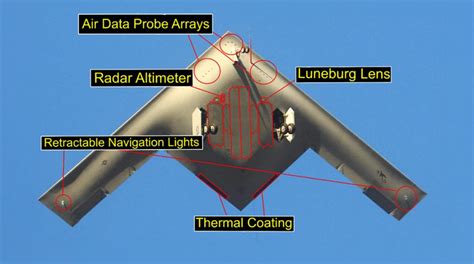
What makes these panels especially intriguing is their arrangement. Four darker squares appear beneath the forward fuselage, while additional panels line the underside near the wing roots and side sections of the aircraft. Larger geometric sections further aft create an appearance almost like primer coating spread unevenly across the bomber’s belly. The unusual layout has led to endless speculation online, ranging from infrared sensors to radar systems and classified electronic warfare arrays.
The truth is likely even more important than internet theories suggest.
The darker panels are widely believed to be dielectric structures designed to conceal critical sensors and antennas without compromising the aircraft’s stealth characteristics. Unlike conventional external equipment mounted on older aircraft, the B-21 cannot afford protrusions, sharp edges, or exposed hardware that would reflect radar energy back toward enemy defenses.
The aircraft must remain as smooth and radar-resistant as possible while still gathering enormous amounts of information from the battlefield.
Why The B-21 Raider Cannot Use Conventional Antennas
Traditional military aircraft rely heavily on externally mounted systems. Pitot tubes, radar antennas, communication arrays, navigation sensors, and electronic warfare equipment often protrude directly from the fuselage. On older bombers like the Boeing B-52 Stratofortress, such equipment barely mattered because survivability depended on speed, altitude, escort fighters, and massive formations.
Stealth aircraft changed everything.
Even tiny surface imperfections can increase radar cross-section dramatically. A single exposed bolt, gap, or metallic edge may produce enough radar reflection to compromise survivability against sophisticated air defense systems. That is why stealth aircraft are engineered with obsessive attention to surface continuity, panel alignment, and material composition.
The B-21 Raider takes this philosophy even further than the legendary Northrop B-2 Spirit. While the B-2 revolutionized low-observable bombing, the Raider was designed for an era dominated by multi-band radar networks, artificial intelligence-assisted targeting systems, and integrated air defense environments far more dangerous than anything encountered during the Cold War.
The dark panels on the B-21’s underside likely function as radar-transparent windows. Beneath them may sit communication antennas, electronic support measures, terrain-following sensors, infrared systems, or advanced electronic warfare hardware. The panels themselves are probably made from composite dielectric materials engineered to allow electromagnetic signals to pass through while minimizing radar reflections.
That combination is extraordinarily difficult to achieve.
A material transparent to radar frequencies must also withstand extreme aerodynamic stress, temperature fluctuations, moisture exposure, vibration, and long-term operational wear. It cannot distort signals while also remaining compatible with the aircraft’s radar-absorbent outer structure. In many ways, these seemingly simple black squares may represent some of the most technologically demanding components on the entire bomber.
The Air Data Probe Theory Explained
One of the strongest explanations comes from aviation analysts who believe many of the panels house air data probe arrays. Unlike traditional aircraft that use visible pitot tubes and static probes extending into airflow, stealth bombers must gather atmospheric and flight data without compromising low observability.
The B-21 reportedly uses a system very similar to that found on the B-2 Spirit. Multiple embedded air data probes are integrated into the aircraft’s surface rather than mounted externally. These sensors collect information such as airspeed, pressure, altitude, and airflow characteristics while preserving stealth geometry.
This approach offers enormous advantages for survivability.
Conventional probes create radar reflections because they physically stick out from the aircraft. Embedded arrays hidden beneath radar-transparent panels eliminate much of that signature problem. The Raider’s darker sections beneath the nose and side fuselage align closely with where such systems would logically be positioned for optimal airflow sensing.
What observers see externally is therefore likely just the outer layer of a much deeper sensor architecture.
Some prototype aircraft also appear to carry temporary calibration equipment during testing. Developmental bombers often feature exposed instrumentation or modified panels not intended for final production examples. That distinction matters because many online debates mistakenly assume prototype configurations perfectly represent operational aircraft.
History shows that assumption is frequently wrong.

Prototype Aircraft Often Reveal Misleading Details
The B-21 aircraft photographed today are still test and pre-production examples. Their coatings, panel treatments, and visible hardware may differ substantially from fully operational bombers entering service later this decade.
This phenomenon is hardly unique.
Russia’s Sukhoi Su-57 faced intense criticism after early developmental aircraft displayed visible screws, panel gaps, and uneven surfaces. Critics claimed those imperfections proved the aircraft lacked meaningful stealth capability. In reality, many photographed airframes were test vehicles built primarily for aerodynamic and systems development rather than finished combat configuration.
The same principle applies to the Raider.
Prototype stealth aircraft frequently use temporary coatings, exposed instrumentation, incomplete radar-absorbent treatments, and substitute materials during testing phases. Engineers prioritize accessibility and data collection before finalizing production-standard surfaces.
That means the B-21’s visible black panels may eventually become less pronounced, differently colored, or partially concealed beneath advanced operational coatings.
At the same time, their existence confirms something crucial about the aircraft’s role. The Raider is not merely a flying bomb truck. It is a highly networked sensing platform operating deep inside hostile airspace while continuously gathering, processing, and transmitting information.
In many respects, the B-21 behaves less like a traditional bomber and more like a stealth command node capable of coordinating complex strike operations across contested regions.
Why The B-21 Raider Uses Light Gray Instead Of Black
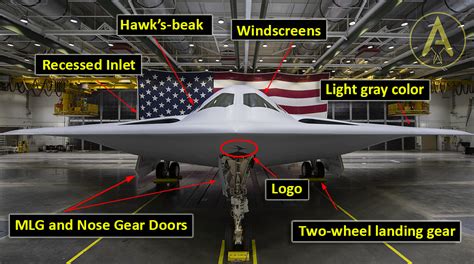
Another striking aspect of the aircraft is its color. The B-2 Spirit became iconic for its dark charcoal appearance, but the Raider adopts a noticeably lighter gray finish that has surprised many aviation observers.
The shift reflects both technological evolution and changing operational doctrine.
During the Cold War, stealth bombers were optimized heavily for nighttime penetration missions. Dark coatings helped reduce visual detection against the night sky while radar-absorbent materials handled electronic survivability. Modern warfare, however, increasingly demands all-day operational flexibility.
The B-21 is expected to penetrate defended airspace both day and night.
Lighter gray coatings reduce visual contrast against daytime atmospheric haze and cloud layers. The finish may also help manage infrared signatures by controlling thermal absorption and heat radiation characteristics. In modern stealth warfare, survivability extends beyond radar cross-section alone. Aircraft must also minimize visibility across infrared, visual, acoustic, and electromagnetic spectrums simultaneously.
That requirement explains why the Raider’s design appears smoother, cleaner, and more refined than the B-2’s already advanced flying-wing configuration.
The aircraft reportedly emphasizes all-aspect stealth rather than primarily frontal stealth optimization. Enemy radar systems today operate across multiple frequencies and attack geometries. Advanced air defenses no longer rely solely on forward-facing detection opportunities. As a result, the B-21 was engineered to reduce signatures from multiple viewing angles simultaneously.
The Long Evolution Toward Stealth Penetration Bombers
The black underside panels become even more significant when viewed through the broader history of American bomber doctrine.
After the Second World War, strategic bombers initially relied on brute force. The Convair B-58 Hustler attempted to survive through speed and altitude, while the experimental North American XB-70 Valkyrie sought near invulnerability by flying faster and higher than enemy interceptors could reach.
Surface-to-air missiles shattered those assumptions.
Radar-guided missile systems made even extreme speed and altitude increasingly vulnerable. The Rockwell B-1B Lancer shifted toward terrain-hugging penetration tactics, using low-level flight to avoid radar coverage. Yet advances in look-down radar technology gradually reduced that advantage as well.
Stealth ultimately emerged as the only viable long-term solution.
The B-2 Spirit demonstrated that reducing radar visibility could allow aircraft to penetrate heavily defended regions without relying solely on speed or altitude. But even the B-2 was designed around assumptions from the late Cold War environment.
The B-21 exists because those assumptions are no longer sufficient.
Modern integrated air defense systems combine ground radars, airborne early warning aircraft, infrared search-and-track systems, passive detection networks, satellites, and artificial intelligence-assisted targeting into layered detection ecosystems. Surviving such an environment requires unprecedented signature control and electronic warfare sophistication.
Those mysterious black panels likely play a direct role in that survival equation.
The B-21 Raider Is More Than A Bomber
The Raider’s real revolution may not be its shape at all. Instead, it is the aircraft’s role within a larger combat ecosystem.
The B-2 operated largely as a stand-alone penetrating bomber carrying precision weapons into defended territory. The B-21 expands that concept dramatically. It is expected to function as a deeply networked battlefield coordinator capable of integrating with satellites, drones, naval assets, fighters, cyber systems, and space-based sensors simultaneously.
Northrop Grumman has even described the Raider as a sixth-generation platform, a label more commonly associated with future fighter aircraft than bombers.
That distinction matters because the B-21’s sensors, communication arrays, and electronic warfare systems may prove just as important as its weapons payload. The bomber is expected to manage vast streams of battlefield information while remaining nearly invisible to hostile defenses.
This explains why embedded sensor panels are so essential.
Every hidden antenna or low-observable sensor window contributes to the aircraft’s ability to see without being seen. The Raider must collect targeting information, communicate securely, jam enemy radars, deploy decoys, coordinate drone operations, and adapt dynamically to evolving threats deep inside hostile territory.
The bomber effectively becomes a stealth intelligence and combat management platform carrying precision strike capability as only one part of its mission set.
What The Black Panels Ultimately Reveal About The Raider
The fascination surrounding the B-21’s black underside panels reflects a larger truth about modern stealth aircraft. In previous generations, military power was visible through engines, weapons, armor, and raw speed. Today, the most important technologies are often the least noticeable.
A small dark square on a stealth bomber may conceal electronic warfare systems capable of blinding enemy radars. It may hide communication arrays linking the aircraft to satellites and autonomous drones. It may contain advanced sensors quietly mapping hostile defenses hundreds of miles ahead.
The panels themselves are reminders that stealth warfare has evolved beyond simple radar reduction.
Modern survivability depends on information dominance, emission control, sensor fusion, and electronic deception working together simultaneously. The B-21 Raider was built specifically for that environment. Its smooth surfaces and mysterious dark sections are not cosmetic curiosities but outward signs of an aircraft designed to survive where older bombers no longer can.
As additional Raider aircraft emerge from testing and operational squadrons begin standing up later this decade, many details will remain classified. The precise function of every black panel may never become public knowledge.
But their importance is already unmistakable.
They are small windows into one of the most advanced combat aircraft programs ever developed, revealing how the future of strategic bombing is no longer defined by brute force or sheer speed, but by invisible networks, hidden sensors, and the relentless pursuit of staying unseen inside the deadliest airspace on Earth.