Modern jetliners are masterpieces of engineering, where every curve, contour, and component exists for a reason. Among the most visually striking features on certain Boeing aircraft are the serrated edges at the rear of their engines—known as chevrons. These jagged nacelle outlines have become synonymous with aircraft like the 787 Dreamliner and 737 MAX, often interpreted as symbols of cutting-edge design. Yet beneath their distinctive appearance lies a far more nuanced story—one shaped by acoustic science, aerodynamic compromise, and the relentless pursuit of regulatory compliance.
The Science Behind Engine Noise and Why Chevrons Exist
Jet engine noise is not merely a byproduct of thrust—it is a direct consequence of turbulent mixing between high-velocity exhaust gases and the surrounding atmosphere. In high-bypass turbofan engines, two primary streams exit the engine: the hot, fast-moving core exhaust and the cooler, slower bypass airflow. When these streams collide with ambient air, they create chaotic vortices that generate intense sound waves.
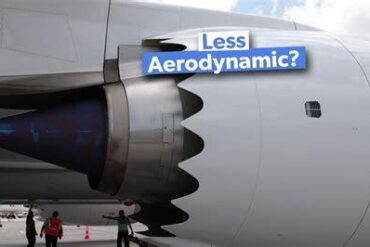
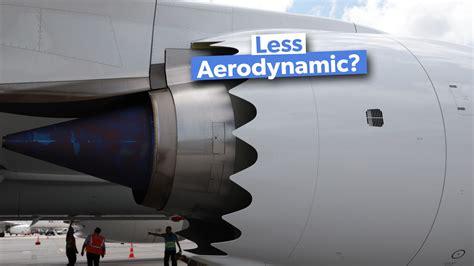
Chevrons were introduced to address this exact problem. By reshaping the trailing edge of the engine nacelle into a serrated pattern, engineers can smooth the interaction between these airflow streams. Instead of abrupt mixing, the chevrons promote a more gradual blending process, reducing the intensity of turbulence—and therefore, noise.
This innovation became particularly critical as airports around the world imposed stricter noise regulations. For aircraft manufacturers, meeting these standards wasn’t optional—it was essential for market viability.
How Chevrons Actually Work in Flight
At first glance, chevrons might appear to simply “break up” airflow, but their function is far more sophisticated. Each serration acts as a small aerodynamic device that generates controlled vortices. These vortices energize the boundary layer between airflow streams, allowing them to merge more smoothly.
This process delivers a measurable reduction in jet noise, especially during takeoff and climb, when engines operate at high thrust levels and noise output peaks.
However, this smoother mixing comes at a cost. The energy used to create and sustain these vortices is not free—it is drawn directly from the exhaust flow itself. In essence, some of the engine’s propulsive energy is diverted toward noise reduction rather than thrust generation.
Why Boeing Adopted Chevrons Selectively Across Its Fleet
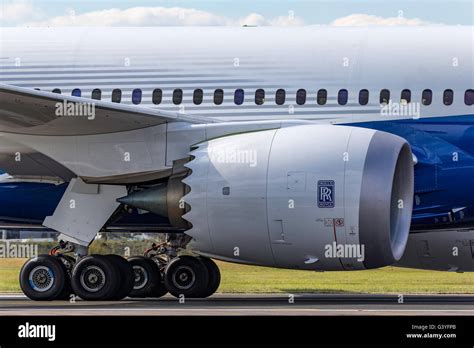
Contrary to popular belief, chevrons are not a universal feature across all Boeing aircraft. Instead, they are applied selectively, depending on the mission profile, engine design, and regulatory requirements of each aircraft program.
Aircraft that prominently feature chevrons include:
- The 787 Dreamliner, where noise reduction was a core design priority
- The 747-8, particularly with its GEnx engines
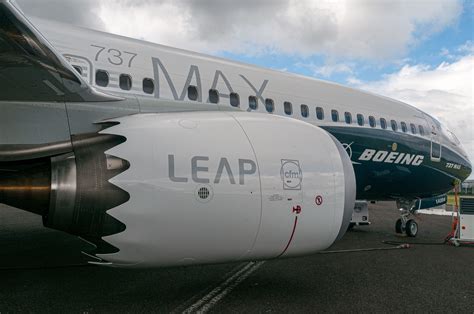
- The 737 MAX, equipped with LEAP-1B engines
Meanwhile, other aircraft such as the 777 and 767 families largely avoid this design approach. Even the newer 777X notably steps away from the chevron-heavy aesthetic, signaling a shift in engineering priorities.
This selective adoption underscores a critical reality: chevrons are not a universal upgrade—they are a calculated compromise.
The LEAP-1B Engine: A Case Study in Trade-Off Engineering
On the 737 MAX, the LEAP-1B engine showcases chevrons as a defining visual and functional element. Designed for improved fuel efficiency and reduced environmental impact, the engine integrates advanced materials, a high-efficiency fan, and aerodynamic refinements—including its serrated nacelle edges.
The results are impressive. Compared to earlier 737 variants, the MAX achieves a significantly smaller noise footprint, making it more compatible with noise-sensitive airports.
But the physics remains unchanged. The same mechanism that reduces noise—enhanced mixing—also introduces minor aerodynamic inefficiencies. The vortices generated by chevrons slightly disrupt the optimal flow of exhaust gases, leading to a small but measurable reduction in thrust.
In isolation, this penalty may seem negligible. However, in aviation, even fractional efficiency losses can translate into higher fuel consumption over thousands of flight hours.
GEnx Engines and the Expansion of Chevron Technology
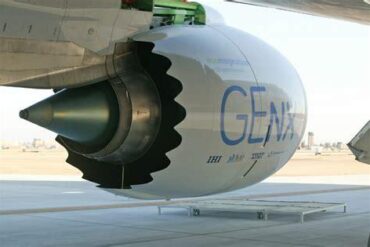
The GEnx engine, used on both the 787 and 747-8, represents one of the most advanced turbofan designs in modern aviation. It incorporates composite materials, improved thermal efficiency, and reduced mechanical complexity.
What makes the GEnx particularly interesting is how Boeing applied chevrons differently across aircraft:
- On the 787, chevrons are primarily used on the nacelle
- On the 747-8, they extend to both the nacelle and core exhaust nozzle
This expanded application reflects a deeper commitment to noise reduction, especially for large, long-haul aircraft operating in densely populated regions.
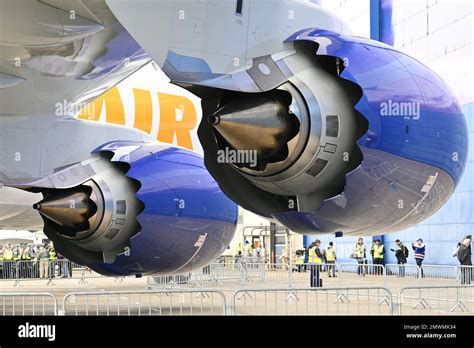
Yet even here, the trade-off persists. By intensifying mixing across multiple exhaust streams, the system achieves quieter operation—but at the expense of slightly reduced propulsive efficiency.
The Real Performance Penalty: Small but Significant
It is important to clarify that chevrons do not dramatically degrade engine performance. Studies, including those conducted by aerospace research institutions, consistently show that the thrust penalty is minor.
However, “minor” does not mean irrelevant.
In commercial aviation, efficiency margins are razor-thin. Airlines operate under constant pressure to minimize fuel burn, reduce emissions, and maximize payload capacity. Even a small reduction in thrust efficiency can influence:
- Fuel consumption over long-haul flights
- Takeoff performance at high-altitude airports
- Engine wear and maintenance cycles
Over time, these factors accumulate, turning a seemingly negligible penalty into a meaningful operational consideration.
Why Airbus Took a Different Approach
While Airbus has explored chevron technology, it has generally avoided making it a defining feature of its aircraft. Instead, the company has focused on a broader, more integrated approach to noise reduction.
This includes:
- Advanced acoustic liners within engine nacelles
- Optimized engine-airframe integration
- Aerodynamic refinements across wings and fuselage
- Improved landing gear design to reduce approach noise
By targeting multiple noise sources simultaneously, Airbus can achieve comparable acoustic performance without relying heavily on chevrons.
This strategy highlights a fundamental difference in philosophy. Rather than accepting a small performance penalty for noise reduction, Airbus often seeks alternative solutions that preserve efficiency.
The Evolution of Noise Reduction Technology
Chevrons were once considered a breakthrough in aviation acoustics, but technology does not stand still. Modern advancements are reshaping how engineers approach the noise-performance balance.
Key innovations include:
- Next-generation acoustic liners that absorb sound more effectively
- Lower fan speeds enabled by higher bypass ratios
- Improved blade aerodynamics to reduce tonal noise
- Hybrid-electric propulsion concepts that promise quieter operation
As these technologies mature, the relative advantage of chevrons becomes less compelling. When similar noise reductions can be achieved without sacrificing performance, the rationale for using chevrons weakens.
Operational Strategies That Reduce Noise Without Hardware Changes
Interestingly, not all noise reduction comes from hardware. Airlines and air traffic controllers play a crucial role through operational techniques.
One of the most effective methods is the continuous descent approach (CDA). By allowing aircraft to descend gradually rather than in stepped intervals, engines can remain at lower thrust levels for longer periods, significantly reducing noise exposure.
Other strategies include:
- Optimized flight paths that avoid densely populated areas
- Reduced thrust takeoff procedures where conditions permit
- Improved scheduling to minimize nighttime operations
These approaches demonstrate that noise reduction is not solely an engineering challenge—it is also an operational one.
The Aesthetic Factor: Form Meets Function
There is no denying that chevrons give aircraft a distinctive, almost futuristic appearance. For many passengers, they symbolize innovation and advanced engineering.
But their visual appeal is incidental. Chevrons were never designed to make aircraft look better—they exist because they solve a specific problem. The fact that they also enhance the aircraft’s aesthetic identity is simply a fortunate byproduct.
The Bigger Picture: Engineering Is Always About Trade-Offs
The story of engine chevrons is not about success or failure—it is about balance. Every engineering decision involves trade-offs, and chevrons are a textbook example.
They offer:
- Reduced noise levels, benefiting communities and regulatory compliance
- Enhanced passenger comfort during critical flight phases
But they also introduce:
- Slight reductions in thrust efficiency
- Potential long-term impacts on operational costs
The key is not whether chevrons are “good” or “bad,” but whether they represent the optimal compromise for a given aircraft and mission profile.
Why Some Future Aircraft May Move Away from Chevrons
As aviation continues to evolve, the role of chevrons is likely to diminish. With improved materials, smarter design techniques, and alternative noise-reduction technologies, manufacturers have more tools at their disposal than ever before.
Aircraft like the 777X suggest a shift in direction—one that prioritizes holistic efficiency over single-feature solutions.
This does not mean chevrons will disappear entirely. In certain scenarios, they may still offer the best balance of performance and noise reduction. But their dominance as a signature design feature is already beginning to fade.
Conclusion: The Real Reason Chevrons Can Hinder Performance
Engine chevrons are a powerful reminder that innovation often comes with compromise. By smoothing airflow and reducing turbulence, they achieve quieter operation—a critical advantage in today’s noise-sensitive aviation landscape.
Yet this same mechanism inevitably diverts energy away from pure propulsion, introducing a subtle but real performance penalty.
In the end, chevrons are not a flaw—they are a deliberate choice. A carefully engineered solution that prioritizes acoustic efficiency over absolute aerodynamic perfection. And in an industry where every decision carries weight, that trade-off tells a story far more compelling than their striking appearance ever could.