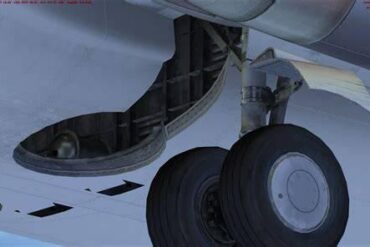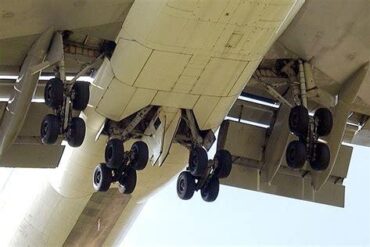
The Boeing 737 is one of the most recognizable aircraft in aviation history, yet one of its most curious design features often goes unnoticed by casual observers and fascinates aviation enthusiasts: the absence of main landing gear doors. While most commercial airliners enclose their landing gear neatly within sealed bays, the 737 leaves its wheels partially exposed even when retracted. At first glance, this seems like an aerodynamic compromise—but the reality is far more nuanced and deeply rooted in engineering philosophy, historical context, and operational priorities.
A Design Choice Rooted in the 1960s
When the Boeing 737 was first conceived in the 1960s, aviation looked very different. Airlines needed rugged, reliable aircraft capable of operating from smaller, less-developed airfields. Infrastructure was limited, ground support equipment was basic, and turnaround efficiency was critical. Boeing’s response was to design an aircraft that emphasized simplicity, durability, and ease of maintenance above all else.
The decision to omit landing gear doors was not an oversight—it was intentional. By eliminating these components, Boeing reduced the number of moving parts that could fail. In remote or under-equipped airports, a malfunctioning gear door could ground an aircraft for extended periods. The 737, by contrast, was built to keep flying.
This philosophy extended to the aircraft’s low ground clearance, which allowed ground crews to service engines and systems without specialized equipment. While this low stance is often cited as the reason for the lack of doors, it is more accurate to say both features stem from the same guiding principle: operational simplicity.
The Aerodynamics vs. Weight Trade-Off
At cruising altitude, aerodynamic efficiency becomes a dominant factor in fuel consumption. Landing gear doors help create a smooth fuselage surface, reducing drag and improving fuel efficiency. So why would Boeing accept the penalty of exposed wheels?
The answer lies in the trade-off between weight and drag.
Adding landing gear doors introduces:
- Additional structural components
- Hydraulic systems and actuators
- Increased maintenance requirements
All of this adds weight, which directly impacts fuel burn—especially during climb and cruise. For a short-haul aircraft like the early 737 variants, the time spent cruising was relatively limited. This meant the aerodynamic benefits of gear doors were less significant compared to long-haul aircraft.
In simple terms, Boeing calculated that the fuel savings from reduced weight outweighed the drag penalty caused by partially exposed wheels. It’s a classic engineering compromise—one that favored efficiency in the specific mission profile the 737 was designed for.

A Clever Aerodynamic Workaround
Leaving the landing gear exposed doesn’t mean Boeing ignored aerodynamics entirely. Instead, engineers implemented low-tech but effective solutions to minimize drag.
The 737 features:
- Rubber seals around the landing gear bays to close gaps
- Wheel hubcaps that smooth airflow
- Partial gear strut doors that cover structural elements
These design elements help create a more streamlined underside, reducing turbulence and drag without the complexity of full landing gear doors.
The result is a hybrid approach: not fully enclosed like larger aircraft, but far from aerodynamically crude. It’s a reminder that engineering isn’t always about perfection—it’s about optimization.
Why Boeing Never Changed It
Over nearly six decades, the Boeing 737 has evolved through multiple generations—from the Original series to the Classic, Next Generation (NG), and now the MAX. Engines have been upgraded, wings redesigned, and avionics modernized. Yet the absence of landing gear doors remains unchanged.
Why?
Because changing it would be far more complicated than it sounds.
Adding landing gear doors would require:
- Significant structural redesign of the fuselage
- New hydraulic and control systems
- Extensive aerodynamic testing
- Potential recertification as a new aircraft type
Certification is particularly critical. The 737 benefits from a continuous type certificate, allowing Boeing to introduce upgrades without treating each variant as an entirely new aircraft. This dramatically reduces development time and cost.
Introducing a major structural change like landing gear doors could jeopardize that continuity, potentially forcing Boeing into a full certification process—a costly and time-consuming endeavor.
In other words, keeping the design as-is isn’t just inertia—it’s a strategic decision that preserves the program’s economic viability.
How It Compares to Other Aircraft
The Boeing 737’s design stands out most when compared to aircraft like the Airbus A320, which features fully enclosed landing gear bays. Airbus opted for a more aerodynamically refined approach, prioritizing fuel efficiency during cruise.
However, the 737 is not alone in its design philosophy. Several aircraft—both older and modern—share similar characteristics:
- The Boeing 727 also featured partially exposed landing gear
- Regional jets like the CRJ series and Embraer E-Jets often lack full gear doors
- Even the modern Airbus A220 incorporates partially exposed landing gear
This pattern reveals an important insight: in short-haul aviation, simplicity often outweighs aerodynamic perfection.
By contrast, larger aircraft such as the Boeing 757, 777, or Airbus A350 always feature landing gear doors. These aircraft operate on long-haul routes where even small aerodynamic improvements translate into significant fuel savings over time.
The Role of Landing Gear Configuration
Another factor influencing the presence of landing gear doors is wheel configuration.
The Boeing 737 uses a relatively simple setup:
- Two wheels on the nose gear
- Two wheels on each main gear strut
This compact arrangement allows the wheels to retract into shallow bays, making partial exposure manageable.
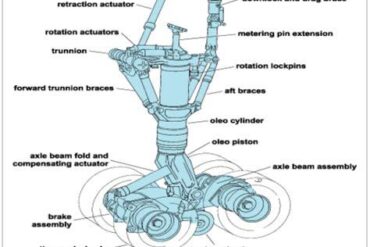
Larger aircraft, however, use multi-wheel bogies with complex geometries. These cannot be neatly integrated into the fuselage without dedicated enclosed compartments. As a result, full landing gear doors become essential for both aerodynamic and structural reasons.
This explains why you’ll never see a widebody aircraft with exposed landing gear—it’s simply not feasible.
Operational Advantages That Still Matter Today
Even in today’s world of advanced airports and sophisticated maintenance systems, the 737’s design continues to offer tangible benefits.
The absence of landing gear doors means:
- Fewer mechanical failures
- Reduced maintenance costs
- Faster inspection and servicing
- Greater reliability in diverse operating environments
For airlines operating high-frequency short-haul routes, these advantages translate directly into higher aircraft utilization and lower operating costs.
It’s not glamorous, but it’s incredibly effective—like choosing a reliable tool over a delicate one that requires constant attention.
A Design That Aged Surprisingly Well
What’s remarkable is how well this 1960s design decision has aged. The Boeing 737 has transitioned from a short-haul workhorse into a versatile aircraft capable of:
- Carrying up to 200 passengers
- Flying transcontinental and even transatlantic routes
- Competing with newer, more advanced designs
Despite these expanded capabilities, the original design philosophy still holds up. The lack of landing gear doors hasn’t prevented the 737 from becoming one of the best-selling aircraft in history.
In fact, one could argue that this very simplicity has contributed to its longevity.

The Hidden Costs of “Fixing” It
It might be tempting to think Boeing could simply “fix” the issue in future versions. But aviation design doesn’t work like software updates.
Every change introduces cascading consequences:
- Added weight affects fuel efficiency
- New systems increase maintenance complexity
- Structural changes impact aerodynamics and balance
Even a seemingly minor modification like adding gear doors could ripple through the entire aircraft design, requiring extensive revalidation and testing.
At that point, Boeing might as well design a completely new aircraft—which is precisely why clean-sheet designs are so rare and expensive.
A Subtle but Iconic Feature
The exposed landing gear has become one of the Boeing 737’s signature characteristics. For aviation enthusiasts, it’s an instantly recognizable detail—a small quirk that tells a much larger story about engineering priorities and historical context.
It also serves as a reminder that different manufacturers make different trade-offs. Airbus prioritized aerodynamic refinement with the A320, while Boeing leaned into simplicity and operational efficiency with the 737.
Neither approach is inherently superior—they simply reflect different philosophies.
The Bigger Picture: Engineering Is About Balance
The question “Why doesn’t the Boeing 737 have landing gear doors?” ultimately reveals something deeper about aircraft design.
Every aircraft is a collection of compromises:
- Weight vs. efficiency
- complexity vs. reliability
- innovation vs. certification constraints
The 737’s design is a masterclass in balancing these competing factors. By accepting a small aerodynamic penalty, Boeing achieved gains in simplicity, reliability, and cost-effectiveness—advantages that have compounded over decades of operation.
Final Thoughts: Simplicity That Stood the Test of Time
The absence of landing gear doors on the Boeing 737 isn’t a flaw—it’s a deliberate, calculated decision that reflects the aircraft’s origins and mission. What began as a practical solution for rugged operations has evolved into a defining feature of one of aviation’s most enduring designs.
In a world where technology often trends toward increasing complexity, the 737 quietly demonstrates the power of doing less—but doing it exceptionally well.