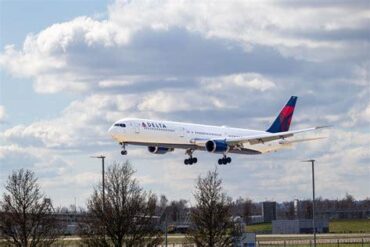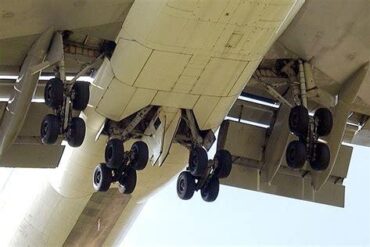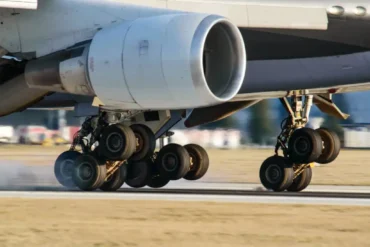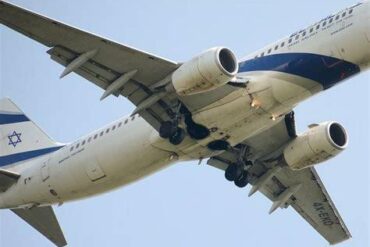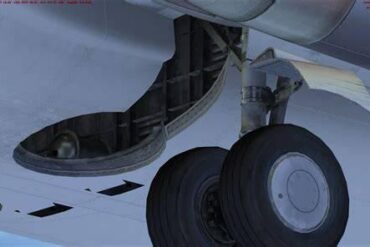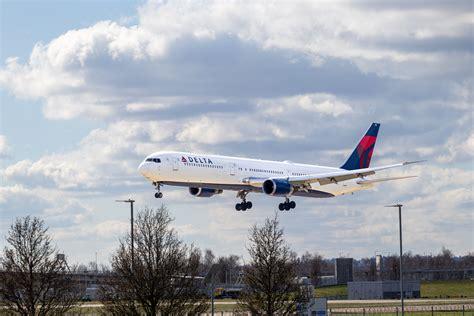
The Boeing 767 stands as one of the most influential widebody aircraft of the late 20th century, known not just for its operational success but also for its unique engineering choices. Among its most distinctive—and initially puzzling—features is its forward-tilting landing gear. While most widebody aircraft, including Boeing’s own 747, 777, and 787, utilize rear-tilting main gear configurations, the 767 defies this norm. Its design was the product of a complex interplay between space optimization, flight dynamics, and historical context. In this article, we delve deep into the technical and historical rationale behind this unusual gear orientation and explore its implications across the aircraft’s legacy.
The Genesis of the Boeing 767: Widebody Innovation for a New Era
When the 767 took to the skies in 1981, it represented a shift in how Boeing approached widebody design. Developed in tandem with the narrowbody 757, the 767 was Boeing’s answer to increasing demand for medium-to-long haul aircraft that could operate with only two engines, a radical concept at the time for transoceanic travel.
What followed was more than just a new airframe—it was a template for the twin-engine ETOPS era. The 767, along with the Airbus A310, helped validate the concept of Extended-range Twin-engine Operational Performance Standards, which eventually enabled aircraft like the 777 and 787 to fly intercontinental routes once reserved for four-engine giants.
Engineering Origins: Shared Lineage and Landing Gear Constraints
The Boeing 767 shares design and certification lineage with the 757, a strategic move to allow pilots to fly both aircraft types under a common type rating. However, the 767 was Boeing’s first widebody to feature a two-axle, four-wheel main landing gear with a forward tilt, setting it apart from predecessors and successors.
The forward tilt was not aesthetic. It stemmed from two critical engineering demands:
- Space conservation inside the landing gear bay.
- Stabilization of pitch behavior during landing.
The 767’s relatively narrow fuselage diameter (for a widebody) and wing-mounted main gear meant that designers had limited vertical and longitudinal space to work with. The main gear trucks tilt forward to fit into the tight wheel wells situated in the belly of the fuselage, where space also had to accommodate hydraulic systems, fuel lines, and structural reinforcements. This configuration allowed the gear to nest efficiently without encroaching into cabin or fuel storage areas.
Unlike newer models such as the 777 or 787, which use more sophisticated tilt-change mechanisms to reorient the gear during retraction and extension, the 767 was built under more constrained technology and budgetary timelines. Thus, the fixed forward tilt offered an elegant, passive solution to a complex spatial challenge.
Flight Dynamics at Touchdown: Addressing Nose-Down Behavior
During early flight testing, Boeing engineers observed that the 767 exhibited a tendency to pitch down aggressively during touchdown, especially when landing at lower weights or under higher flare angles. This created not only a comfort issue for passengers but also a potential hazard for structural stress on the nose gear.
By designing the main landing gear to tilt forward, Boeing manipulated the aircraft’s landing attitude. Unlike aircraft where the rear wheels touch down first, the 767’s forward-tilting gear ensures the forward wheels contact the runway sooner, helping to counteract pitch-down tendencies. The result is a softer, more level touchdown profile, reducing wear on the nose gear and improving the overall stability during landing roll.
This solution was not just reactive—it represented Boeing’s forward-thinking approach to aircraft handling characteristics, balancing complex aerodynamic behaviors with straightforward mechanical design.
The 767 Is Not Alone: Other Aircraft With Forward-Tilting Gear
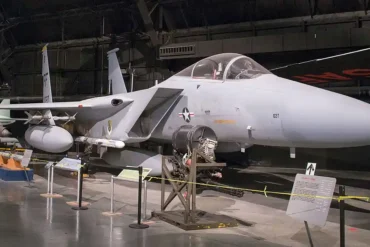
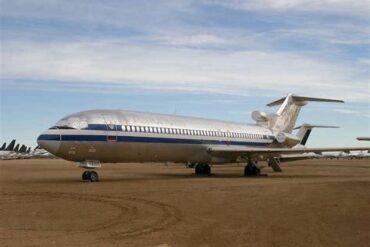
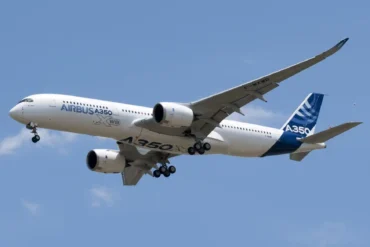
Although unusual, the 767 is not the only aircraft to adopt this design philosophy. Several notable airliners and military aircraft feature forward-tilting gear, including:
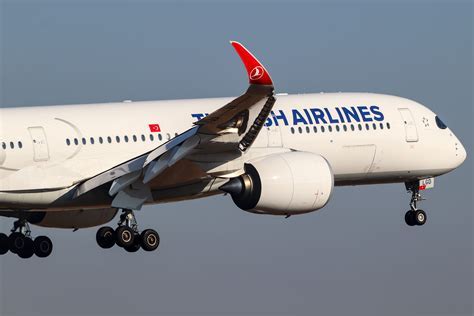
- Airbus A350-900
- Airbus A380
- McDonnell Douglas MD-11
- Airbus A340-600 (mixed tilt: wing gear tilts backward, center gear tilts forward)
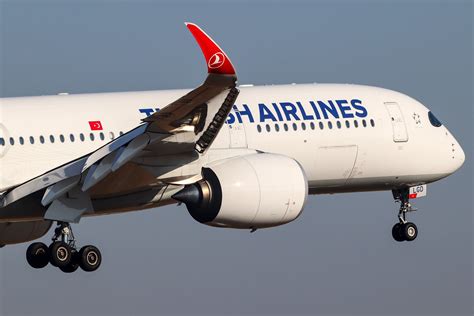
These examples confirm that the forward tilt is a legitimate, if specialized, design choice, often linked to space constraints, specific ground handling needs, or landing dynamics. However, among Boeing widebodies, the 767 remains unique in this regard.
Passenger Experience and Unique Cabin Engineering
While the gear design grabs technical attention, the 767’s cabin engineering choices also stand out. Most commercial aircraft use outward-opening doors; however, the 767’s passenger doors are designed to open inward and then lift upward into the cabin ceiling.
This design shares heritage with older aircraft such as the L-1011 TriStar, DC-10, and MD-11, indicating the influence of engineers with McDonnell Douglas backgrounds who later contributed to Boeing’s programs. The plug-type door mechanism enhances safety by allowing cabin pressure to help seal the door during flight, reducing the need for complex latching systems.
Though not directly related to the landing gear, this door system illustrates Boeing’s practical approach to reusing proven design elements where they added value.
Powerplants and Their Influence on Weight and Balance
Another layer of complexity in the 767’s landing gear orientation involves its engine configurations. Across its production span, the 767 has flown with four major turbofan engines:
- Pratt & Whitney JT9D
- General Electric CF6
- Rolls-Royce RB211
- Pratt & Whitney PW4000 (94” and 112” variants)
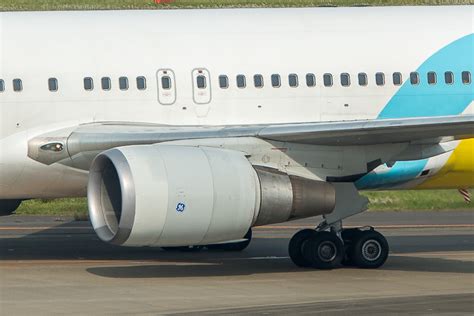
Each engine model introduces slight variations in weight distribution, which directly affects the aircraft’s center of gravity and landing attitude. The forward tilt in the landing gear contributes to maintaining consistent rotation angles during takeoff and landing, helping mitigate handling discrepancies introduced by different engine weights or thrust ratings.
Operational Longevity and the 767F Advantage
Despite its age, the Boeing 767 remains a cornerstone of modern air cargo operations. While production of the passenger version has ceased, the 767-300F (freighter) continues to roll off the line, primarily serving FedEx, UPS, and other cargo integrators.
Its forward-tilting gear design, once novel, now fits naturally into the freighter’s role. This configuration contributes to:
- Efficient loading due to consistent floor angles.
- Reliable touchdown performance even on shorter runways.
- Reduced nose gear wear in heavy freight configurations.
The 767’s continued demand in the freighter market proves that practical, functional design wins over flashier alternatives when it comes to logistics performance.
High-Frequency and Long-Range Routes: Still in the Game
While newer aircraft dominate modern fleets, Delta and United Airlines still operate extensive 767 fleets, especially on transatlantic and trans-South American routes. For example, United uses the 767-300ER on long hauls from Houston to Munich and Rio de Janeiro, while Delta operates the 767-400ER between Atlanta and Buenos Aires.
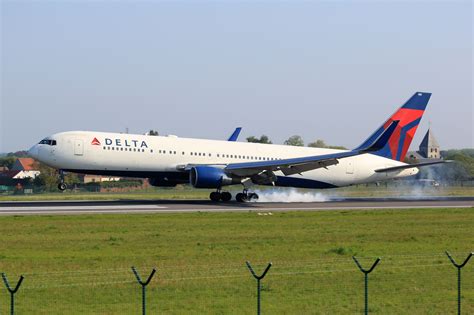
On the other side of the globe, Japanese carriers ANA and JAL continue to rely on the 767-300ER for high-frequency domestic operations, highlighting the aircraft’s unrivaled versatility. These operators value the 767’s fuel efficiency, range, and reliability—even decades after its introduction.
Conclusion: A Tilt That Stood the Test of Time
The forward-tilting landing gear on the Boeing 767 is far more than an aerodynamic curiosity. It represents the intersection of necessity and innovation, born from space constraints, refined through flight testing, and validated through four decades of global operation.
From helping launch ETOPS regulations to serving both dense short-haul routes and intercontinental corridors, the 767 has proven itself adaptable and enduring. Its gear design—once a topic of skepticism—has become a defining element of its identity, a quiet contributor to its operational success.
In an industry driven by innovation and iteration, the 767 remains a testament to how a single engineering decision—executed well—can impact generations of aircraft design. And in this case, that decision tilted forward.