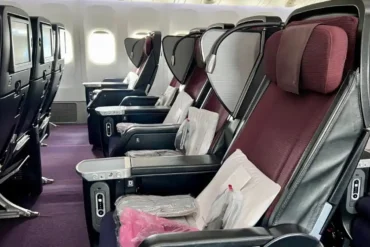
Crossing the Pacific in business class is a very different proposition from taking a premium seat on a shorter international flight. Transpacific flights can last well beyond 12 hours, and some of the longest services connect major Asian and North American cities with journeys that consume most of a day. At that length, the quality of the seat becomes central to the entire travel experience. A seat that feels comfortable for three hours can become surprisingly restrictive after eight or ten.
Modern business class has therefore evolved far beyond the traditional wide reclining seat. Airlines are now competing with fully flat beds, private suites, sliding doors, expansive personal spaces, sophisticated entertainment systems, dedicated storage, premium bedding, and carefully designed work areas. The best products are effectively small private rooms that allow passengers to sleep, work, dine, and relax without feeling as though they are spending an entire day inside an aircraft cabin.
For travelers choosing a transpacific itinerary, however, the newest seat is not automatically the best seat. Privacy, bed comfort, width, direct aisle access, service consistency, dining, and the overall cabin environment all matter. A spectacular-looking suite can lose some of its appeal if the bed is awkward, while a less dramatic seat can become a favorite when it consistently delivers several hours of genuinely restful sleep.
Five airlines stand out particularly strongly in this demanding environment: All Nippon Airways, Singapore Airlines, Cathay Pacific, Japan Airlines, and EVA Air. Each approaches premium travel differently, but all have developed business class products that can make an exceptionally long Pacific crossing considerably more comfortable.
All Nippon Airways The Room: An Exceptionally Wide Business Class Seat
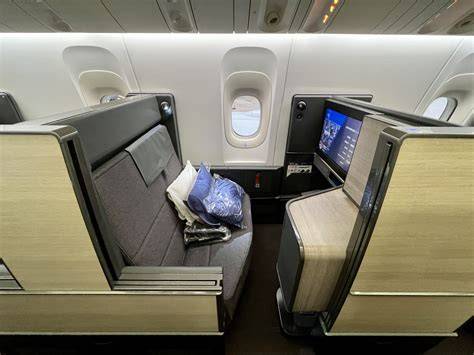
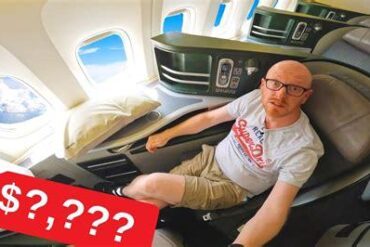
All Nippon Airways (ANA) has one of the most distinctive business class products in the world with The Room. Rather than simply refining the conventional business class recliner, ANA took a much more ambitious approach to personal space. The result is an unusually wide seat with a residential, almost sofa-like character that immediately separates it from many conventional business class designs.
Width is one of The Room’s greatest advantages. Passengers have significantly more freedom to change sitting positions, stretch their legs, or relax without constantly feeling confined by the boundaries of the seat. That additional space becomes particularly valuable on a long transpacific journey, when passengers are not merely trying to sit comfortably for dinner but may spend half a day using the same personal area.
The design also works well for passengers who prefer to alternate between different activities. A traveler can work upright, dine comfortably, watch a movie, or simply lounge in a more relaxed position. The seat converts into a fully flat bed, providing the essential sleeping capability expected from a premium cabin on ultra-long-haul routes.
Privacy is another major strength. High walls and a sliding privacy door create a semi-enclosed environment, giving passengers a greater sense of separation from the aisle and neighboring travelers. Yet the suite does not feel excessively enclosed when the door is open, allowing passengers to maintain a connection with the cabin when they want it.
The Room is particularly compelling on ANA’s long-haul services between Japan and North America. On routes such as Tokyo Haneda to New York, the combination of width, privacy, and flat-bed functionality has enough time to demonstrate why seat architecture matters so much on transpacific flights.
ANA also complements the hardware with polished service and a strong dining experience. Its Japanese hospitality philosophy places considerable emphasis on attentiveness and detail without making the cabin feel excessively formal. Bedding, meal timing, and cabin service all contribute to an experience that feels carefully coordinated rather than simply assembled from premium features.
For passengers who place the highest value on personal space and a spacious business class seat, The Room remains one of the strongest choices available.
Singapore Airlines Business Class: Space, Privacy, and Long-Haul Refinement
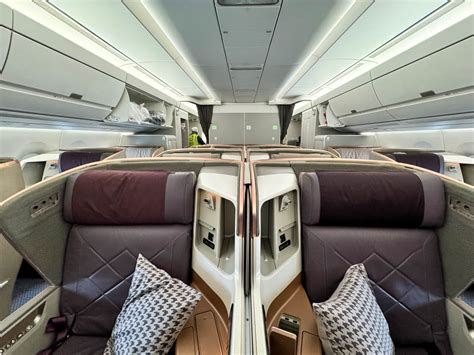
Singapore Airlines has spent decades building one of the industry’s strongest premium brands, and its business class product reflects that experience. The airline’s approach is less about a single dramatic feature and more about creating a complete environment in which the seat, service, food, bedding, and cabin atmosphere work together.
The seat itself provides an impressive 30 inches of width and converts into an 81-inch fully flat bed. Those dimensions give passengers enough room to settle into different positions during a long journey and provide a substantial sleeping surface when the cabin transitions into its nighttime routine.
Privacy is equally important. The business class design incorporates full-height privacy doors, allowing passengers to create a secluded personal environment. On an overnight transpacific journey, that separation can make a meaningful difference. Instead of being constantly exposed to movement in the aisle, passengers can close the door and create a quieter space dedicated to rest.
The seat is also designed for productivity. A large work area, storage compartments, and accessible controls make it practical for passengers who need to work during the flight. This is particularly useful on flights between Singapore and North America, where the enormous distance can make the aircraft function as both an office and a bedroom.
Singapore Airlines also understands that premium comfort is not solely about the physical seat. Service consistency remains one of the carrier’s defining characteristics. Cabin crew are renowned for being attentive while generally avoiding the feeling of constant interruption. Meals are another important component, with a broad selection designed to accommodate different tastes and expectations.
The bedding deserves particular attention because sleep is arguably the most important test of a business class seat on an ultra-long-haul flight. A seat can look spectacular in promotional photography, but its real value becomes apparent at 35,000 feet when a passenger attempts to sleep for several hours.
Singapore Airlines has built its business class around that complete experience. The result is a product that feels refined without depending entirely on visual spectacle. For travelers who want privacy, a wide seat, strong service, and a dependable sleeping environment, it remains one of the leading choices for long-distance premium travel.
Cathay Pacific Aria Suite: A Modern Business Class Experience
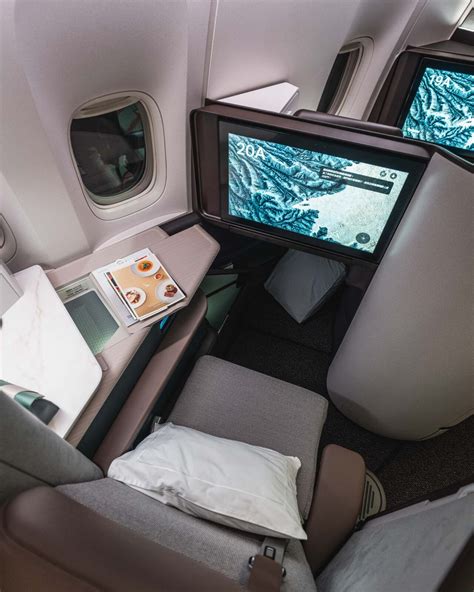
Cathay Pacific’s Aria Suite represents an important modernization of the airline’s long-haul business class offering. With a fully enclosed design and sliding privacy door, the suite moves the carrier toward the increasingly popular concept of the private business class cabin.
The visual character of the Aria Suite is deliberately restrained. Instead of relying on excessive ornamentation, Cathay Pacific uses clean lines, contemporary materials, and a calm cabin aesthetic. That approach is particularly appropriate for a seat intended to function as a personal environment for many hours.
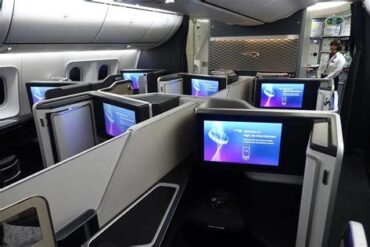
One of its most notable features is the 24-inch 4K entertainment screen, giving passengers a large and highly detailed display for movies, television programs, and other onboard entertainment. Bluetooth connectivity allows travelers to use compatible personal headphones, while wireless charging adds another layer of convenience.
These details may appear relatively minor compared with a fully flat bed or privacy door, but they become increasingly important on very long flights. A passenger may spend several hours watching entertainment, working, eating, or simply relaxing. Convenient technology reduces the small frustrations that can accumulate during a long journey.
The Aria Suite’s privacy is particularly valuable on transpacific routes. A sliding door separates the passenger from the aisle and provides a greater sense of personal ownership over the space. That can be especially useful during sleeping hours, when the cabin is quieter and passengers want to minimize visual distractions.
Cathay Pacific has also placed renewed emphasis on its dining and onboard service. The carrier’s Hong Kong hub puts it at the center of a highly competitive Asian premium aviation market, where passengers have access to several major airlines offering sophisticated business class products.
The Aria Suite therefore represents more than a new seat. It is part of a broader effort to make Cathay Pacific’s long-haul premium cabin more competitive through privacy, technology, comfort, and improved service consistency.
For travelers flying across the Pacific through Hong Kong, the Aria Suite deserves serious consideration, particularly for passengers who value a private, modern cabin environment.
Japan Airlines Sky Suite: A Business Class Seat Built Around Sleep
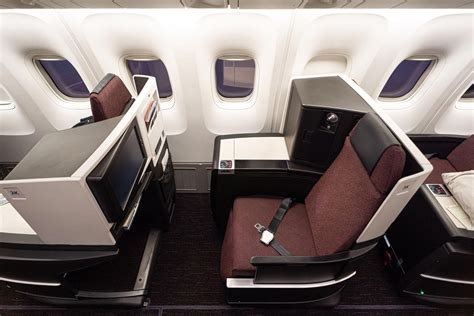
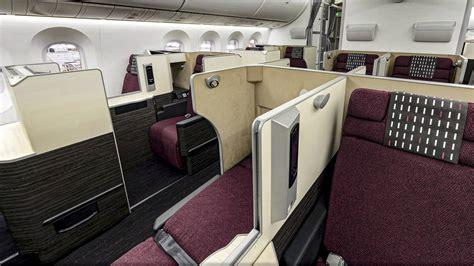
Japan Airlines (JAL) takes a somewhat different approach. Its Sky Suite may not have the enormous width of ANA’s The Room or the same visual impact as some enclosed suites, but it excels in one area that matters enormously on transpacific flights: sleeping comfort.
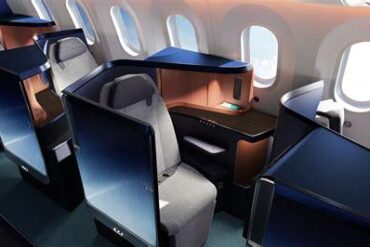
The Sky Suite’s seating arrangement provides a strong degree of personal privacy through high dividers between passengers. This creates individual spaces while avoiding the feeling of being completely boxed into a narrow compartment.
Once converted into bed mode, the seat becomes particularly appealing for overnight Pacific crossings. Japan Airlines provides a thick mattress pad and high-quality duvet, helping transform the seat from an aircraft chair into a more convincing sleeping surface.
That distinction matters because a fully flat seat alone does not guarantee good sleep. The firmness of the surface, bedding quality, available width, footwell arrangement, privacy, and cabin environment all influence whether passengers can actually rest. JAL’s approach focuses heavily on those practical details.
The airline’s service style is another major advantage. Its cabin crews are known for professionalism and the principles associated with Japanese hospitality, creating an environment that is attentive without necessarily being intrusive. For a passenger trying to sleep, that balance can be particularly valuable.
Dining also reflects JAL’s identity. Menus commonly include Japanese cuisine alongside Western selections, giving passengers greater flexibility while maintaining a strong connection to the airline’s cultural heritage.
The Sky Suite demonstrates that the best business class seat does not necessarily need to be the widest or most technologically elaborate. On an extremely long flight, a seat that reliably supports several hours of quality sleep can be more valuable than a collection of flashy features.
For travelers whose priority is rest rather than spectacle, Japan Airlines remains an exceptionally strong transpacific option.
EVA Air Royal Laurel: Consistency as a Premium Advantage
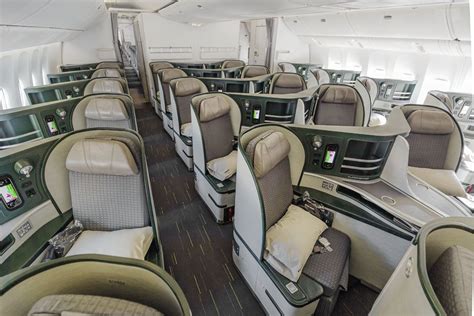
EVA Air’s Royal Laurel completes the group with a business class product that emphasizes consistency and balance. Based at Taipei Taoyuan International Airport, the Star Alliance carrier has built a strong reputation among long-haul travelers for delivering a polished premium experience across its international network.
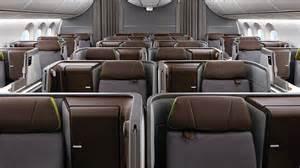
One of the most important characteristics of Royal Laurel is its 1-2-1 seating configuration, giving every passenger direct access to the aisle. This has become one of the defining standards of modern international business class because passengers no longer have to climb over a neighbor when they want to leave their seat.
The seats convert into fully flat beds and provide enough personal space for long-distance travel. While Royal Laurel may not generate the same immediate visual excitement as some newer enclosed suites, its appeal comes from how effectively the different elements work together.
EVA Air has developed a particularly strong reputation for clean cabins, careful maintenance, attentive service, and dependable execution. These characteristics can be easy to overlook when airlines advertise premium cabins because glamorous design tends to receive more attention than operational consistency.
Yet consistency matters enormously on transpacific flights. Travelers often book business class specifically because they want to remove uncertainty from an exhausting journey. A clean aircraft, comfortable seat, reliable service, good food, and predictable sleeping environment can be more valuable than one extraordinary feature surrounded by weaker elements.
Dining is another area in which EVA Air performs strongly. Royal Laurel meals commonly combine Asian and international influences, giving passengers a broad selection while maintaining the carrier’s distinctive identity. Presentation and preparation are treated as meaningful components of the premium experience rather than an afterthought.
The result is a business class product that feels balanced, dependable, and mature. EVA Air may not always be the airline with the most dramatic suite, but travelers who prioritize reliability can find considerable value in Royal Laurel.
Which Business Class Seat Is Best for Transpacific Flights?
Choosing the best business class seat ultimately depends on what matters most during the journey. ANA The Room is arguably the standout choice for passengers who place maximum importance on width and personal space. Its unusually broad design changes the way passengers can use the seat throughout a long flight.
Singapore Airlines is particularly compelling for travelers seeking a complete premium experience, combining a spacious seat and privacy with consistently strong service and dining. Its strength is the integration of multiple elements rather than dependence on a single feature.
Cathay Pacific’s Aria Suite appeals to passengers who want a contemporary enclosed environment with impressive technology. Its large 4K screen, Bluetooth capability, wireless charging, and privacy door make it particularly attractive to travelers who expect modern conveniences throughout a long flight.
Japan Airlines Sky Suite takes the practical route. It focuses strongly on sleep, bedding, privacy, and refined service, making it an excellent option for travelers who view business class primarily as a way to arrive rested.
Meanwhile, EVA Air Royal Laurel is perhaps the most convincing choice for passengers who value consistency above all else. Its direct aisle access, flat-bed seating, attentive service, clean cabins, and strong catering create a dependable premium package.
The important point is that transpacific business class is no longer defined by simply having more legroom and a reclining seat. At twelve, fourteen, or even more hours in the air, passengers experience every strength and weakness of the cabin. Seat width, privacy, bed quality, bedding, storage, entertainment, food, and service all become part of the equation.
That is why these five airlines remain so compelling. Each recognizes that a long Pacific crossing requires more than luxury in the conventional sense. It requires an environment in which a passenger can genuinely live comfortably for an entire day in the sky.
As airlines continue introducing enclosed suites, larger screens, improved bedding, smarter storage, and increasingly sophisticated cabin layouts, competition in transpacific business class will only become more intense. For travelers, that competition is excellent news. The modern business class cabin is no longer simply a better seat; on the best airlines, it has become a carefully engineered private space designed to make one of aviation’s longest journeys feel substantially shorter.