The Boeing 787-9 is celebrated for long-haul efficiency, but step through the boarding door of two different Dreamliners and you may wonder whether they belong to the same aircraft family. Behind identical fuselage shapes sit cabins that range from conventional staggered pods to sealed suites with sliding doors, and the gulf between them can shape an entire journey. The aircraft model alone reveals remarkably little about what awaits onboard, which is why savvy travelers now scrutinize fleet configurations as closely as departure times. Some airlines have gone further than others in dedicating scarce cabin real estate to business class, producing Dreamliners where premium demand, not seat count, drives the blueprint. The five carriers below each operate Boeing 787-9s with at least 40 business class seats, yet their layouts, seating products, and premium philosophies diverge sharply.
The order follows business class seat counts, but raw figures only begin the story. Cabin density, direct aisle access, suite doors, bed lengths, and the share of total capacity surrendered to premium cabins all determine whether a 787-9 feels like an efficient long-hauler or a flying premium lounge. One configuration near the top of this list raises a pointed question about how much of a Dreamliner’s cabin an airline is genuinely prepared to hand over to its most valuable passengers.
Qantas’ 787-9: 42 Business Seats Built for the Longest Flights
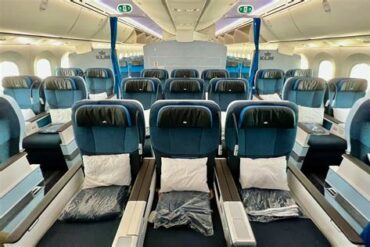
Qantas operates a 236-seat 787-9 with 42 business seats in a 1-2-1 layout, each granting direct aisle access alongside 28 premium economy and 166 economy seats. The first aircraft arrived in October 2017, and the seat is the Thompson Aero Vantage XL, an evolution of the suite Qantas already flew on its Airbus A330s. The 42 seats split between a 30-seat forward cabin and a 12-seat secondary cabin, separated by a galley and lavatories, giving the main cabin genuine exclusivity while keeping a smaller forward zone for higher-tier frequent flyers.
Business class accounts for roughly 18% of total capacity, a modest share compared with the configurations later in this countdown. The 787-9’s range allows Qantas to operate long-haul routes directly from Australia rather than leaning heavily on hubs such as Singapore and Hong Kong, and the aircraft lets the carrier match capacity to demand without filling an Airbus A380. On routes where a jet sells so few seats, that flexibility matters enormously.
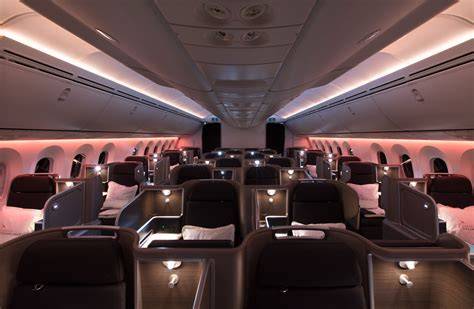
Qantas is not standing still. The airline has advertised an evolved suite with a sliding privacy door for new 787-9 deliveries from fiscal year 2028, a significant change given that today’s suites have no doors. For now, 42 seats remain enough to make the aircraft a serious long-haul proposition, though the next carrier pushes the premium investment considerably further.
ANA’s 787-9 With The Room FX: 48 Business Seats, Sofa by Day and Bed by Night
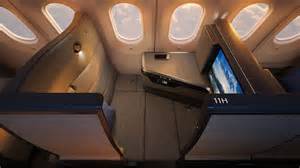
All Nippon Airways flies a 206-seat 787-9 layout carrying 48 business seats in The Room FX, a product that alternates between forward- and rear-facing positions. Each seat is self-contained with a door and a 24-inch 4K monitor, and ANA describes it as the largest business class seat for a mid-sized aircraft, developed with Safran Seats and Acumen. Pre-reclining creates a sofa-like position by day, while adjustable leg rests convert the space into a bed by night. The 48 pods split into forward and rear cabins of six rows each, a symmetrical arrangement that keeps the premium zones balanced.
The dimensions explain the attention. Reported figures put bed length at 76.5 inches and waist width at 27 inches, while the sofa end measures 41.5 inches wide. In effect, the seat delivers more living space without adding weight, a clever trade for a mid-sized jet. Business class accounts for roughly 23% of the 206 seats, and ANA plans a gradual rollout from 2026 on major long-haul routes.
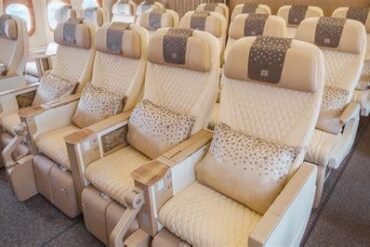
There is a critical catch: not every ANA 787-9 has The Room FX. The carrier’s 215-seat and 246-seat 787-9s use the Business Staggered seat, which also gives every passenger direct aisle access. Because ANA lists each option by aircraft layout, identifying yours takes a minute, and checking the seat map before booking is essential when configurations change the entire experience.
American Airlines’ 787-9P: 51 Business Seats With a Door on Every Suite
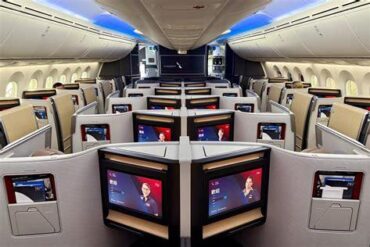
American Airlines’ premium-heavy 787-9P carries 51 business seats, comprising eight Flagship Suite Preferred seats and 43 standard Flagship Suites, all fitted with doors. The eight Preferred seats occupy the front row of each of the two business cabins, while pitch measures 42 inches at the windows and 44 inches in the center for an efficient arrangement. Preferred suites offer up to 19% more bed space and 42% more living area, and the whole aircraft seats 244, making business class about 21% of the cabin.
The forward mini-cabin delivers the most exclusivity, and the 787-9P also adds 32 premium economy seats, so the premium cabins together hold 83 seats. Entertainment screens measure 17.5 inches, competitive with other US carriers, and every seat offers wireless charging. The first 787-9P entered service in spring 2025 on transatlantic routes from Chicago and Philadelphia, with 30 scheduled in total. Beware the contrast: American also flies a 285-seat 787-9 with only 30 business seats, a very different proposition from this Flagship-heavy Dreamliner.
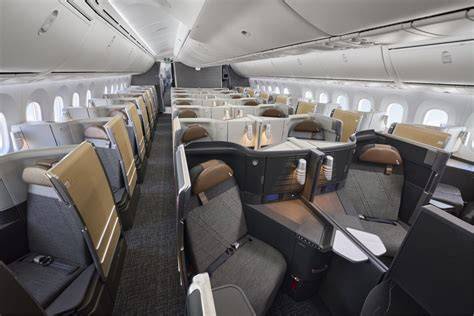
Japan Airlines’ 787-9: Up to 52 Business Seats and a Clever Geometry Trick
Japan Airlines flies two versions of the 787-9 with more than 40 business seats. Its 203-seat layout carries 52 Sky Suite III seats, a reverse-herringbone design in 1-2-1 where every seat angles toward the window with direct aisle access, up from the previous 44 business seats. The cabin splits into 28 seats in rows 1 through 7 and 24 seats in rows 8 through 13, and the bed measures about 78 inches. The design first appeared on JAL’s Boeing 777-200ER in mid-2016 before moving to the 787-9 in 2017.
Business class takes up roughly 26% of the 203 seats, a huge share for a Dreamliner and a reason corporate travelers pay close attention. The denser layout let JAL answer strong corporate demand while keeping lie-flat comfort. The older 195-seat layout offers 44 original Sky Suite seats in a 2-2-2 arrangement, where window seats are staggered so every passenger can still reach the aisle, with each seat about 20.5 inches wide. Both versions carry 35 premium economy seats, so the difference is felt up front. JAL also flies a third 787-9 layout with fewer business seats that does not qualify.
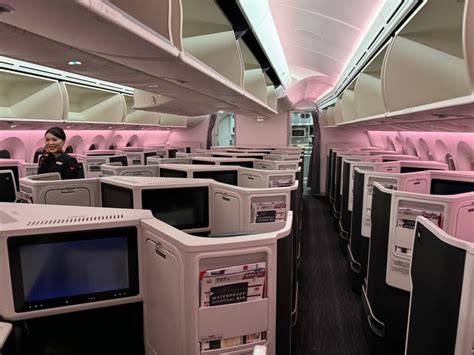
United Airlines’ Elevated 787-9: 64 Business Seats, the Most Premium-Heavy Dreamliner in America
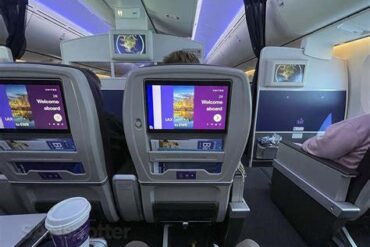
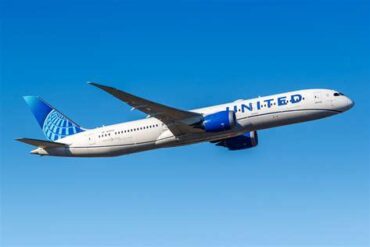
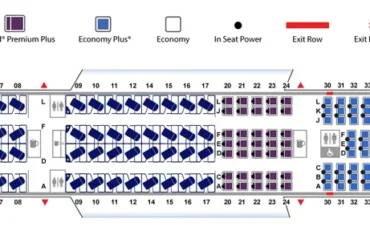
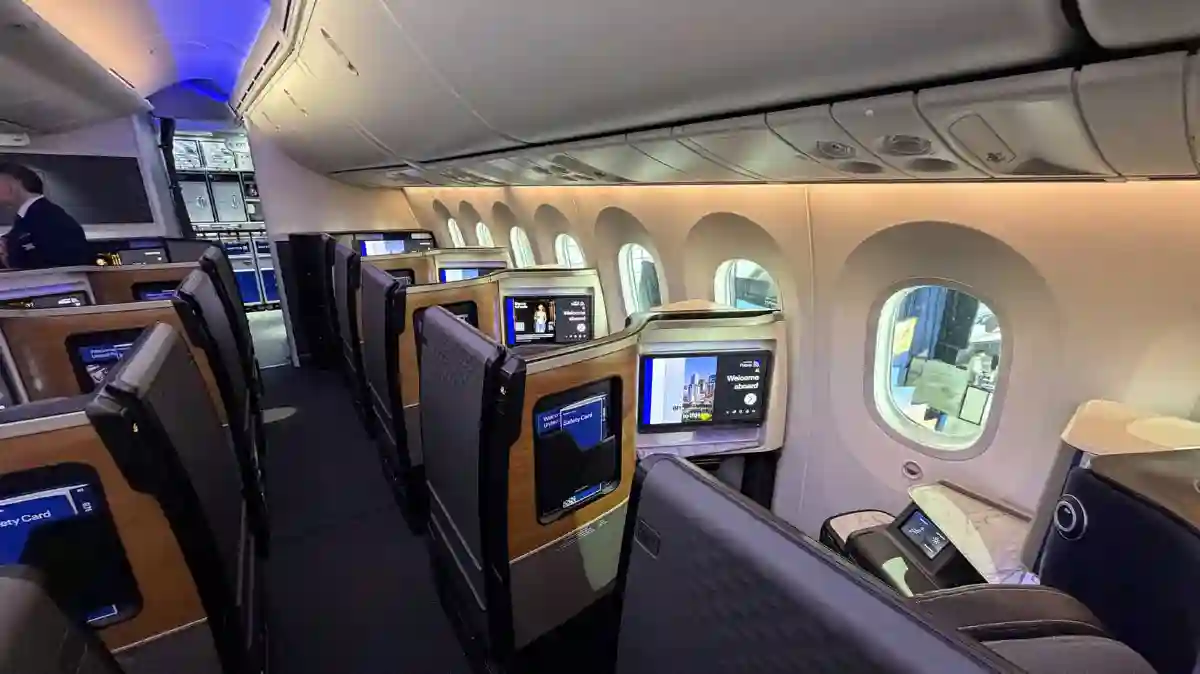
United Airlines’ newest 787-9s carry just 222 seats, and 64 of them are Polaris business suites in a 1-2-1 layout across 16 rows. Eight are larger Polaris Studio suites at the front of the business cabin, each roughly 25% larger than a standard Polaris seat, with a sliding door and a 27-inch 4K OLED screen. The studios add a companion ottoman for dining with a guest plus wireless charging, details that nudge the product toward first class. Business class alone accounts for nearly 29% of the cabin.
Add 35 Premium Plus seats, which now have privacy dividers, reading lights, and 16-inch 4K OLED screens, plus 123 economy seats, and 99 of the 222 seats are premium — the highest percentage among US carriers. The Elevated configuration departs sharply from United’s conventional 787-9. Late September 2026 counts found just 11 Elevated aircraft among United’s 59 787-9s, with most still flying 48 Polaris seats. The Elevated version offers one-third more Polaris capacity than the conventional aircraft seating 257 passengers, despite carrying 35 fewer people overall.
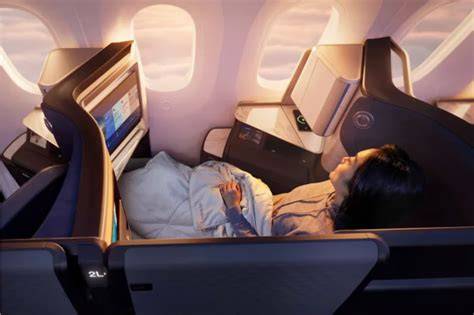
The jets entered service on April 22, 2026, between San Francisco and Singapore, and from October 24, 2026 United will base them in Houston for flights to São Paulo, Sydney, and Tokyo. United plans 33 Elevated 787-9s by 2028, making the configuration increasingly visible. With 64 business seats, including eight larger Studio suites, United tops this countdown, dedicating nearly 45% of total capacity to business and premium economy.
The distance between Qantas’ 42-seat cabin and United’s 64-seat layout is striking, and it demonstrates the flexibility of Boeing’s 787-9. The same aircraft can be configured for long-distance efficiency, distinctive private suites, or a much larger premium operation. Before booking any of them, remember the recurring lesson from all five carriers: check the aircraft configuration, because the 787-9 name alone does not guarantee the cabin you expect.
| Airline | Configuration | Business Seats | Business Share | Seat Product |
|---|---|---|---|---|
| Qantas | 787-9 | 42 | ~18% | Thompson Aero Vantage XL |
| ANA | 787-9 (206 seats) | 48 | ~23% | The Room FX |
| American Airlines | 787-9P | 51 | ~21% | Flagship Suite / Suite Preferred |
| Japan Airlines | 787-9 (203 seats) | 52 | ~26% | Sky Suite III |
| United Airlines | Elevated 787-9 | 64 | ~29% | Polaris / Polaris Studio |