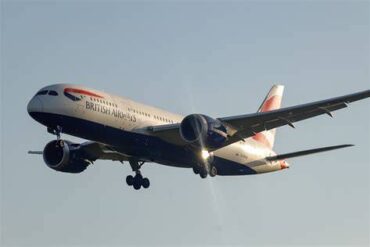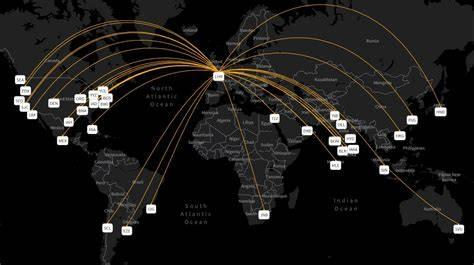
British Airways has quietly reshaped one of the most recognizable fleets at London Heathrow Airport (LHR), pulling the Boeing 787 Dreamliner from six routes from the UK’s busiest hub during 2026. Every one of the carrier’s 787s is currently deployed from Heathrow, although the largest 787-10 variant will eventually migrate to London Gatwick, so the route changes reflect fleet planning as much as network ambition. Five of the six markets lost their Dreamliners across March, April and October 2026, with a sixth, Newark Liberty International Airport (EWR), set to lose the type in late November.
Few airlines fly all three Dreamliner variants, but British Airways is one of them. Ch-aviation data shows 43 examples in the fleet: 18 787-9s configured for 215 and 216 seats, 13 787-10s at 256 seats, and 12 787-8s at 204 seats. The smallest variant, with its relatively modest seat count and less premium-heavy layout, is expected to play an important role in growing the airline’s future US network to smaller cities. That strategic logic helps explain why the short-fuselage 787-8 has been shuffled off mature trunk routes and onto a different kind of mission.
The Five Routes That Have Already Lost the 787
Comparing the Dreamliner’s Heathrow network from January to October 2026 with what is scheduled from November 2026 onwards reveals five routes where the type has stopped appearing. Three simply switched to other equipment, one market was suspended, and another has ended completely.
The first to go was Abu Dhabi, which lost its 787-8 and 787-9 service on March 18, 2026. No replacement aircraft has been scheduled because the route is currently suspended. It is theoretically set to return next winter, though that remains uncertain, and British Airways’ schedule currently extends to October 31, 2027 with no sign of Abu Dhabi reappearing. The second was Jeddah, which saw its last 787-8 and 787-9 flights on April 24, 2026; that market has now ended outright rather than being upgauged.
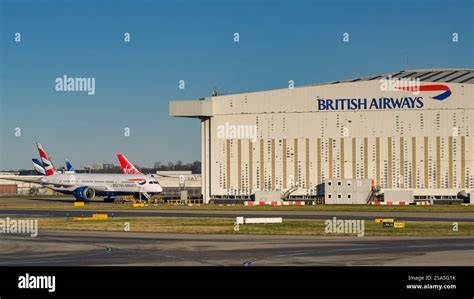
Then came a same-day trio of changes on October 24, 2026. Austin, previously served by the 787-8 and 787-9, moved to the A350-1000 with a 777-200ER joining from March 2027. Las Vegas, a 787-9 market, gained the A350-1000, the 777-200ER from March 2027, and the 777-300ER between January and March 2027. Vancouver, also flown by the 787-8 and 787-9, switched to the A350-1000, with the 777-200ER added from June 2027. In each case the Dreamliner gave way to larger, higher-capacity long-haul equipment.
Newark Loses Its 787-10 Before November Ends
Newark is the sixth market on the list, and it offers a useful case study in how fluid schedule plans can be. British Airways runs two daily flights from Heathrow to EWR, the airport that usually offers a quicker route into Manhattan than New York JFK. Until November 7, the 235-seat 777-200ER and the 256-seat 787-10 each operate daily on the pair of services.
From November 8 to 10, the 777-200ER coexists with a 258-seat 777-300ER, before the 787-10 briefly reappears between November 11 and 14. The reshuffling continues after that, with the 777-200ER as the only constant. The Dreamliner’s penultimate operation is currently listed for November 20, before the variant returns once more on November 30. No 787 flights to Newark are scheduled beyond that date, although further changes remain possible as the airline finalizes its winter and summer allocations.
Where the Dreamliners Are Flying Instead
Freed aircraft and new deliveries inevitably shift destinations, and British Airways has redeployed its 787s decisively. The airline began flying the Dreamliner on the very short Heathrow-to-Madrid service in late October 2026, primarily to carry freight as part of its partnership with Iberia on South American connections. The same month brought new 787 routes to San Jose, Costa Rica and Tampa, alongside a return to Johannesburg, where the equipment had last been used in March 2024.
The most significant addition is the 787-9 flying to Melbourne via Kuala Lumpur from January 2027, operated daily. That long, thin pairing of a Southeast Asian connection with an Australian endpoint is exactly the kind of mission where the Dreamliner’s economics shine, and it demonstrates that routes lost at Heathrow are being balanced by ambition elsewhere in the network.
Forty-Six Destinations Still See Heathrow Dreamliners
Narrowing the focus to December 2026 through October 2027 shows that British Airways’ 787s remain scheduled from Heathrow to 46 destinations, though some appear only at certain points in the period. Examples include 787-9 service to Doha, a route operated in partnership with Qatar Airways, at the end of October 2027, and just six departures to Nashville in March 2027 using a mix of the 787-8 and 787-9.
Across the period, the Dreamliner network touches Bahrain, Baltimore, Barbados, Bengaluru, Boston, Cape Town, Chennai, Chicago, Cincinnati, Dallas, Delhi, Denver, Doha, Dubai, Houston, Hyderabad, Johannesburg, Kuala Lumpur and Lagos, alongside Madrid, Malé, Melbourne, Mexico City, Miami, Montreal, Mumbai, Nairobi, Nashville, New Orleans, New York JFK, Pittsburgh, Portland, Rio de Janeiro, Riyadh, St. Louis, San Francisco, San Jose, Santiago, Seattle, Shanghai, Singapore, Sydney, Tampa, Tokyo Haneda, Toronto and Washington Dulles. Flights to Dubai resumed on November 3.
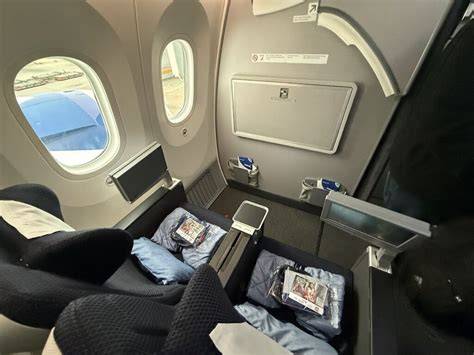
For travelers, the practical impact of these changes is straightforward: passengers booked on the affected markets should check their equipment, since the swap from Dreamliner to A350-1000 or 777 brings different cabins and seat maps. The Newark changes in particular involve three aircraft types within a single month, so itinerary checks are worthwhile before departure. British Airways’ Dreamliner story at Heathrow is not one of retreat but of repositioning, with the 787-8 increasingly pointed toward smaller US cities while its larger siblings concentrate on dense, premium-heavy and freight-friendly long-haul markets.