The Step-Over Problem That Ended the 787-9 Grid
The Boeing 787-9 arrived as a technical triumph, its composite fuselage and lower cabin altitude promising a gentler journey across long ocean sectors. Yet when passengers turned left at the door, many found a forward cabin full of seats bolted to the floor in six-abreast rows. Those 2-2-2 business class grids served airlines well for a decade, packing high yields into a narrow cross-section. Today they are being pried out, rewired, and replaced at prodigious cost, and the reason is surprisingly simple: a window passenger should never have to climb over a sleeping stranger to reach the lavatory.
That single inconvenience, known across the industry as the step-over factor, has curdled from a minor annoyance into a commercial liability. In a traditional 2-2-2 layout, anyone in a window seat whose chair lies fully flat must either vault their aisle neighbor or wait for that neighbor to wake, unfold, and shuffle aside. When a premium ticket routinely costs several thousand dollars, telling a high-yielding traveler to negotiate their escape route through someone else’s legroom has become untenable. Direct aisle access is no longer a perk quoted in a brochure; it is the bare minimum demanded by the customers who pay the bills.
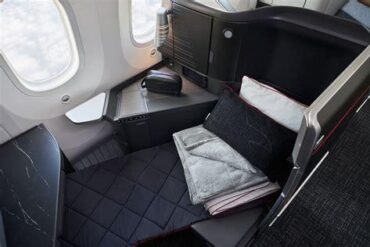
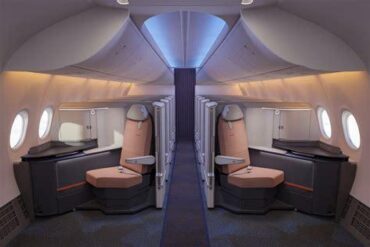
The result is a global retrofit wave. Legacy long-haul carriers are committing hundreds of millions of dollars to strip out 2-2-2 seating and install modern single-passenger suites in a 1-2-1 configuration, where every seat touches a corridor and a sliding door can seal off the outside world. What began as a gradual drift in passenger preference has hardened into a strict commercial rule: modernize the forward cabin, or watch your best clients book elsewhere.
Why Direct Aisle Access Became Non-Negotiable on Boeing 787 Flights
The psychology behind the step-over factor is easy to underestimate and expensive to ignore. A business traveler who pays for a flatbed is buying control over their own time in the air, and that control collapses the moment their seat becomes a cul-de-sac. Frequent flyers remember the layouts that trapped them, and they talk about them at the gate, in loyalty forums, and over dinner with colleagues who book the same routes. Reputation compounds in both directions, and the carriers with open-grid cabins burned through theirs quickly.
British Airways remains the clearest illustration of the correction. The airline launched its 787-9 fleet with a high-density 2-3-2 Club World layout of 42 seats, in which alternating forward and rear-facing chairs forced middle and window passengers to slide past a neighbor’s footrest on the way to the aisle. The configuration was a marvel of space efficiency and a thoroughly unlovable passenger product. British Airways has since launched a fleet-wide retrofit, replacing the old cabin with 38 Club Suites in a 1-2-1 arrangement complete with sliding privacy doors. The airline surrendered four seats in the swap and gained a product that meets contemporary long-haul expectations.
That trade, fewer chairs in exchange for undeniable comfort, is only the opening argument. Removing the step-over problem solves the most visible flaw, but it does not remove the chairs’ neighbors, their noise, or the feeling of being observed while asleep. The next campaign is about enclosure.
Privacy Doors Have Redefined What a 787-9 Business Seat Must Be
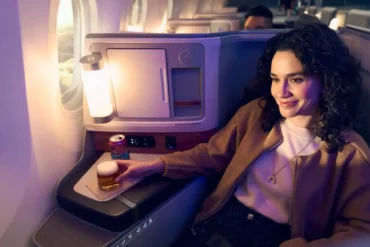
Guaranteed direct aisle access defined the benchmarks of the 2010s. Sliding doors define the standard of the current decade. Airlines operating the 787-9 are no longer upgrading merely to acquire corridor access; they are retrofitting existing 1-2-1 cabins to install doors, because premium travelers increasingly regard a fully enclosed suite as the price of a restful crossing.
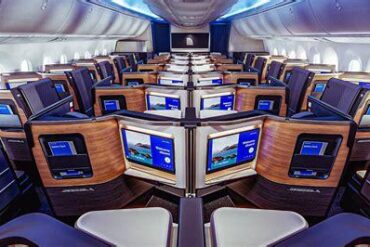
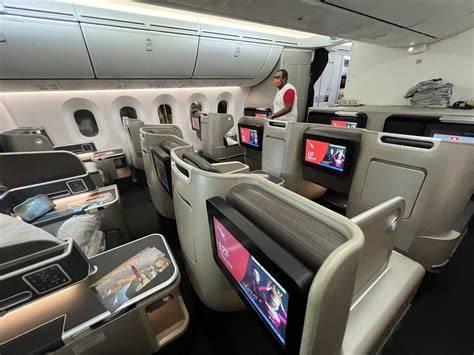
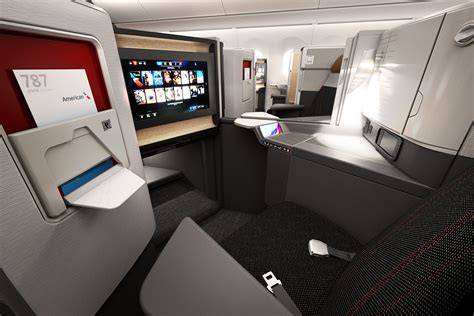
United Airlines configured its premium 787-9 fleet with 64 Polaris suites in a 1-2-1 layout. American Airlines introduced its Flagship Suite product, offering 51 suites with privacy doors on new deliveries. Qantas uses a 42-seat 1-2-1 business suite arrangement on its 787-9s, tuned for direct aisle access and strong side-wall privacy. The message across North America and Asia-Pacific is consistent: a seat without a door now reads as a seat from the past.
How Air India and LATAM Are Funding the 787-9 Cabin Retrofit
Cabin overhauls this size are not cosmetic refreshes; they are billion-dollar commitments that expose how badly carriers want to defend premium revenue. Air India launched a $400 million multi-year fleet retrofit program that strips dated 2-2-2 seats out of its 787-8 and 787-9 jets and installs 1-2-1 direct-aisle business suites alongside dedicated premium economy cabins. For an airline rebuilding its international reputation, the retrofit is the argument itself.
LATAM Airlines has committed a $360 million cabin redesign across its 787 fleet, swapping 2-2-2 frames for staggered 1-2-1 Recaro R7 suites. The target is high-yield transcontinental traffic linking South America with Europe and North America, a market where a single lost corporate account can erase the savings of a denser cabin many times over. The retrofit is aimed squarely at capturing that traffic rather than merely keeping it on existing routes.
To offset the floor space surrendered in business class, airlines have leaned hard on premium economy. Installed in a 2-3-2 layout on the 787, premium economy generates exceptionally strong revenue per square foot by capturing budget-conscious corporate travelers and premium leisure flyers unwilling to pay full business fares. The dual-cabin strategy lets carriers shrink the forward section without losing total revenue, converting an apparent loss of seats into a smarter product mix.
Do 1-2-1 Retrofits Actually Cut Business Class Seat Count?
Enthusiasts often assume that moving from a 2-2-2 grid to a 1-2-1 layout shrinks the seat count. Sometimes it does, as British Airways demonstrated. But modern seat geometry lets engineering teams hold or even expand density through overlapping footwells and angled bodies. Density and comfort are not simple opposites; they are a design equation.
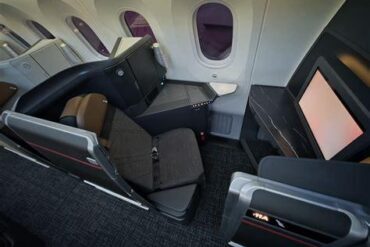
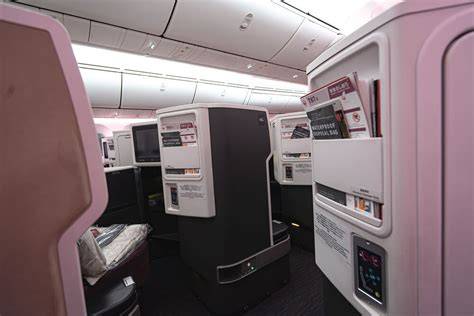
Japan Airlines offers the proof. Its initial 787-9 international fleet carried 44 Sky Suite I seats in a 2-2-2 configuration, using an Apex Suites layout that gave every passenger direct aisle access through a narrow private corridor. When JAL introduced its higher-density 203-seat 787-9 variant, it replaced that setup with 52 Sky Suite III reverse herringbone suites in a 1-2-1 grid. By angling seats toward the windows and overlapping footwells beneath adjacent consoles, the airline gained eight business class seats. Corporate demand on medium and long-haul international routes could be met without adding a single square meter of floor.
The Ergonomic Trade-Offs of Fitting Four Suites Across 18 Feet
Designing a dense 1-2-1 cabin inside the 787-9 is harder than it looks because the airframe’s cabin is genuinely tighter than its rivals. The 787’s interior measures roughly 18 feet (5.49 meters) across, about 1 foot 3 inches (38 cm) narrower than a 777-300ER and roughly 5 inches (13 cm) narrower than an A350. Fitting four individual suites across that cross-section forces manufacturers to compress armrests, mechanical hardware, and foot cubbies into a confined envelope, often producing narrower hip room and tapered footwells.
Passenger reviews capture the cost. JAL’s older 2-2-2 Apex Suites offered a wide open bed with unrestricted leg clearance, while its 1-2-1 Sky Suite III has narrower hip space and a tapered foot cubby that taller flyers find restrictive when fully reclined on a 78-inch (198 cm) flatbed. The lesson is that aisle access and privacy can squeeze the oldest and most intuitive comfort measure of all: the width of the bed at the body’s widest point. Carriers who ignore that will find their suites photographed and dissected online within weeks of launch.
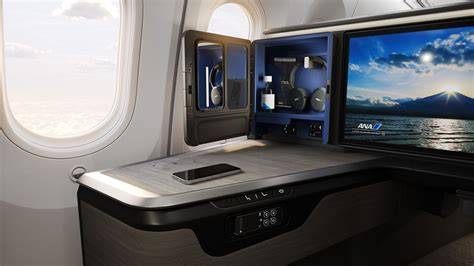
ANA THE Room FX and the Fixed-Shell Solution
The next leap in 787-9 premium cabins comes from trying to solve the width problem outright. ANA’s THE Room FX, developed with Safran Seats for its 787-9 fleet, uses alternating forward and rear-facing positions in a one-two-one layout, expanding seat width to 41.5 inches (105 cm) at its widest while incorporating sliding privacy doors. The clever part is structural: a fixed sofa shell replaces complex heavy recline tracks, simplifying the seat while expanding usable girth.
The engineering logic is worth studying because it reframes the whole cabin conversation. The 787-9 is narrow, immutable, and already flying. Every improvement in suite size must therefore come from smarter use of the same box, either by removing mechanical bulk or by exploiting asymmetry between forward and rear-facing seats. ANA shows that direct aisle access was merely step one. Sealed enclosures and generous shoulder room are now the competitive baseline, and anything less reads as a compromise in a market where luxury is compared side by side.
What Privacy Doors Cost in Weight and Maintenance
Doors are not free. Each mechanical sliding door adds roughly 10 to 15 pounds (4.5 to 6.8 kg) per suite in structural weight, which is multiplied across dozens of seats and then amplified by fuel burn over a 15-hour sector. Door tracks and latching mechanisms are additional maintenance points that require regular inspection to satisfy aviation safety regulators. Airlines buying dozens of suites must weigh passenger delight, brand perception, and corporate contracts against kilograms and engineering hours, and the calculation rarely produces a clean answer.
Corporate Travel Policies Are Redrawing Route Economics
Procurement contracts have quietly become the most powerful engine of this retrofit wave. Corporate travel managers now specify direct aisle access and personal privacy as non-negotiable criteria in preferred carrier agreements, often before they discuss schedules or loyalty perks. Airlines that keep older 2-2-2 layouts suffer a measurable yield penalty as high-spending clients shift volume to competitors that offer individual aisles on the same routes or to alternative routings entirely.
The mechanism is straightforward. A procurement officer negotiating a multi-million-dollar contract can simply demand a verified lie-flat bed with a door and a corridor, because rivals will supply one. Failing to meet that standard removes carriers from shortlists, and shortlists are where revenue is won. The Air India and LATAM investments, the British Airways retrofit, and the widespread adoption of enclosed suites by United, American, Qantas, and Japan Airlines all point to the same conclusion: premium hardware is now the qualification to compete rather than the differentiator that wins the business.
Six-Abreast Business Class and the Road to Final Obsolescence
Over the next 12 to 24 months, complete fleet retrofits will further standardize the 1-2-1 landscape. Air India’s program and LOT Polish Airlines’ installation of new Recaro CL6720 suites across its Dreamliner fleet suggest that six-abreast business class will virtually disappear from main-line transcontinental operations. Operators that fail to finish these retrofits risk losing corporate market share to competitors selling fully enclosed suites, and the cost of catching up later will not shrink.
The competitive focus is shifting from aisle access to spatial optimization within the 787’s 18-foot (5.49-meter) fuselage. Seat manufacturers will keep refining composite materials to shed door weight while maximizing bed width and footwell space, and airlines will keep experimenting with fixed shells, staggered geometry, and asymmetric rows. The carriers that balance passenger comfort, cabin density, and weight efficiency most skillfully will define the next decade of premium air travel. The 787-9’s forward cabin has been reinvented once already, and the doors, once installed, are not coming off.