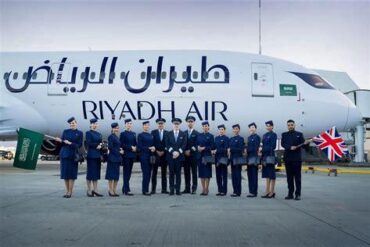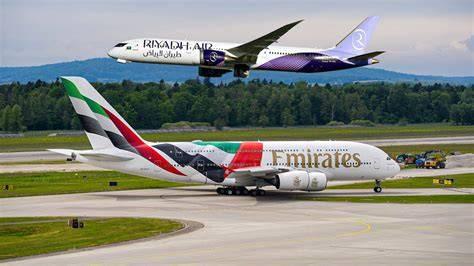
The skies over the Arabian Peninsula have never carried more money, more ambition, or more nervous incumbents. Saudi Arabia’s Riyadh Air has crossed the threshold from blueprint to boarding pass, opening public ticket sales and scheduling commercial routes that funnel premium traffic through King Khalid International Airport (RUH) rather than Dubai. Backed by the Public Investment Fund and shielded by the Saudi National Aviation Strategy, the newcomer is scaling with a financial safety net no previous challenger has ever enjoyed, aiming at more than 100 destinations by 2030. Dubai’s Emirates posted a record annual profit of AED 22.8 billion ($6.2 billion) for the fiscal year ending March 31, 2026, and instead of slashing fares, it is deploying $2 billion to build a luxury moat so deep that capital alone cannot cross it.
The Geopolitical Stakes Behind the Dubai–Riyadh Rivalry
This is not a conventional corporate scrap over market share. For more than two decades, Dubai has operated as the undisputed crossroads of the world, using its hub-and-spoke architecture to capture the high-yield traffic moving between Europe, Asia, and Africa. That entire business model depends on connecting passengers, and every traveler who chooses a layover in Riyadh instead of Dubai chips away at the sum. Riyadh Air’s early emphasis on high-profile sectors, including London Heathrow Airport (LHR) and Manchester Airport (MAN), reads as a deliberate attempt to redirect lucrative passenger streams through Saudi airspace. Emirates cannot answer that with discounts, because discounting would erode the premium brand equity it spent three decades building. Its countermeasure is a rapid, visible upgrade of the passenger experience that turns the Saudi upstart into a moving target, forcing Riyadh Air to match a product that keeps improving before its first planes have even lost their factory sheen. While a new airline can write spectacular orders, it cannot instantly manufacture brand recognition, decades of frequent flyer loyalty, or the institutional muscle that comes from operating one of the world’s largest long-haul networks through every oil shock, pandemic, and airspace closure.
Rebuilding 219 Widebodies From the Inside Out
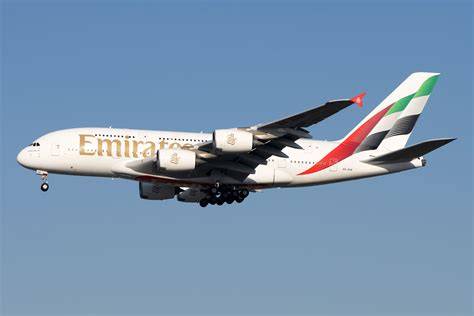
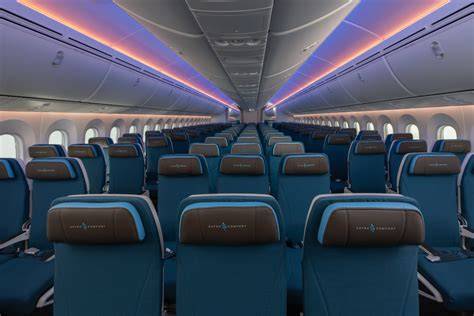
Emirates’ defensive strategy rests on a hyper-accelerated interior modernization program that strips down and rebuilds 219 widebody aircraft, split between its flagship Airbus A380 double-deckers and its workhorse Boeing 777 fleet. Every seat, carpet, and bulkhead panel is removed to install standard-setting configurations that hold consistency across all major long-haul corridors. The centerpiece of this hard-product overhaul is the widespread rollout of premium economy, a mid-tier cabin inserted into routes historically locked into a binary business-and-economy layout. That single move captures the growing bloc of high-yield leisure travelers who want upgraded comfort without paying for a full flat bed, a segment where Riyadh Air has already pre-positioned itself with a four-class layout from day one aboard its incoming Boeing 787-9 aircraft. The economics favor the incumbent in ways that are easy to overlook. Emirates spreads its capital across an immense active fleet, keeping unit costs manageable, and it refreshes aircraft it already owns rather than waiting in a delivery queue. If aircraft delivery delays continue to plague manufacturers into late 2026, Emirates’ ability to upgrade its flying fleet while its rival waits for new frames becomes a quiet but decisive tactical advantage.
Soft Product as the Real Battleground
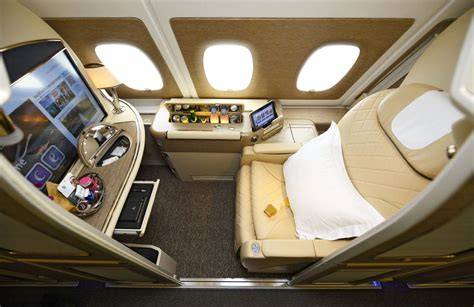
Seats establish the baseline, but the sensory texture of a flight is where premium travelers form their allegiances. Emirates has channeled a substantial share of its investment into touchpoints passengers can touch, smell, and taste, and the clearest expression is the rollout of the 18th iteration of its Bvlgari amenity kits. Appearing on select long-haul routes through the year, the redesigned kits are customized by gender and cabin class to mirror the warm tones of the retrofitted cabins. First class female passengers receive exclusive 30-milliliter bottles of Le Gemme Sahare Eau de Parfum, a high-perfumery fragrance inspired by desert landscapes and built around notes of ambergris and Taif rose. These are retention tools disguised as indulgences, designed to keep elite flyers from sampling the freshness of a new competitor. Emirates pairs this opulence with recycled fabrics and eco-friendly kraft paper packaging, answering modern sustainability expectations without sacrificing an ounce of the indulgence that built its reputation.

The Ground Race for Premium Transit Dominance
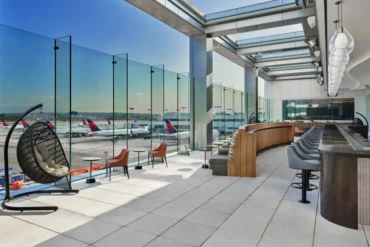
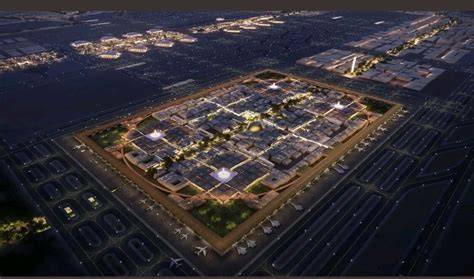
An elite cabin loses its advantage if the journey on the ground fails to match it. Emirates currently defends its title with a proven multi-concourse operation at Dubai International Airport (DXB) while preparing a long-term transition to a massive multibillion-dollar expansion at Al Maktoum International (DWC). Saudi Arabia is answering with the brand-new King Salman International Airport in Riyadh, designed to handle 120 million passengers annually by the end of the decade, a sovereign-wealth-backed mega-hub aimed squarely at Dubai’s hub monopoly. Winning high-yield business travelers comes down to eliminating friction through private terminal entrances, dedicated customs lanes, and ultra-luxury lounges, and Emirates has spent three decades refining that ground-handling ecosystem. Riyadh Air must construct these premium environments from a blank slate, which makes its airport layout a critical part of its market entry rather than a background detail.
Why Unlimited Capital Cannot Buy a Network
Riyadh Air enjoys backing few startups could dream of, but capital does not automatically convert into a functioning global network. A clean-sheet design lets a new carrier install 15.6-inch 4K OLED screens and four dedicated USB-C ports at every seat without dismantling legacy systems, yet it still lacks the scheduling density that makes an airline genuinely convenient. Emirates operates a mature hub that processes millions of transit passengers seamlessly across six continents, creating a connectivity advantage that would take a startup years and enormous capital to replicate. High-spending corporate travelers and frequent flyers do not switch alliances based on seat width or screen resolution. The ultimate luxury in modern aviation is time, dictated by flight frequency and minimal layover windows, and that is precisely the fortress a mature hub provides. Money can buy aircraft, terminals, and technology, but it cannot immediately purchase the habit of choosing Dubai as the natural place to change planes.
What This Rivalry Means for the Next Golden Era
The collision between these two Middle Eastern titans is already reshaping the global aviation landscape. Billions are flowing into hardware and cabin refinement, and the baseline expectation for long-haul comfort is shifting permanently upward, forcing carriers far outside the region to adapt or risk becoming obsolete. For everyday travelers, the most meaningful consequence is the maturation of premium economy from an afterthought into a legitimate upscale tier offering genuine luxury elements at a fraction of a flat-bed fare. The geopolitical push to turn the region into a premier global tourism and logistics axis guarantees the capacity war will only intensify. As Riyadh Air scales its widebody fleet, the battlefield will migrate beyond hardware into the digital realm, where biometrics, personalized catering, and seamless cloud-based entertainment will define the next generation of airline loyalty. Emirates is spending $2 billion to make sure that when that next generation chooses an airline, the answer remains Dubai.