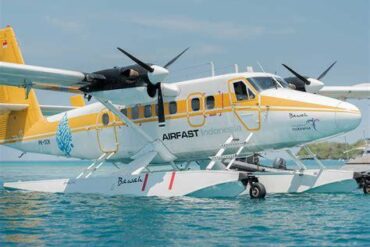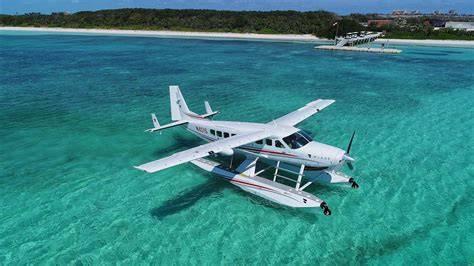
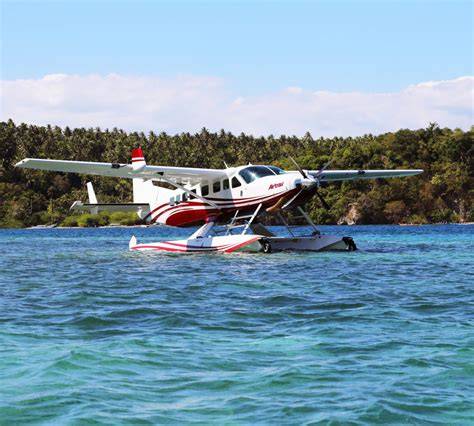
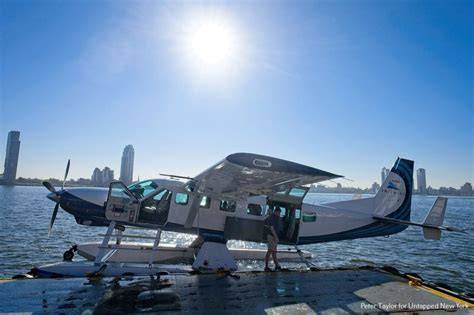
The Cessna Caravan amphibian has quietly become the workhorse of a very particular kind of travel: the kind that skips airport terminals entirely and ends at a wooden dock with salt water lapping at the floats. What separates this aircraft from almost anything else in commercial service is a deceptively simple piece of engineering. Beneath a high-wing turboprop airframe sit substantial Wipline amphibious floats fitted with retractable wheels, which means the same aircraft can take off from a paved runway, splash down on open water, and then roll up a concrete ramp without ever being lifted out of the water. That dual capability is not a novelty. It is the reason operators in the Bahamas, the Arabian Gulf, Long Island, Boston Harbor, and South Florida can sell scheduled and charter flights to places where no runway was ever built and none is likely to be.
The performance envelope supports the mission. A Pratt & Whitney Canada PT6A engine pulls the Grand Caravan along at a cruise speed of roughly 160 knots, or about 184 mph (296 km/h), while the cabin seats as many as nine passengers in air-conditioned, reasonably quiet comfort. For an archipelago scattered across shallow water, a coastal resort town, or a crowded metropolitan harbor, those numbers translate into something no regional jet can offer: direct access, door to dock, with baggage and sports gear loaded behind the passengers. The five destinations below are the routes where passengers can experience the Cessna Caravan amphibian in active service today.
The Bahamas: Dockside Access Across 700 Islands and Cays
With more than 700 islands and cays spread across turquoise shallows, the Bahamas is close to an ideal operating environment for amphibious aviation. Nassau and Freeport have long paved runways, but most of the outer islands do not, or offer strips too short and too marginal for conventional regional aircraft to use with a worthwhile payload. That gap is exactly where the Cessna Grand Caravan EX amphibian earns its keep. Tropic Ocean Airways, based in Fort Lauderdale, uses its fleet of Caravan amphibians to link South Florida directly with dockside landings across the Abacos, Harbour Island, and Bimini, turning what would be a multi-leg journey into a single water-to-water flight.
The operational difference is felt on the ground, or rather on the dock. Landing alongside a private marina removes the need for a long ground transfer or a second water taxi after touching down at a regional airport. According to operational details published by Textron Aviation, the Caravan’s short-field water performance allows it to operate out of tight cays while still carrying a full load of passengers and baggage in air-conditioned comfort. Safety practice on these routes goes beyond the regulatory minimum: federal rules permit single-pilot operations for aircraft of this size, yet Tropic Ocean Airways requires two fully qualified pilots on every flight deck, adding a layer of redundancy when coastal weather turns and marine traffic thickens.
Dubai and the United Arab Emirates: Water Runways Beneath the Skyline
Amphibious aviation in the UAE blends luxury tourism with a direct line back to the earliest days of commercial flight. Operating from Dubai Creek, the local operator Seawings flies nine-seat Cessna Caravan amphibians from the same waters where Imperial Airways Short Empire flying boats landed during regional and transatlantic mail runs in the 1930s. Reporting from Gulf News describes the operator establishing daily scheduled water links connecting Ajman’s Al Zora Marina to Dubai Creek, alongside scenic aerial excursions over Abu Dhabi.
The geography rewards the aircraft. A typical 45-minute flight lifts off from the creek’s saltwater channels and climbs toward sweeping aerial views of the Palm Jumeirah, Dubai Marina, and the Burj Khalifa, which rises to 2,717 feet (828 meters) and sits near the top of countless travel bucket lists. Analysis from the Royal Aeronautical Society points to the Caravan’s high-wing layout and large panoramic cabin windows as the reason every one of the nine passengers gets an unobstructed view, with none of the wing spar sitting in the middle of the frame. By treating the Persian Gulf as a water runway, operators deliver executive tours and inter-emirate transfers without chasing scarce runway slots at saturated hubs such as Dubai International Airport (DXB).
The Hamptons, New York: Beating the Summer Gridlock
In peak summer, the highways from New York City to Long Island’s East End turn a routine drive into a multi-hour endurance test. The alternative arrives on floats. Operators fly Cessna Grand Caravan EX amphibians point to point from Manhattan to the Hamptons, and as Business Jet Traveler has detailed, seasonal departures from East River seaplane bases such as New York Skyports (NYS) put passengers down on the waters around East Hampton or Shelter Island in roughly 35 minutes. Set that against the 2.5 to 4-plus hours a car typically needs, and the value proposition is not subtle.
The amphibious configuration is what makes the corridor work at all. The aircraft can launch from paved runways at regional airports around New York, splash down in the coastal bays of the Hamptons, or use a suburban airstrip when weather or passenger preference calls for it. A traveler can board within sight of Midtown skyscrapers and step onto a wooden dock before a car would have cleared city limits. The quiet PT6A turboprop also helps operators stay inside strict noise-abatement limits over sensitive coastal communities, a consideration that matters more with every passing summer.
Boston and Nantucket: Harbor Departures to the Offshore Islands
Connecting Boston’s business district with historic offshore islands has always meant a compromise. Traditionally, a trip to Nantucket or Martha’s Vineyard involved fighting city traffic out to Logan International Airport (BOS), or driving for hours south to Cape Cod to catch a slow passenger ferry. Operators such as Tailwind Air broke that pattern by flying amphibious Cessna Caravans straight out of Boston Harbor, a model covered in detail by Simple Flying.
The advantage of a turboprop that is equally at home on water and asphalt is that the route can be flown water-to-water, water-to-runway, or anything in between. Departing a harbor dock, a Caravan amphibian climbs over Massachusetts Bay and cruises at typical altitudes of 5,000 to 8,000 feet (1,524 to 2,438 meters) before touching down at Nantucket Memorial Airport (ACK) or directly on harbor waters in under 45 minutes. According to reporting from the Royal Aeronautical Society, regional operators have repeatedly studied extending amphibious Caravan networks into other high-density corridors, including Washington, D.C., Pittsburgh, Montreal, and Toronto. The ability to use harbor waterways cuts door-to-door transit times for executive and leisure travelers alike, which makes further expansion less a question of demand than of docking rights and local approval.
South Florida: The Global Hotbed of Amphibious Aviation
South Florida is, by most measures, the true center of gravity for amphibious flight, and the launchpad for scheduled and charter service into the Florida Keys and across the Gulf Stream. Tropic Ocean Airways runs scheduled amphibious flights from Fort Lauderdale and Miami’s Biscayne Bay to Key West, setting passengers down at resort docks or regional airport ramps. Alongside the scheduled carriers, the private charter operator flyExclusive offers dedicated amphibious Caravan flights across the region.
The fleet flying these routes is telling. The operator’s Sea Caravans are configured for eight to nine passengers on Wipline floats, departing from executive hubs such as Palm Beach International Airport (PBI) or Miami Executive Airport (TMB) and arriving alongside waterfront properties in Key West, Harbour Island, and remote private cays. Inside, a spacious leather-appointed cabin pairs with the rare ability to set down on open ocean swells or sheltered inland bays. Routine travel becomes part of the destination rather than an interval between two of them: no security queue, no cramped gate, no second water taxi. Passengers step from a marina dock into an air-conditioned cabin with panoramic windows and stay in the view until the floats settle.
Why the Caravan Amphibian Dominates These Routes
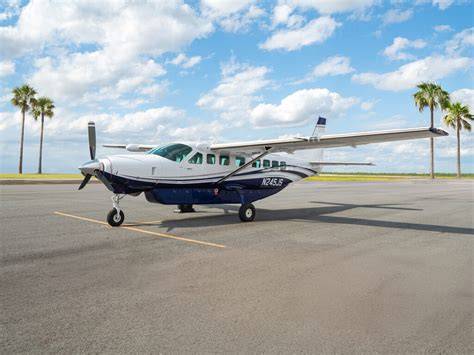
The common thread across all five destinations is geography that refuses to cooperate with conventional aviation. Islands without usable runways, coastlines where concrete cannot be laid, and city centers where the nearest airport is an hour of traffic away all create the same problem and reward the same solution. The Cessna Caravan amphibian answers it with a combination no competitor matches as cleanly: the payload and cabin space of a nine-seat turboprop, the reliability of a PT6A, and amphibious floats that treat leftover water as infrastructure. That is why the same airframe appears in the Caribbean, the Gulf, Long Island Sound, Boston Harbor, and Biscayne Bay, flown by operators large and small, on schedules that would be impossible for anything confined to a runway.