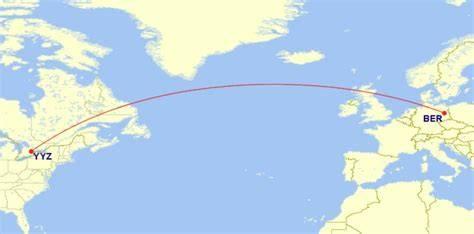
Air Transat has removed its seasonal Toronto Pearson International Airport (YYZ) to Berlin Brandenburg Airport (BER) service from the summer 2027 schedule, pulling the plug on a transatlantic route it launched only two years earlier. The Canadian leisure carrier had intended to fly the roughly nine-hour Airbus A321LR link up to three times weekly, connecting Canada’s largest city with the German capital for a third consecutive summer season. Its latest schedule filing instead erases Berlin from the network entirely, which leaves Air Transat with no destination in Germany at all and strips Toronto of the only nonstop service to Berlin. The change lands alongside the airline’s decision to open five new European routes for summer 2027 and comes as it counts down to receiving its first Airbus A321XLR, an aircraft that could reshape how far and how thinly it is willing to fly.
Air Transat Drops Berlin Just Two Years After Launch
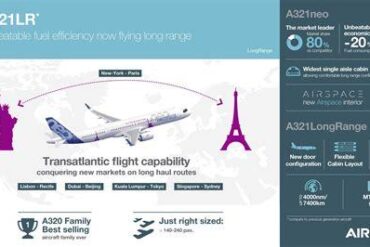
The withdrawal is a visible retreat from a market Air Transat had only recently won back. The carrier returned to Germany in June 2025 after an absence of eleven years in Berlin specifically, having previously served Frankfurt, Düsseldorf, Hamburg and Munich before discontinuing its final Frankfurt flights in 2014. Berlin was meant to anchor that comeback, and the numbers initially pointed in the right direction: scheduled departures across Toronto–Berlin doubled during 2026. According to AeroRoutes, the route was set to resume on May 1, 2027, initially twice weekly and then tripling to three weekly between June 14 and October 2, 2027. The city pair spans approximately 4,050 miles (6,520 kilometers), with a published westbound block time of eight hours and 50 minutes—close to the nine-hour benchmark that defines the outer edge of comfortable narrowbody flying. All of that flying time was allocated to the fuel-efficient A321LR, an aircraft Air Transat has leaned on heavily to make markets like Berlin economical to operate at lower frequencies.
Berlin Loses Its Toronto Nonstop But Keeps a Canadian Link
Losing the Toronto flight does not leave Berlin completely cut off from Canada. Air Canada restored nonstop service from Montréal–Trudeau International Airport (YUL) earlier this year, so the German capital retains a direct Canadian connection and German-bound travelers from Quebec still have an option. What disappears is the Toronto nonstop, and with it the only way passengers in Canada’s biggest metropolitan area could reach Berlin without a connection. For Air Transat, the bigger picture is starker: a carrier that once flew to four German cities now flies to none, and Berlin joins a growing list of European points that looked promising on paper but could not hold their place in the schedule.
The Cut Berlin Is Part of a Wider European Retreat
Berlin is not an isolated casualty. The same 2027 schedule removes Ottawa Macdonald-Cartier International Airport (YOW) to London Gatwick Airport (LGW) and Montréal to Reykjavík’s Keflavík International Airport (KEF) from the carrier’s European map. The Reykjavík service is especially telling because it only began flying in 2026, meaning Air Transat is walking away from a brand-new route after a single season. Ottawa’s Gatwick link falls away as well, leaving the Canadian capital without that particular connection. Taken together, the three cuts expose the fragility of thin transatlantic markets—routes whose demand is seasonal, concentrated, and often dependent on a small pool of visiting friends and relatives or price-sensitive leisure travelers. Even smaller aircraft with lower trip costs cannot manufacture enough year-round demand to justify a slot and a crew rotation.
Air Transat Adds Five New Narrowbody Routes for Summer 2027
The retreat from Berlin is happening at the same time as a deliberate push into different kinds of European destinations. Air Transat’s existing narrowbody footprint is already substantial: according to aviation analytics firm Cirium, 32 transatlantic routes will operate with the A321LR through October 2027, split between 19 from Montréal, 11 from Toronto, and two from Quebec City. The airline is now adding five more European services starting in June 2027. Geneva and Birmingham are entirely new destinations on the map, while Lyon, Barcelona and Faro deepen the airline’s reach from gateways where it already operates.
| New route | Launch date | Weekly flights |
|---|---|---|
| Quebec City – Lyon | June 8, 2027 | 1 |
| Quebec City – Barcelona | June 14, 2027 | 1 |
| Montreal – Faro | June 14, 2027 | 1 |
| Montreal – Geneva | June 19, 2027 | 2 |
| Toronto – Birmingham | June 22, 2027 | 2 |
The additions hinge on underserved regional markets rather than head-to-head battles at major international hubs. Barcelona–El Prat Airport (BCN) becomes Quebec City’s first nonstop Spanish destination, extending a European network from the provincial capital that already includes Paris, Marseille and Nantes. Birmingham International Airport (BHX) gives Toronto passengers a fourth UK gateway, and it also supports Air Transat’s partnership with Porter Airlines, which feeds connecting traffic from across Canada into these point-to-point services. In effect, the network is being reshaped around cities where competition is thin and the destination itself creates demand, rather than around major capitals that are already crowded with widebody capacity.

Could the A321XLR Open Truly Unusual European Routes?
The main narrative arc for Air Transat points toward the aircraft it has not yet flown. The carrier is preparing to introduce four Airbus A321XLRs leased from Air Lease Corporation, with deliveries scheduled across 2027 and 2028. The XLR offers a maximum range of roughly 4,700 nautical miles (5,400 miles; 8,700 kilometers), a 17% increase in range over Air Transat’s current narrowbodies. That matters less as a headline number than as a planning tool: the extra reach could allow the XLR to step in for larger A330s on selected routes, improving capacity flexibility in shoulder seasons and potentially stretching thin seasonal services into longer operating windows. Airbus markets the aircraft precisely this way, as a tool for opening thinner long-haul markets while avoiding the financial exposure that comes with committing widebody capacity to marginal routes.
A comparable playbook already exists. United Airlines has built a genuine narrowbody transatlantic strategy around destinations where novelty and the absence of competition make low frequencies viable. Air Transat’s existing services to Agadir, Nantes and Porto show the philosophy is already embedded in its network, just as Berlin now shows its limits. That prompts an obvious question: could future XLR destinations include Mediterranean leisure points such as Ibiza, or farther cities like Dubrovnik and Catania that sit beyond the practical reach of today’s A321LRs? No such routes have been announced, and the airline has given no signal that they are imminent. But an airline with smaller long-haul aircraft, four new XLRs arriving, and an increasingly adventurous route map has more room to experiment. The Berlin cancellation is not a retreat from Europe; it is a recalibration of where, and how often, Air Transat believes a nine-hour single-aisle flight can pay for itself.