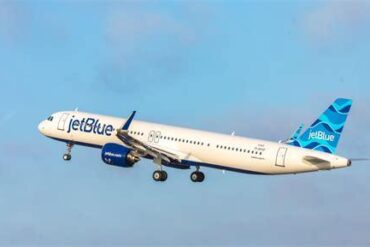
JetBlue’s transatlantic story has quietly become one of the most interesting experiments in modern commercial aviation. A decade ago, the idea that a single-aisle jet could shoulder routes stretching deep into Europe would have sounded like optimistic cocktail-napkin math. In 2026, those napkins have turned into boarding passes. The Airbus A321LR now forms the long, slender bridge between the US East Coast and some of Europe’s most in-demand cities, carrying not just passengers, but a strategy built around precision, efficiency, and a sharp understanding of how people actually travel across oceans today.
The logic behind these routes is not theatrical bravado. It is an exercise in matching aircraft capability with market reality. Many transatlantic city pairs are vibrant yet inconsistent in demand, especially outside peak summer months. Flying widebody aircraft into these markets often means carrying more seats than the route can profitably fill. The A321LR threads that needle. It offers the range to cross the Atlantic while keeping capacity tight enough to protect yields. That balance lets JetBlue schedule more frequencies, refine departure times, and stay competitive against legacy carriers that still lean heavily on larger twin-aisle jets.
The experience onboard matters just as much as the economics. JetBlue’s long-haul narrowbody service is not a stripped-down compromise. The airline has treated the A321LR as a boutique long-haul platform, pairing long legs with a premium-forward cabin design and connectivity that treats time in the air as usable time, not a digital desert. The result is a transatlantic product that feels tailored rather than improvised, and that distinction shapes how travelers perceive narrowbody long-haul flying in 2026.
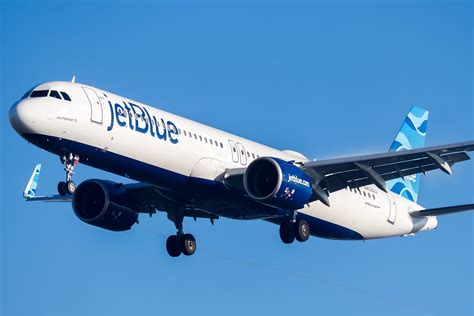
JetBlue Airbus A321LR Routes in 2026: The Longest Nonstop Links
The longest nonstop sectors in JetBlue’s 2026 network cluster around a familiar geographic spine: Boston and New York reaching deep into Western and Southern Europe. These are not experimental one-offs but dense, repeatable city pairs with proven demand in business travel, visiting friends and relatives, and premium leisure. Boston–Milan stretches close to the upper practical limits of the A321LR’s operational envelope, while Barcelona, Paris, Amsterdam, and London round out a portfolio that reads like a greatest-hits album of transatlantic demand. Each of these routes sits comfortably above 3,400 miles, long enough to stress-test aircraft performance while remaining economically rational for a narrowbody.
What makes these routes strategically potent is not simply their distance but their frequency profile. Daily and near-daily services allow JetBlue to behave like a network carrier on the Atlantic without carrying the overhead of a widebody fleet. Travelers benefit from schedule choice, which quietly changes buying behavior. When flights run often enough, passengers plan trips around convenience rather than brand loyalty alone. Over time, that habit reshapes market share.
Seasonality adds texture to this network. Routes such as Boston–Barcelona and Boston–Madrid swell in summer, driven by leisure traffic and diaspora travel, while Paris and London maintain steadier year-round demand anchored by business travel and tourism. The A321LR allows JetBlue to dial capacity up and down without the blunt instrument of aircraft swaps that often disrupt passenger experience. In winter, when headwinds lengthen westbound flights, the aircraft’s performance margins become a daily operational calculation, yet the route structure remains intact. The airplane’s range is not just a brochure number; it is a working tool that shapes scheduling decisions every week of the year.
Inside the Airbus A321LR Advantage for Transatlantic Flying
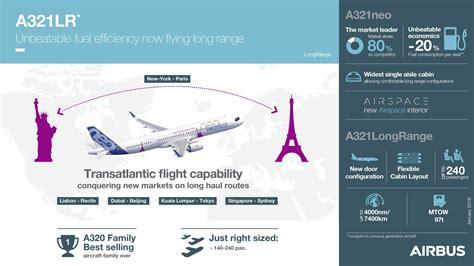
The A321LR is not a simple extension of the A321neo with more fuel in the wings. It is a carefully tuned long-range instrument. Additional center fuel tanks, aerodynamic refinements, and high-bypass turbofan engines stretch the aircraft’s reach to roughly 4,000 nautical miles while keeping fuel burn per seat sharply below that of older widebodies on comparable missions. This matters in the transatlantic environment, where margins are thin and competition is relentless. Fuel efficiency is not an abstract virtue here; it is the difference between sustaining a route year-round and retreating to seasonal service.
The design philosophy behind the A321LR leans into versatility. The cabin can be configured for premium-heavy layouts without crippling range, allowing JetBlue to install its Mint product without sacrificing operational performance. The aircraft’s lighter structure and optimized systems reduce maintenance complexity compared with larger jets, and that reliability compounds over a year of long sectors. Each saved hour of unscheduled maintenance becomes another protected departure, and consistency builds trust with passengers who choose nonstop flights precisely to avoid disruption.
There is also a psychological component to narrowbody long-haul flying that the A321LR softens. Quieter engines, refined cabin airflow, and improved pressurization profiles reduce fatigue on flights that now regularly exceed seven hours. The aircraft does not pretend to be a widebody, but it narrows the experiential gap enough that travelers judge the flight on comfort and service rather than aisle count. That subtle shift in perception is part of why narrowbody transatlantic flying has crossed from novelty into routine.
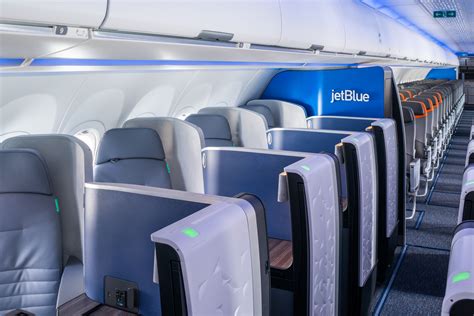
JetBlue Mint on the A321LR: Premium Comfort Without the Widebody
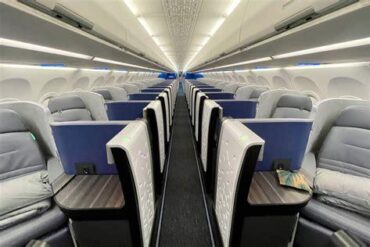
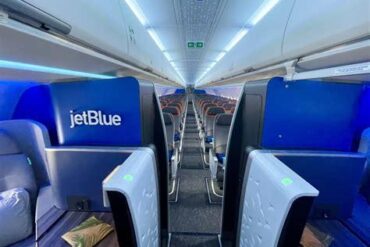
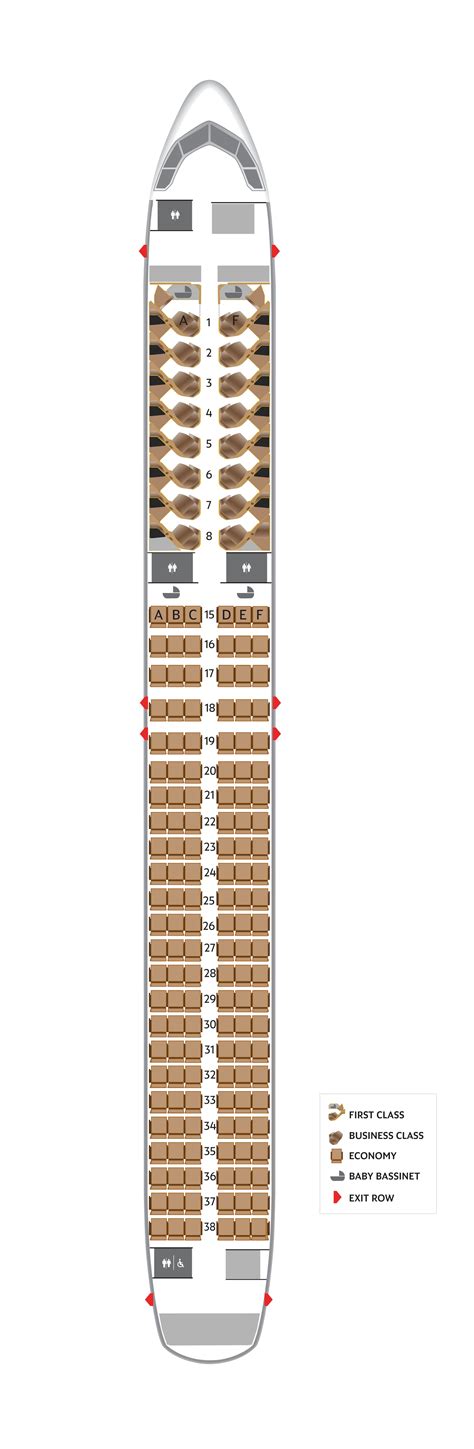
JetBlue’s Mint cabin on the A321LR is a strategic statement dressed as a seating product. Fully lie-flat suites with direct aisle access rewrite the expectations of what a narrowbody can offer on long-haul routes. The design favors privacy and personal space, acknowledging that transatlantic business travelers and premium leisure passengers increasingly value rest over spectacle. The Mint Studio seats, positioned as elevated premium options, turn the front of the aircraft into a micro-cabin that competes with the front rows of widebody business class in comfort if not in sheer floor area.
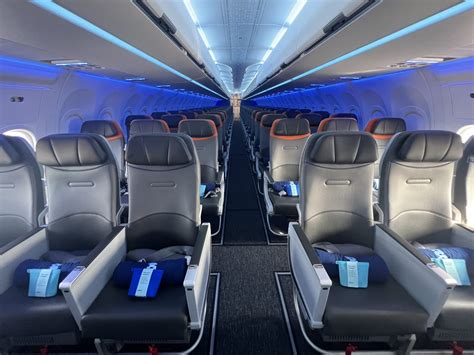
Behind Mint, the economy cabin benefits from a density strategy that resists the industry’s temptation to squeeze every inch of revenue out of the fuselage. JetBlue’s choice to carry fewer economy seats than many competitors on similar routes translates into legroom that feels generous on a seven-hour flight. That space becomes a brand signal. Passengers who disembark without feeling folded into themselves tend to remember the airline kindly, and memory shapes repeat booking behavior more than any marketing slogan.
Connectivity completes the product. Gate-to-gate high-speed WiFi and seatback entertainment turn transatlantic time into usable time. Workflows do not pause at the Atlantic shoreline, and JetBlue’s cabin experience reflects that reality. The aircraft becomes a moving office, living room, and dining nook stitched together at 35,000 feet. This is not luxury for its own sake; it is a pragmatic response to how people actually use long flights in 2026.
Boston and New York as Transatlantic Launchpads
Boston Logan International Airport and New York JFK serve as JetBlue’s twin Atlantic slingshots. Boston, with its dense academic, biotech, and tech communities, generates steady premium demand to European business centers. Milan and Paris fit neatly into that profile, while Barcelona and Madrid draw on a mix of corporate travel and leisure. The A321LR allows JetBlue to tailor service to each city’s demand curve without oversupplying seats in shoulder seasons.
New York JFK brings scale and diversity. London Heathrow and Paris Charles de Gaulle remain the heavyweight routes, where competition is fiercest and schedule frequency is a weapon. JetBlue’s decision to operate narrowbody aircraft into these hubs is not about challenging legacy carriers on raw capacity. It is about carving a niche defined by service quality, competitive pricing in premium cabins, and nonstop convenience. The A321LR’s economics make that niche sustainable. It lets JetBlue show up daily, quietly build loyalty, and expand frequencies without gambling on filling 250 seats per flight.
Fleet Strategy and the A321LR’s Place in JetBlue’s Network
JetBlue’s fleet composition in 2026 reflects a deliberate narrowing of focus. An all-Airbus narrowbody lineup simplifies training, maintenance, and scheduling while allowing the airline to deploy aircraft across domestic, Caribbean, and transatlantic routes with minimal friction. The A321LR sits at the top of this narrowbody hierarchy, handling missions that once belonged exclusively to widebodies. Its presence does not crowd out other aircraft types; it complements them. The A220 handles thinner domestic and near-international routes, while the A321neo and A321ceo fill high-density domestic corridors. Together, they form a modular network where capacity can be matched to demand with surgical precision.
This modularity changes how JetBlue thinks about growth. New European routes can be tested with lower risk, and underperforming routes can be reshaped rather than abandoned. The A321LR’s operating profile makes experimentation economically survivable. That encourages network creativity, which is rare in a transatlantic market often dominated by cautious capacity planning and alliance-driven conservatism.
Global Context: How the A321LR Is Reshaping Long-Haul Flying
JetBlue’s use of the A321LR sits within a broader industry shift. Airlines across Europe, Asia, and Central Asia have embraced long-range narrowbodies to unlock routes that sit awkwardly between regional jets and widebodies. Icelandair’s transatlantic links through Reykjavík and Air Astana’s marathon sectors into Western Europe demonstrate how the A321LR opens city pairs that were previously underserved or commercially fragile. The aircraft is not replacing widebodies on trunk routes; it is filling the negative space in global networks, stitching together demand pockets that never justified larger aircraft.
This global adoption feeds back into passenger expectations. As more travelers experience narrowbody long-haul flights that feel thoughtfully designed, the stigma attached to single-aisle aircraft on long sectors erodes. Comfort becomes a product of interior design and service philosophy rather than fuselage width alone. JetBlue’s A321LR operations benefit from this cultural shift. The airline is not asking passengers to accept a compromise; it is inviting them into a redefined version of long-haul travel.
What JetBlue’s Longest A321LR Routes Signal for 2026 and Beyond
JetBlue’s longest nonstop routes with the Airbus A321LR in 2026 are more than technical feats of range. They are signals of a deeper change in how airlines think about scale, comfort, and risk on long-haul networks. By aligning aircraft capability with route economics and cabin experience, JetBlue has built a transatlantic presence that feels intentional rather than aspirational. The A321LR enables the airline to compete on frequency and product quality instead of sheer size, and that competitive posture resonates with travelers who value time, comfort, and predictability.
The broader implication is that long-haul flying is fragmenting into finer-grained markets. Instead of funneling passengers through mega-hubs on widebodies, airlines can now stitch together direct links between cities with just enough demand to sustain regular service. This fragmentation favors carriers willing to invest in premium narrowbody products and disciplined network planning. JetBlue’s 2026 A321LR network stands as a clean example of how technology, when paired with thoughtful strategy, redraws the map without needing to shout about it.