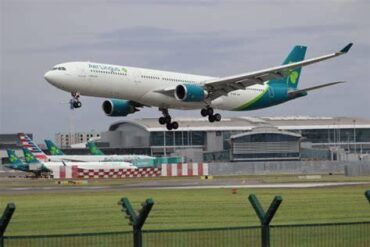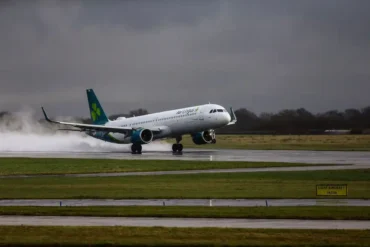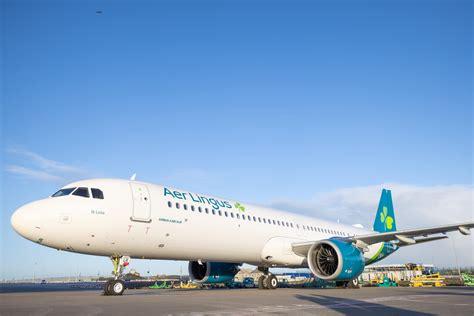
Aer Lingus is reshaping its transatlantic strategy once again, and this time Washington Dulles is at the center of the adjustment. Beginning in late May 2026, the Irish flag carrier will reduce its Airbus A321LR and A321XLR operations between Dublin and Washington Dulles from double daily to a single daily narrowbody rotation. The second daily frequency will shift to the larger Airbus A330, fundamentally altering the capacity mix on one of the airline’s key US routes.
The change is not a retreat from the Washington market. Instead, it represents a recalibration—fewer narrowbody flights but significantly more seats during the crucial summer season. From May 25 through October 24, the second daily service will be operated by an Airbus A330-200 or A330-300, boosting overall seat supply and especially premium cabin capacity.
Aer Lingus Rebalances Narrowbody And Widebody Capacity At Dulles
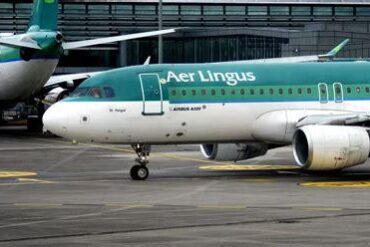
Since relaunching Dublin–Dulles service in 2015, Aer Lingus has experimented with a variety of aircraft types on the route. The Airbus A330-200 and A330-300 have both featured prominently, alongside leased Boeing 757-200 aircraft in earlier years. In 2019, the route welcomed its first Airbus narrowbody long-haul aircraft, marking a pivotal shift in fleet strategy.
From 2021 onward, narrowbodies—specifically the A321LR and, more recently, the A321XLR—have dominated operations. Both aircraft share identical seating layouts: 184 seats in total, with 16 in business class and 168 in economy. They also carry the same IATA code, 32Q, making them operationally indistinguishable in published schedules.

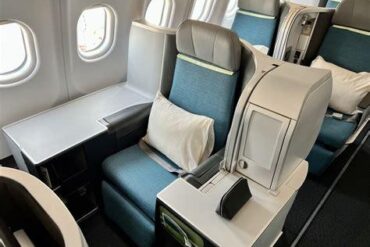
Until the latest schedule update, the plan for 2026 had been to operate the route exclusively with these 184-seat narrowbodies. That strategy has now shifted. The A330 will take over the second daily frequency on selected days throughout the summer peak, dramatically increasing seat supply. When the A330-300 is deployed, available seats on that frequency rise by more than 70% compared to the A321LR/XLR, while business class capacity nearly doubles.
Why Replace Frequency With Gauge?
On the surface, halving narrowbody frequencies may seem like a downgrade. In reality, this is a classic case of “gauge up”—using larger aircraft to move more passengers per flight rather than maintaining higher frequency with smaller jets.
US Department of Transportation data offers important context. Between November 2024 and October 2025, Aer Lingus carried 178,608 passengers on the Dublin–Dulles route. That made Washington its fourth-busiest US destination from Dublin, trailing New York JFK, Boston, and Chicago O’Hare.
However, the average load factor—meaning the percentage of seats filled—stood at 74.8%. While slightly stronger than United’s 72.5% on the same route, it was still below optimal performance for a transatlantic service. Aer Lingus’ broader US network averaged 76.4% during the same period, suggesting that Dulles was roughly in line with overall system performance but not a standout.
Seasonality played a decisive role. February 2025 saw loads slump to just 60.9%, while November 2024 recorded 63.1%. Such winter softness likely influenced the airline’s decision to adjust aircraft deployment for 2026. Rather than flying two narrowbodies year-round, consolidating frequency and boosting capacity during summer peaks allows for smarter fleet utilization.
Summer 2026 Schedule Breakdown
Under the revised schedule, one daily Airbus A321LR/XLR rotation remains consistent:
- Dublin departure: 12:35 pm, arriving Dulles at 3:45 pm
- Dulles departure: 5:15 pm, arriving Dublin at 5:15 am (+1)
The second daily frequency transitions to Airbus A330 aircraft on specific days. Thursdays and Saturdays will see A330-200 and A330-300 operations respectively, while Mondays, Wednesdays, Fridays, Sundays, and Tuesdays are scheduled for A330-300 service. Departure times vary slightly but remain in the late afternoon from Dublin and late evening from Dulles.
This structure preserves connectivity while maximizing peak-season yield opportunities. Business travelers benefit from enhanced premium cabin availability, while leisure demand during Q3—the financially vital July to September quarter—can be accommodated more efficiently.
Impact On Aer Lingus’ Broader US Network
The Dulles adjustment reduces LR/XLR departures on the route by approximately 7% week-over-week. Yet the bigger picture tells a different story. For Q3 2026, Aer Lingus plans nearly 13 daily narrowbody departures from Dublin and Shannon combined to the United States. Across July, August, and September, 14 US routes will operate using the A321LR/XLR platform.
Twelve of these routes originate in Dublin, including Boston, Cleveland, Hartford, Indianapolis, Minneapolis, Nashville, Newark, New York JFK, Philadelphia, Pittsburgh, Raleigh/Durham, and Washington Dulles. Shannon continues to support Boston and JFK.
Even with the Dulles reduction, Aer Lingus is planning 19% more US flights on the LR/XLR in Q3 2026 compared to the same period in 2025. That statistic underscores an expansionary narrowbody strategy overall. The Dulles shift appears less like contraction and more like redistribution.
Fleet Implications And The Manchester Factor
The introduction of additional A330 capacity raises a practical question: where is the widebody coming from? The likely source is the closure of Aer Lingus’ Manchester base, which has freed up long-haul aircraft capacity. Redeploying those A330 frames into the Dublin hub strengthens core transatlantic routes without requiring new deliveries.
Meanwhile, the freed-up A321LR/XLR capacity from Dulles remains an open question. Barbados is an obvious candidate, but that route is currently scheduled only through May. Another possibility is incremental growth on emerging US destinations such as Pittsburgh or Raleigh/Durham, both relatively new additions to the network.
A Strategic Bet On Profitability Over Frequency
Airline economics often reward precision rather than brute force. Running two daily narrowbodies year-round on a route averaging mid-70% load factors may dilute yields, particularly during weaker months. Consolidating to one daily narrowbody while deploying a larger aircraft during peak demand balances connectivity with revenue optimization.
Washington Dulles remains a significant gateway, particularly for political, diplomatic, and technology sector traffic. The nearly doubled business-class capacity on select days signals confidence in premium demand during summer. At the same time, maintaining a consistent narrowbody presence ensures schedule reliability and network feed.
This adjustment reflects a carrier fine-tuning its transatlantic model. Aer Lingus pioneered long-haul narrowbody operations across the Atlantic, connecting secondary US cities with Dublin efficiently. The Dulles change shows that even successful models require constant recalibration.
The result for 2026 is not a retreat from Washington but a strategic reshaping—one that trades frequency for capacity, seasonality for efficiency, and flexibility for focus.