When Boeing opened the order book for the 747-400 in October 1985, the company did something no other widebody program had attempted at that scale: it certified the same wing to carry powerplants from General Electric, Pratt & Whitney, and Rolls-Royce without a single structural compromise. Every other long-haul jet of the era arrived with one or two engine suppliers. The 747-400 shipped with three, and each one came with its own nacelle, its own pylon, its own flight-deck software, and its own multi-million-dollar flight-test campaign. That decision was not engineering vanity. It was a calculated commercial weapon aimed squarely at the airlines Boeing still needed to convert, and it reshaped how widebody sales were fought for the next two decades.
The scale of the commitment is easy to underestimate. An engine is never simply bolted to a wing. Each installation demands a bespoke nacelle that shapes the airflow entering the fan, a pylon whose stiffness and curvature must be tuned to the local wing loads, and a set of bleed-air, fuel, and thrust-reverser systems that behave differently on every engine family. Boeing then had to prove each combination safe through airworthiness certification flights that consumed months of test aircraft time and thousands of engineering hours. Multiply that across three suppliers and the bill climbs into the hundreds of millions before a single aircraft is delivered. Boeing paid it anyway, because the alternative, losing a flagship order to a competitor, cost far more.
Why Engine Loyalty Decided Who Won the Order
By the late 1980s, the world’s long-haul carriers were deeply invested in engine families, not just aircraft. An airline that had spent a decade building overhaul shops, stocking spare parts, and training mechanics on one manufacturer’s hardware did not want to discard that ecosystem for a new airframe. Offering all three engines meant that no carrier could reject the 747-400 on the grounds that it flew the wrong powerplant. British Airways, Lufthansa, and Cathay Pacific each brought different engine histories to the table, and each could order the same airframe while staying inside its existing supply chain and maintenance network.
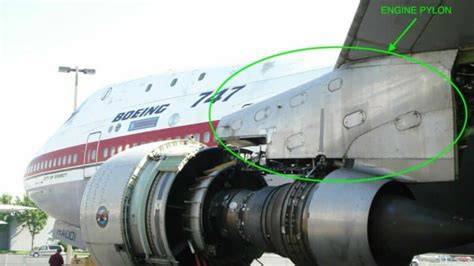
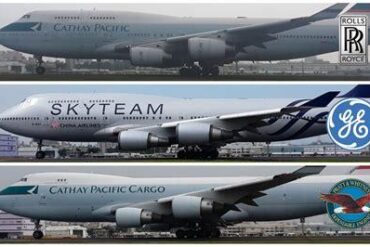
The three options were genuinely different machines. Boeing certified the aircraft with the Pratt & Whitney PW4056, the General Electric CF6-80C2B1F, and the Rolls-Royce RB211-524G/H, turbofans that delivered between roughly 56,500 lbf and 63,300 lbf of static thrust depending on the sub-variant. All three were a generation ahead of the powerplants that had pulled the original 747 into the sky, cutting fuel burn and stretching payload-range performance to a point early operators could only have imagined. For an airline weighing a 10,000-nautical-mile route network, that efficiency mattered as much as the badge on the cowling.
The Foundation Laid by the 747-100, -200, and -300
The three-engine philosophy did not begin with the 747-400. When the 747-100 entered service in 1970, it flew exclusively on Pratt & Whitney’s JT9D, a single-source arrangement that reflected the urgency of getting the giant airframe into revenue service. As international networks expanded through the 1970s, carriers running mixed fleets pushed back. Boeing listened during the development of the 747-200 and 747-300, adding General Electric’s CF6 and Rolls-Royce’s RB211 to the order sheet and proving that the wing could be adapted to accommodate rival hardware.
That earlier work mattered commercially as much as technically. An airline already flying CF6-powered Douglas DC-10s or RB211-powered Lockheed L-1011 TriStars could slot the 747-400 into its fleet without duplicating ground-support tooling, mechanic training, or spare engine inventory. The savings ran into the tens of millions over a fleet’s lifetime, and they gave Boeing a persuasive argument no rival could match: the Queen of the Skies would fit the airline you already were, not the airline the factory wanted you to become.
Two-Spool Versus Three-Spool: What Airlines Were Really Choosing
Beneath the cosmetic differences sat a genuine split in mechanical philosophy. The CF6-80C2 and PW4056 use a classic two-spool configuration, in which concentric shafts link a high-pressure turbine and compressor to their low-pressure counterparts and the fan. Fewer rotating bearings and internal seals mean a simpler overhaul path, and both engines inherited decades of proven reliability data that maintenance planners could trust. Airlines that prioritized straightforward shop visits and established procedures gravitated toward this architecture.
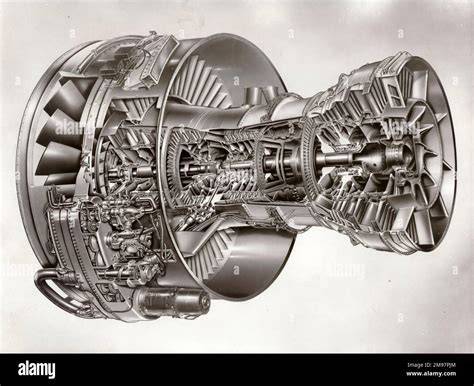
Rolls-Royce took the opposite road with the RB211-524G/H and its triple-spool layout. Three independent concentric shafts let the low-, intermediate-, and high-pressure sections each spin at its own optimal speed, which keeps compressor stages closer to peak aerodynamic efficiency across changing altitudes and throttle settings. The payoff shows up in surge margin, faster acceleration during a go-around, and lower blade stress. The cost is complexity: heavy C and D checks demand specialized tooling and procedures that a two-spool shop cannot simply reuse.
When a Single Engine Becomes a Single Point of Failure
The commercial case for three engines was clear enough, but the operational case ran deeper. In commercial aviation, an Airworthiness Directive targeting one engine family can ground a widebody fleet overnight, wiping out long-haul schedules and bleeding millions of dollars a day in lost revenue. An airframe locked to a single powerplant has no escape route from that scenario. The 747-400’s multi-engine compatibility gave carriers a genuine operational insurance policy against a fault that lived inside one manufacturer’s hardware.
Large flag carriers exploited that flexibility in different ways. Some split their 747-400 orders between two engine types so that a technical fault or a supply-chain breakdown on one engine line would never fully freeze their international timetable. Others leaned on their mixed-engine experience at the negotiating table, playing General Electric, Pratt & Whitney, and Rolls-Royce against one another to secure better power-by-the-hour maintenance contracts and spare-parts support. Competition among suppliers, in other words, was not merely a purchasing convenience. It became a lever for controlling the total cost of ownership across the airframe’s entire service life.
Why the 747-8 Abandoned the Three-Engine Formula
That flexibility did not survive into the final generation of the jumbo jet. When Boeing launched the 747-8 in the mid-2000s, it selected General Electric as the sole engine supplier, powering the aircraft exclusively with the GEnx-2B. The move was not a retreat from customer service but a response to economics that had shifted decisively against multi-supplier programs. Certifying three distinct nacelles, pylon structures, and digital bleed-air systems for a modern airframe now costs hundreds of millions in duplicated development, and that money buys less and less in return.
Aerodynamics pushed the same direction. Optimizing a wing around one tightly integrated engine casing yields better efficiency than hanging three competing geometries from the same wing box, each with its own strut fairing and interference drag. The industry followed: sole-source agreements became standard on flagship programs including the Airbus A350, and engine choice on new widebodies narrowed to an exception rather than a rule. The 747-400 now stands as the last great monument to an era when airline preference genuinely shaped airframe design.
A Legacy of Engineering on the Airline’s Terms
The 747-400 remains one of the most adaptable widebody airliners ever built, and that adaptability came directly from Boeing’s willingness to let customers dictate engineering. It matched two-spool designs from General Electric and Pratt & Whitney alongside Rolls-Royce’s three-spool architecture, fitting into almost any global airline’s maintenance ecosystem. Operators gained freedom in fleet planning, protection against engine groundings, and real leverage over overhaul providers. The surviving passenger and freighter airframes are steadily moving toward retirement, but the industrial lesson outlasts them: the Queen of the Skies achieved global supremacy not by forcing airlines to accept a rigid factory baseline, but by offering the engineering versatility to fly international routes on an airline’s own terms.