Historical Development of the S-64
The roots of the Sikorsky S-64 trace back to the early 1960s when the U.S. Army sought a heavy-lift helicopter capable of carrying substantial loads. Originally, Sikorsky designed the S-64 as a civilian version of the military’s CH-54 Tarhe, which had already proven its effectiveness in lifting and transporting heavy materials. The first flight of the S-64 occurred on May 9, 1962, and the prototype immediately showed its immense potential, thanks to its powerful Pratt & Whitney turboshaft engines and robust six-blade rotor system.
By the 1970s, Sikorsky developed multiple variants of the S-64, including S-64A and S-64E, with slight modifications to meet the diverse needs of both military and civilian customers. The U.S. Army initially ordered the YCH-54A Tarhe model, followed by additional civilian variants like the S-64B. As demand for heavy-lift helicopters continued to rise, Sikorsky expanded its production line, leading to the eventual development of the S-64F and later S-64E, with significant improvements in payload capacity and operational efficiency.
The Transition to Erickson: A New Era for the S-64
In 1992, Sikorsky sold the S-64’s manufacturing rights and type certificate to Erickson Air-Crane, marking a major shift in the helicopter’s history. Erickson, now the world’s largest operator of S-64 helicopters, has made over 1,350 modifications to enhance the helicopter’s performance. These changes have included upgrades to the airframe, payload capabilities, and instrumentation. Today, the Sikorsky S-64 is produced under the name S-64 Aircrane, and Erickson has developed specialized configurations for a wide array of applications, including aerial firefighting, heavy-lift construction, and disaster relief operations.
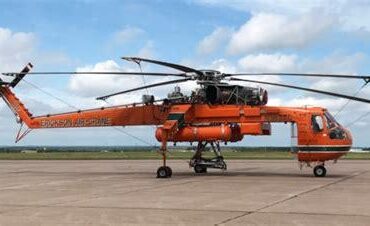
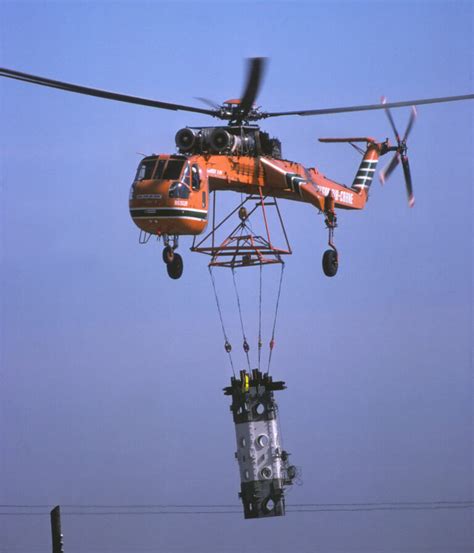
Erickson’s version of the S-64 has become renowned for its distinctive design, especially the extended boom and underslung load capabilities. One of its hallmark features is the ability to carry massive external loads, sometimes weighing up to 20,000 pounds (9,100 kg), and deliver them with pinpoint accuracy. The Aircrane variant has further refined the aircraft’s versatility by enabling it to carry water or retardant tanks for aerial firefighting operations, particularly useful during wildfires.
Key Features and Specifications of the S-64
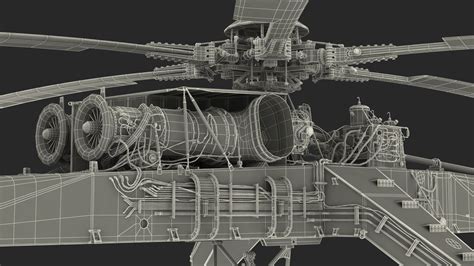
The Sikorsky S-64 Skycrane is a twin-engine heavy-lift helicopter, powered by two Pratt & Whitney JFTD12-4A turboshaft engines, each generating a maximum of 4,500 shaft horsepower. This immense power allows the helicopter to achieve a maximum takeoff weight of 42,000 pounds (19,051 kg), with the ability to lift and transport substantial payloads with ease.
Dimensions and Capacity
- Length: 70 feet 3 inches (21.41 meters)
- Height: 18 feet 7 inches (5.66 meters)
- Main rotor diameter: 72 feet (21.95 meters)
- Payload capacity: Up to 20,000 lbs (9,100 kg)
Performance
- Maximum speed: 115 knots (132 mph, 213 km/h)
- Cruise speed: 115 knots (132 mph, 213 km/h)
- Range: 200 nautical miles (370 km)
- Hover ceiling: 10,600 feet (3,200 meters)
- Rate of climb: 1,330 feet per minute (6.8 meters per second)
Operational Roles and Applications
The S-64 Aircrane is incredibly adaptable, with operations that span across numerous industries, particularly in aerial firefighting, construction, timber harvesting, and disaster relief. Some of the most iconic uses of the S-64 include:
Aerial Firefighting
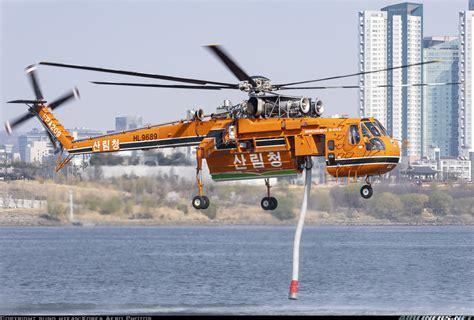
The S-64 is a key player in aerial firefighting, where its ability to carry massive water or retardant loads has made it indispensable in wildfire suppression efforts around the world. With a 2,650 US gallon (10,000 liter) fixed tank, the S-64 can scoop up water from nearby sources and drop it on fire-affected areas within seconds, helping to control the spread of flames. Notably, S-64s have been deployed in countries like the United States, Australia, and Italy to assist in firefighting operations during peak wildfire seasons.
Heavy-Lift Construction and Infrastructure
The S-64’s primary strength lies in its ability to carry large and heavy payloads to otherwise inaccessible locations. It has been used extensively in construction projects, including the installation of telecommunication towers, electrical grids, and oil rigs. A prime example of the S-64’s construction capabilities is the historic role it played in lifting the CN Tower antenna segment in Toronto, Ontario, using the Aircrane variant, aptly named “Olga”.
Disaster Relief and Emergency Response
In the aftermath of natural disasters such as earthquakes, hurricanes, and floods, the S-64 has been utilized for emergency relief operations, transporting supplies and rescued individuals from disaster-stricken areas. Its large cargo capacity and ability to operate in challenging environments have made it a vital tool in humanitarian efforts.
Timber Harvesting and Logging Operations
Another important application for the Sikorsky S-64 is in logging and timber harvesting. The helicopter’s ability to carry and deliver large logs to sawmills or transport locations has greatly increased efficiency in the logging industry. This application is particularly useful in rugged, remote, or mountainous regions where traditional logging vehicles cannot reach.
Safety Record and Challenges
While the Sikorsky S-64 has earned a reputation for its robustness and dependability, like any aircraft, it has not been without its challenges. Over the years, a few notable accidents have occurred, including crashes during firefighting operations or midair collisions with other aircraft. One such incident occurred on October 1, 2006, when the S-64 Gypsy Lady crashed in Ojai, California, while performing fire suppression duties. Fortunately, these incidents have led to continuous safety improvements in the design and operation of the aircraft, ensuring that it remains one of the safest and most reliable heavy-lift helicopters in use today.
Future of the Sikorsky S-64
Looking forward, the Sikorsky S-64 remains a key player in the heavy-lift helicopter market. As of now, Erickson continues to manufacture and remanufacture S-64 aircraft, with newer models being equipped with advanced avionics and autonomous flight capabilities. In particular, advancements in remote piloting systems and automation could significantly enhance the efficiency and safety of S-64 operations in the future.
Conclusion
The Sikorsky S-64 Skycrane remains a marvel of aviation engineering, continuing to serve as a versatile and powerful tool across a broad range of industries. From its early days as a military prototype to its current role as an indispensable asset in firefighting, construction, and disaster relief, the S-64’s legacy is cemented in aviation history. With continued innovation and global demand for heavy-lift operations, the S-64 Aircrane is sure to remain an essential player in aviation for years to come.