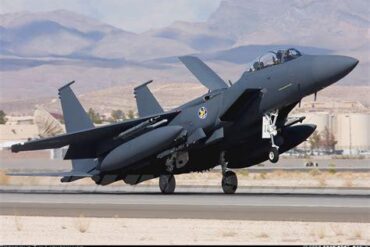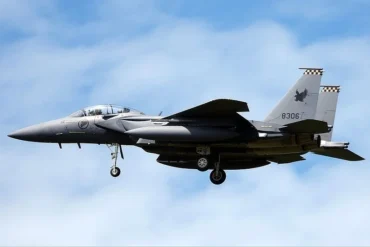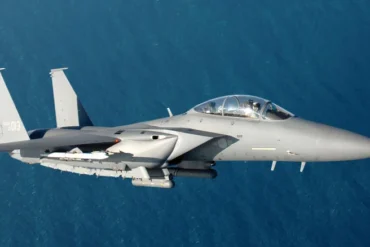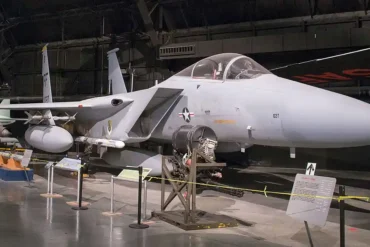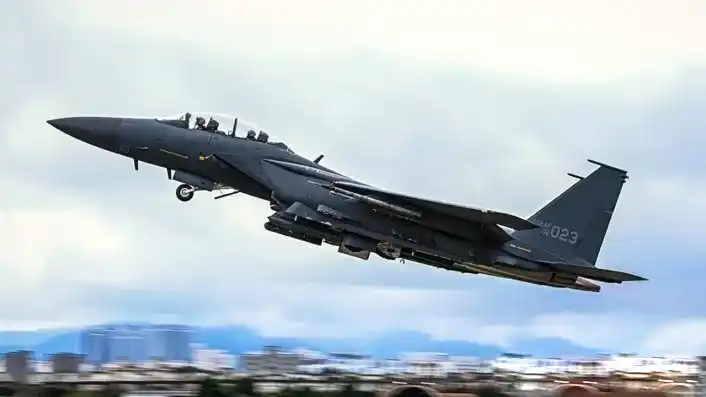
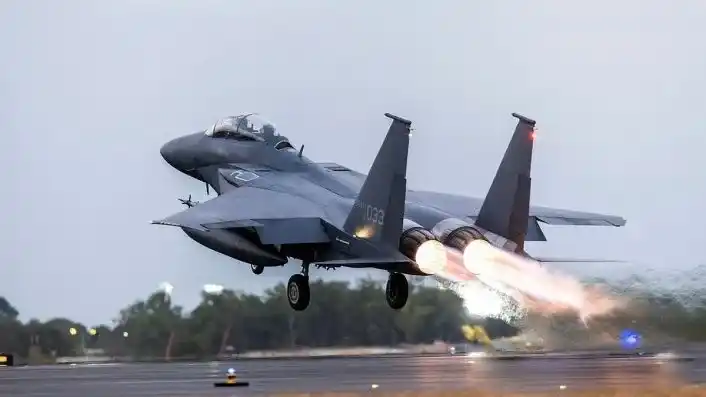
The F-15K “Slam Eagle” is a key component of South Korea’s air defense strategy. With a focus on enhancing multi-role capabilities and ensuring air superiority, the South Korean Air Force (ROKAF) has invested heavily in upgrading its fleet of F-15Ks. This article explores the procurement history, technological advancements, and strategic implications of the F-15K, as well as the broader context of its role within the region.
The F-15K Procurement and Upgrade Background
Acquisition History and Aircraft Role
South Korea’s interest in the F-15 began in the late 1990s when the need to replace aging fighter jets like the F-4D/E Phantom and F-5E/F Tiger II became apparent. In 2002 and 2008, the country purchased 61 F-15K “Slam Eagle” aircraft in two separate batches, with a total cost of approximately $6.3 billion. These aircraft were meant to serve as multi-role combat platforms capable of a wide range of missions, from air superiority to precision strikes against both ground and naval targets.
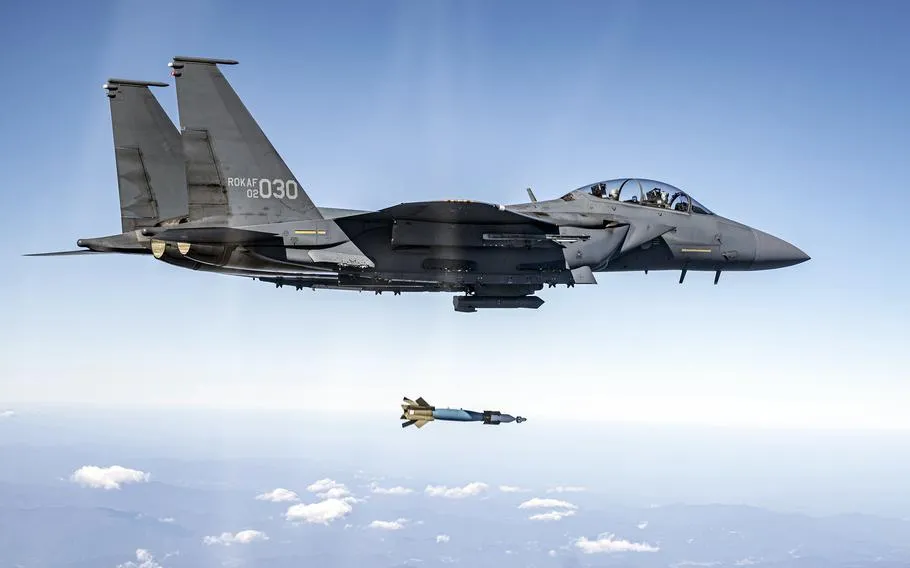
The F-15K is a variant of the F-15E Strike Eagle, modified to suit South Korea’s specific operational needs. It was designed to provide advanced air-to-air and air-to-ground capabilities, integrating advanced avionics, radar, and weapons systems to significantly increase the South Korean Air Force’s combat potential.
Domestic Production and Technology Transfer
A crucial aspect of the F-15K procurement was South Korea’s push for domestic production through technology transfer agreements. Under these agreements, South Korean companies, such as Korea Aerospace Industries (KAI), participated in the assembly and manufacturing process. Approximately 40% of the aircraft was produced domestically, including critical components like inertial navigation systems and flight control actuators.
The first batch of F-15Ks was equipped with General Electric F110-GE-129A engines, while the second batch, due to compatibility with the KF-16 maintenance program, was outfitted with Pratt & Whitney F100-PW-229 EEP engines.
Modernization Efforts: The F-15K Upgrade Program
In 2024, South Korea embarked on a major upgrade program for its F-15K fleet, with an estimated cost of $6.2 billion. This program aims to bring the existing fleet of 59 aircraft up to the standards of the F-15EX “Advanced Eagle”, which incorporates a host of technological advancements.
The modernization project is set to be completed by 2034, ensuring that the F-15K remains operational and relevant well into the next several decades. Upon completion, the upgraded F-15K will be able to serve until 2060, making it a cornerstone of South Korea’s air defense strategy.
Cost Comparison and Long-Term Benefits
The cost of upgrading each individual F-15K is substantial, with each aircraft’s modernization valued at over $100 million. This is almost equivalent to the procurement cost of a Chinese J-20 fighter jet, underscoring the high cost of technological upgrades in the defense industry. However, South Korea has argued that this investment is a more cost-effective option compared to purchasing entirely new aircraft, as it avoids the training and logistical costs associated with integrating a completely new fleet.
Core Technological Upgrades
Avionics Overhaul
One of the most significant aspects of the F-15K upgrade is the comprehensive avionics modernization. The F-15K will be outfitted with the AN/APG-82(V)1 AESA radar, a key improvement over the existing radar system. This radar system features enhanced detection range and target reliability, providing superior capabilities for both air-to-air and air-to-ground operations. Furthermore, the integration of the ADCP II mission computer allows for a processing speed of 870 billion instructions per second, vastly improving the aircraft’s ability to track multiple targets and plan complex missions in real-time.

Electronic Warfare and Survivability Enhancements
In terms of electronic warfare (EW), the F-15K will be equipped with the AN/ALQ-250 electronic warfare system. This suite provides full-spectrum jamming and situational awareness, significantly enhancing the aircraft’s survivability in contested environments.
In addition, the AN/AAR-57 missile warning system will be integrated into the aircraft. This system uses infrared sensors to detect and track incoming missile threats, providing the crew with ample time to react or deploy countermeasures. The countermeasures system will also be upgraded, with the total number of flares and chaff increased to 360 to improve protection against enemy missiles.
Weapons Compatibility and Multi-Role Capability
The F-15K upgrade will also enhance its weapons compatibility, allowing it to carry advanced munitions such as the AIM-120D AMRAAM (Advanced Medium-Range Air-to-Air Missile) and the AGM-158 Joint Air-to-Surface Standoff Missile-Extended Range (JASSM-ER). These upgrades bolster the F-15K’s ability to conduct long-range precision strikes, giving it a significant edge in air-to-ground combat scenarios.
The maximum payload capacity of the F-15K will be increased to 13.4 tons, allowing the aircraft to carry a combination of air-to-air and air-to-ground munitions, further enhancing its versatility. This multi-role capability is essential for South Korea’s defense strategy, as the aircraft will be expected to perform a variety of missions, from air superiority to strategic strike operations.
Strategic Significance of the F-15K
Countering North Korean Threats
One of the primary reasons for the F-15K’s importance to South Korea is its ability to address the growing threat from North Korea. The F-15K, equipped with SLAM-ER and KEPD 350 cruise missiles, can strike deep into North Korean territory, targeting high-value assets and infrastructure.
The aircraft’s long-range strike capability ensures that South Korea can project power well beyond its borders, forming an essential component of its deterrence strategy. In addition, the F-15K’s participation in joint exercises with the U.S. and Japan — such as the upcoming 2025 B-1B bomber training — ensures that the aircraft remains a key tool in regional defense.
Synergy with F-35 Fighters
South Korea’s air force strategy also involves the integration of the F-15K with the F-35 stealth fighter. By pairing the F-15K’s long-range strike capabilities with the F-35’s stealth and deep strike potential, South Korea creates a balanced air force capable of addressing a wide variety of operational challenges.
The F-15K focuses on long-range strike and air superiority, while the F-35 excels in stealth and penetrating enemy defenses. This synergy ensures that South Korea’s air force is equipped to handle both high-intensity conflicts and low-intensity skirmishes.
Technological and Industrial Self-Reliance
The F-15K program has also played a critical role in advancing South Korea’s industrial self-reliance. Through partnerships with local defense contractors like Hanwha and KAI, South Korea has gained valuable experience in producing and maintaining advanced fighter jets. This experience is laying the groundwork for future indigenous programs like the KF-21 Boramae, which aims to produce a homegrown fighter jet for the South Korean military.
Challenges and Controversies Surrounding the F-15K Upgrade
Cost vs. Value Debate
The $6.2 billion upgrade program for the F-15K has sparked debates regarding the cost-effectiveness of modernizing an existing fleet versus purchasing new aircraft. Critics argue that the cost per aircraft is comparable to the procurement of new fighter jets like the J-20 or F-35, which offer newer technology and potentially greater capabilities. However, South Korea’s defense leadership maintains that upgrading the existing fleet will provide more cost-effective results in terms of operational continuity and reduced training and maintenance overheads.
Dependence on U.S. Technology
Despite the advancements made in domestic manufacturing and technological transfer, South Korea’s F-15K still relies heavily on U.S.-sourced technologies. Core systems such as the radar, electronic warfare systems, and missile technologies remain under U.S. control, limiting South Korea’s autonomy in some areas. This reliance on external suppliers raises questions about supply chain security and the potential impact of future geopolitical tensions on South Korea’s defense capabilities.
Conclusion
The F-15K program represents a critical element in South Korea’s air defense strategy, offering a robust, multi-role fighter jet with advanced avionics, weapons systems, and long-range strike capabilities. The ongoing upgrade program ensures that the F-15K will remain a cornerstone of South Korea’s air power well into the 21st century. However, the high costs and dependence on foreign technologies pose significant challenges that the country will need to navigate as it continues to modernize its military forces.