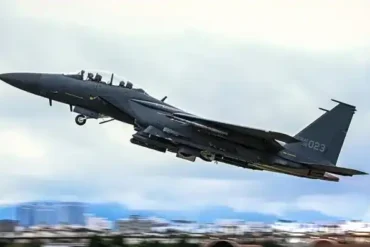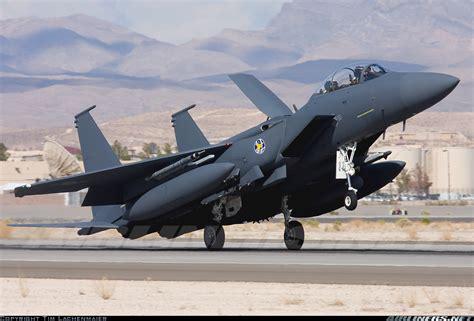
South Korea has taken a decisive step to secure the long-term relevance of its most powerful strike aircraft, moving forward with a comprehensive modernization of the F-15K Slam Eagle fleet under a $2.8 billion Foreign Military Sales contract awarded to Boeing. Rather than opting for a limited life-extension effort, Seoul has chosen a deep systems overhaul that reshapes the aircraft’s digital spine, ensuring it remains lethal, interoperable, and survivable well into the 2040s.
The contract, awarded by the U.S. Air Force on January 30, 2026, carries a not-to-exceed value of $2.81 billion, with an initial obligation of $540 million at award. Work under the agreement spans system design, development, integration, and aircraft modification through December 31, 2037, reflecting both the technical depth of the effort and the strategic importance placed on the platform by South Korea’s defense planners.
At its core, the modernization focuses on replacing aging avionics, sensors, electronic warfare systems, mission computers, and communications architecture. The intent is clear: preserve the F-15K’s role as the backbone of South Korea’s long-range strike force while aligning it technologically with allied air forces operating increasingly networked and data-centric combat aircraft.
The scope and ambition of the program underline a broader reality. Despite the arrival of stealth fighters such as the F-35A, South Korea continues to rely on the F-15K for missions that demand payload, range, persistence, and weapons flexibility—qualities that remain difficult to replicate even with newer designs.
Strategic Rationale Behind the F-15K Modernization
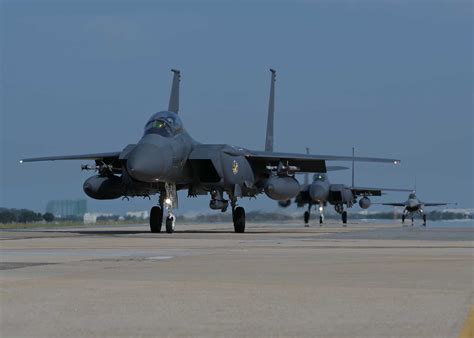
All 59 operational F-15K Slam Eagles are assigned to the 11th Fighter Wing, where they form the spearhead of South Korea’s long-range precision strike capability. From deterrence patrols to deep-penetration missions, the aircraft’s ability to carry heavy ordnance over extended distances makes it uniquely suited to the security environment of the Korean Peninsula and surrounding maritime approaches.
The decision to modernize, rather than replace, reflects a sober cost-capability calculation. Replacing the F-15K with an equivalent number of new heavy strike aircraft would be vastly more expensive and operationally disruptive. Modernization allows South Korea to leverage a proven airframe while inserting new digital systems that address evolving threats, particularly advanced air defenses and electronic warfare environments.
Equally important is interoperability. By updating communications, data links, and mission systems under a U.S.-managed FMS framework, the upgraded F-15Ks will remain fully compatible with U.S. and allied forces, a critical requirement given the integrated nature of modern air operations in Northeast Asia.
The F-15K Slam Eagle: A Tailored Strike Platform
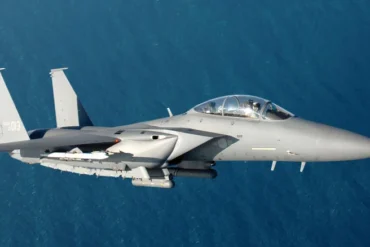
The F-15K is a specialized derivative of the F-15E Strike Eagle, adapted from the outset to meet South Korea’s operational needs. While retaining the two-seat configuration and structural robustness of the U.S. aircraft, the Slam Eagle introduced customized mission systems, sensor combinations, and engine options that diverged from standard U.S. Air Force configurations.
South Korea selected the F-15K in April 2002 under its FX fighter acquisition program, prioritizing range, payload, and interoperability over lighter alternatives. The initial contract covered 40 aircraft, with deliveries completed by 2008, followed by a second batch of 21 aircraft delivered between 2010 and 2012. One early loss was offset by an additional airframe, resulting in the current fleet strength of 59 aircraft.
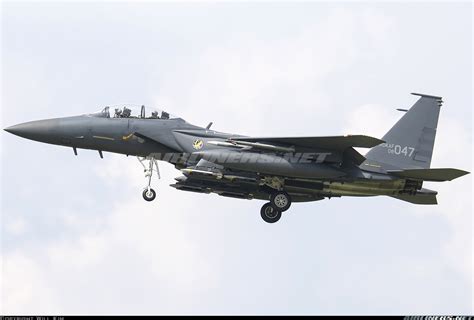
Physically, the F-15K remains an imposing presence. Measuring 19.43 meters in length with a maximum takeoff weight of 36,740 kilograms, it can carry approximately 13,400 kilograms of external payload. Its twin-engine configuration—using either GE F110 or Pratt & Whitney F100-PW-229 engines depending on batch—delivers Mach 2.5 performance, a service ceiling above 18,000 meters, and a combat radius exceeding 1,800 kilometers.
These characteristics explain why the platform remains indispensable. The F-15K can launch with fuel, sensors, and a full weapons load simultaneously, a combination that directly supports South Korea’s emphasis on rapid response and decisive strike options.
Deep Digital Upgrades Rather Than Structural Life Extension
Unlike traditional mid-life upgrades that focus primarily on airframe fatigue, the F-15K modernization is fundamentally a systems replacement program. Avionics architectures designed decades ago are being replaced with modern, open-architecture solutions capable of rapid updates and future growth.
Mission computing lies at the heart of this effort. New processors will dramatically increase data throughput, enabling the aircraft to fuse information from radar, infrared sensors, electronic warfare systems, and off-board sources into a coherent tactical picture. This is essential in environments saturated with sensors, jammers, and long-range surface-to-air threats.
Communications upgrades are equally critical. Modernized datalinks and secure communications will allow the F-15K to operate seamlessly alongside fifth-generation fighters, airborne early warning aircraft, and joint command-and-control networks. In practice, this means the Slam Eagle will continue to function as both a shooter and a networked battle manager, extending its relevance well beyond traditional strike roles.
Sensors, Survivability, and Electronic Warfare Evolution
The F-15K’s existing sensor suite already provides formidable capability, anchored by the AN/APG-63(V)1 radar and complemented by infrared search and track and advanced targeting pods. However, emerging threats demand greater sensitivity, resilience, and resistance to electronic attack.
The modernization effort addresses these demands by refreshing radar processing, enhancing electronic support measures, and upgrading internal countermeasures. Improved electronic warfare systems will offer faster threat detection, more precise emitter identification, and more effective jamming responses against modern radar-guided weapons.
Survivability enhancements are not limited to electronics. By integrating new mission systems with existing defensive aids, the aircraft gains the ability to react faster and more intelligently to threats, reducing exposure time in contested airspace while maintaining mission effectiveness.
Weapons Integration and Long-Range Strike Continuity
One of the F-15K’s defining strengths is its weapons flexibility, and modernization ensures this advantage is preserved. The aircraft remains capable of carrying a diverse mix of air-to-air missiles, precision-guided bombs, anti-ship missiles, and long-range cruise weapons.
Particularly significant is the continued integration of the KEPD 350 Taurus cruise missile, which provides South Korea with a powerful stand-off strike option against hardened and high-value targets. Combined with upgraded sensors and mission planning systems, the F-15K retains the ability to conduct precision strikes at ranges that complicate adversary defenses.
This capacity reinforces deterrence by signaling that South Korea can hold critical targets at risk without immediate reliance on stealth platforms alone.
A Calculated Investment in Regional Deterrence
The $2.8 billion modernization program reflects more than a technical upgrade. It represents a strategic commitment to maintaining credible, visible, and flexible airpower during a period of rapid military modernization across the region. By extending the F-15K’s operational life into the 2040s, South Korea preserves a proven strike platform while buying time for future force development decisions.
In an era where air combat increasingly depends on data, networks, and electronic dominance, the upgraded F-15K Slam Eagle will stand as a bridge between generations—an aircraft rooted in raw performance, yet fully adapted to the digital battlespace of modern warfare.