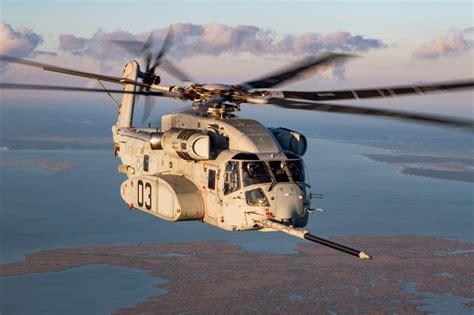
The United States Navy has taken a bold and strategic step in solidifying its future heavy-lift aviation capabilities by awarding GE Aerospace a $1.42 billion contract modification for the production of T408-GE-400 turboshaft engines, the powerhouse behind the CH-53K King Stallion helicopter. This monumental deal is not only a significant industrial development but also a resounding endorsement of the CH-53K program’s operational maturity and indispensable role in future U.S. Marine Corps expeditionary warfare.
GE Aerospace Secures Multi-Lot Engine Procurement Deal
In a deal confirmed by the U.S. Department of Defense in January 2026, General Electric Aerospace, based in Lynn, Massachusetts, was awarded a contract modification identified as P00003 under N0001924C0019, a firm-fixed-price agreement. The contract covers production of engines across Lots 9 through 13, totaling 277 T408 engines. Each CH-53K helicopter is outfitted with three of these advanced turboshafts, which collectively enable it to carry unmatched loads across great distances with speed and precision.
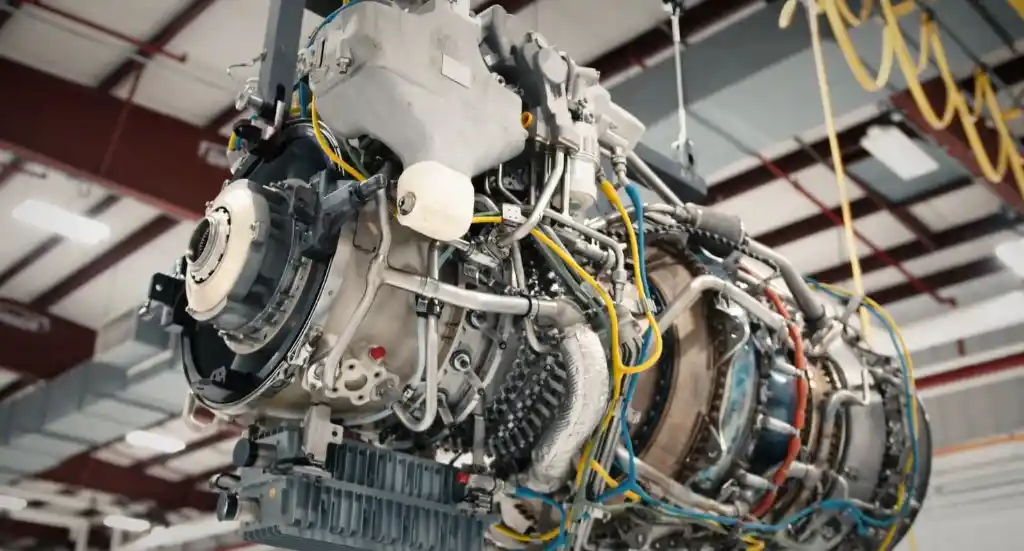
This award is a definitive transition from earlier provisional agreements, now anchoring long-term full-rate production. The decision to commit to five production lots under a single contract reflects the Pentagon’s confidence in the CH-53K’s operational reliability and critical role in future naval and Marine Corps logistics.
The T408-GE-400: Redefining Military Rotorcraft Power
The T408-GE-400 is not just another helicopter engine—it is the most powerful turboshaft the U.S. military has ever deployed. With a staggering 7,500 shaft horsepower per engine, it dramatically outpaces the legacy CH-53E Super Stallion’s propulsion system. The result? A 57% increase in power, significantly improved fuel efficiency, and robust capability in austere and contested environments.
Each engine feeds into a split-torque main gearbox, a revolutionary design that handles extreme torque while enhancing survivability, maintainability, and operational efficiency. This technological leap allows the CH-53K to operate under harsh conditions where other helicopters would be grounded, making it an invaluable asset in emerging expeditionary and distributed warfare concepts.
From Airframe to Avionics: The CH-53K’s Comprehensive Evolution
The CH-53K King Stallion is more than a modernized version of its predecessor. It represents a complete generational leap in heavy-lift helicopter technology. The aircraft integrates advanced composite materials throughout its airframe, drastically reducing weight while increasing resistance to corrosion—critical for extended maritime deployments.
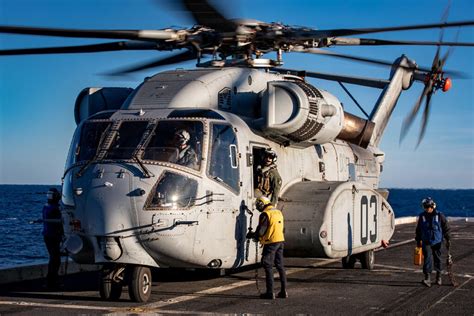
Its fourth-generation rotor blades, constructed from high-strength composites, are not only wider and more efficient but also quieter and more stable. This aerodynamic refinement translates engine power into superior lift, with reduced vibration and lower acoustic signatures, allowing stealthier and smoother operations.
In terms of raw capability, the CH-53K sets a new standard:
- Internal payload capacity of 30,000 pounds
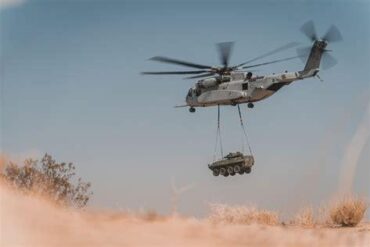
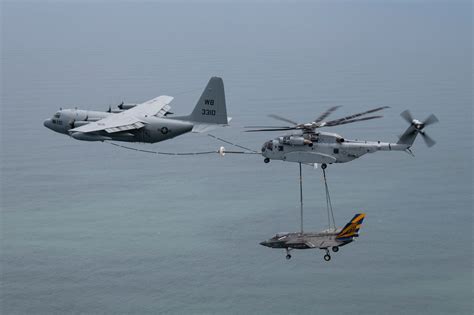
- External load capability exceeding 36,000 pounds
- Ability to carry armored vehicles, large artillery, and fully stocked logistics pallets over extended ranges
These upgrades position the King Stallion as a force multiplier for Marine operations in remote, infrastructure-deprived environments.
Fly-by-Wire Brilliance: Avionics Designed for the Future
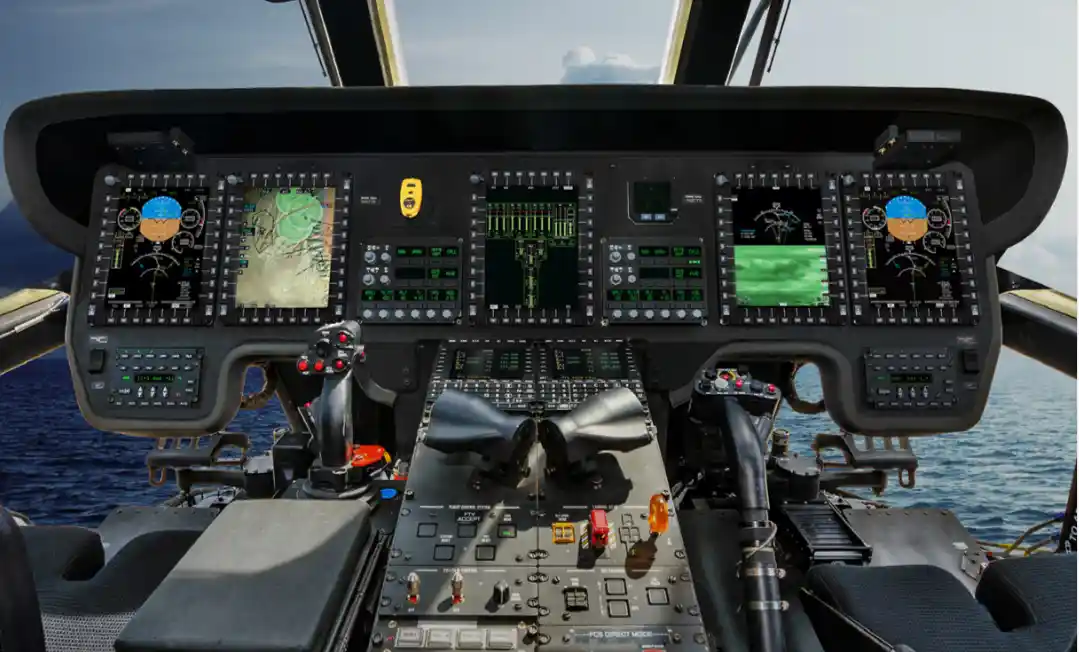
The King Stallion’s brains are as impressive as its brawn. The cockpit features a full glass, fly-by-wire flight control system—a first for heavy-lift helicopters. This digital control architecture enhances maneuverability, precision, and pilot safety, especially during high-risk missions involving external loads or degraded visual environments like dust storms or night flights.
The aircraft’s avionics suite includes integrated vehicle health monitoring that continually tracks engine and drivetrain performance. This allows ground crews to anticipate maintenance needs, reducing unplanned downtime and boosting mission-capable rates. In scenarios where logistics and sustainment access is limited, this proactive system proves crucial to operational endurance.
Operational Doctrine: Designed for Distributed Maritime Operations
The CH-53K is tailored to modern U.S. Marine Corps doctrines such as Distributed Maritime Operations (DMO) and Expeditionary Advanced Base Operations (EABO). These concepts prioritize mobility, decentralization, and rapid deployment of forces across wide maritime spaces—hallmarks of potential future conflict scenarios in the Indo-Pacific.
At a combat radius of 110 nautical miles, the CH-53K can lift nearly three times the external load of its predecessor. This enables a ship-to-shore logistics bridge, even in the absence of ports, airstrips, or infrastructure. The aircraft’s agility allows Marines to reposition artillery, fuel bladders, ground vehicles, and other critical equipment between islands and forward operating bases, reinforcing their autonomy and lethality.
Sustaining the Industrial Base: Lynn, Massachusetts at the Core
Work under the engine contract will be executed primarily in Lynn, Massachusetts, a designated labor surplus area. This geographic focus aligns with the Pentagon’s broader goal of reinforcing the domestic defense industrial base, which has been under stress from global supply chain disruptions and workforce attrition.
In recent years, the Lynn facility has undergone major modernization efforts, incorporating digital quality assurance systems and automation-enhanced assembly lines to meet rising demand and stringent military standards. The result is a production line capable of delivering engines at high volume and precision, on schedule.
Strategic Implications: A Vote of Confidence in CH-53K Program
The multi-lot engine contract signifies a resounding strategic commitment by both the Department of Defense and the U.S. Navy to the long-term success of the CH-53K platform. Funding for the contract draws from FY2025 and FY2026 Navy aircraft procurement accounts, with $497 million already obligated, and the remainder scheduled to be disbursed through September 2032.
Crucially, none of the obligated funds expire at the end of the fiscal year, indicating strong budgetary confidence and continuity. This positions the CH-53K program to avoid the turbulence of year-to-year funding debates that have derailed other aviation modernization efforts.
The Naval Air Systems Command (NAVAIR) at Patuxent River, Maryland, serves as the contracting authority. Officials describe the definitization of Lots 9–13 as a risk-reduction milestone, providing cost stability, enabling long-term materials procurement, and improving workforce retention and training investments on both the government and industry side.
Replacing the CH-53E: Retiring a Workhorse, Embracing a Titan
As the Marine Corps begins the retirement process of the CH-53E Super Stallion, the King Stallion emerges not just as a successor, but as a transformational upgrade. The CH-53E, though a stalwart since the 1980s, faces increasing limitations in terms of engine power, fuel consumption, survivability, and modern operational integration.
The CH-53K overcomes these hurdles by combining raw power with intelligent systems and modular sustainment, ensuring it is not just combat-capable today but adaptable for the challenges of tomorrow.
Conclusion: Lifting the Future of Expeditionary Warfare
This $1.42 billion contract award to GE Aerospace is more than a procurement action—it is a strategic realignment of U.S. military aviation. By locking in engine production across five full-rate production lots, the Pentagon has removed one of the final barriers to scaling the CH-53K fleet.
For the U.S. Navy and Marine Corps, this move affirms the CH-53K’s place as a cornerstone of future power projection. For GE Aerospace, it represents a triumph of engineering excellence, industrial resilience, and alignment with national defense priorities. And for America’s adversaries, it sends a clear signal: the U.S. is investing in the world’s most capable heavy-lift helicopter, designed for the battlespaces of the next decade and beyond.