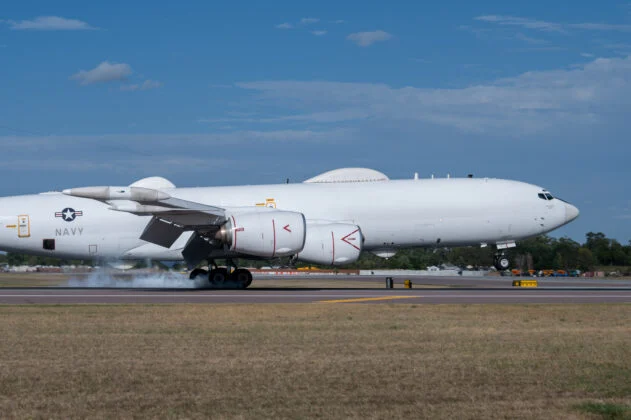
The U.S. Navy has awarded Collins Aerospace a $20.3 million contract modification to modernize the high-power transmit systems aboard the E-6B Mercury, reinforcing one of the most obscure yet indispensable pillars of America’s strategic deterrence architecture. Quiet in public profile but immense in consequence, the upgrade focuses on the aircraft’s ability to transmit nuclear command-and-control messages under the most extreme operational conditions, ensuring continuity while the Navy advances plans for a future replacement platform.
This contract, formally issued as modification P00002 under an existing basic ordering agreement, calls for the delivery of three full-rate production high-power transmit set modernization kits. Administered by Naval Air Systems Command (NAVAIR) at Patuxent River, Maryland, the award is structured as a firm-fixed-price, cost-reimbursable order, with all fiscal 2026 Navy aircraft procurement funds obligated at the time of award. Work will be carried out in Richardson, Texas, and is scheduled for completion by June 2027, underscoring that this is not an experimental effort but a production-level sustainment program for an aircraft expected to remain operationally decisive well into the decade.
While defense headlines often gravitate toward missiles, fighters, or submarines, the E-6B Mercury occupies a rarer strategic niche. It serves as the airborne backbone of the Navy’s TACAMO mission—Take Charge And Move Out, a role centered on maintaining survivable nuclear communications, particularly with ballistic missile submarines operating deep beneath the oceans. The Mercury’s value does not lie in speed or stealth, but in its ability to function when terrestrial communications networks are degraded, destroyed, or deliberately attacked.
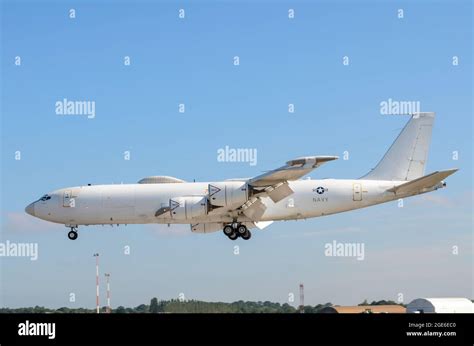
At the heart of this mission is the aircraft’s high-power very low frequency (VLF) transmit capability, a system that allows the E-6B to send authenticated messages to submerged submarines without forcing them to surface or expose their positions. This requires not only specialized radios, but an entire transmission chain capable of handling extreme electrical loads, precise signal stability, and the physical demands of operating a trailing wire antenna that can extend for miles behind the aircraft in flight. The transmit system is therefore not an accessory; it is the mission.
The modernization effort supported by this contract addresses a problem familiar across aging military fleets: electronics obsolescence. Many legacy high-power radio frequency components rely on parts that are no longer manufactured, require intensive maintenance, or struggle with heat dissipation and reliability under sustained operation. Publicly available details indicate that the new transmit sets move toward a solid-state, 200-kilowatt-class amplification architecture, a shift that promises higher reliability, improved mean time between failures, and reduced logistical burden. For an aircraft that must be ready at all times, often with crews on alert status, these gains translate directly into operational availability.
Beyond the technical improvements, the timing of the contract is strategically revealing. The Navy is modernizing the E-6B not because it lacks a vision for the future, but because deterrence cannot tolerate a gap. A successor platform is under consideration, yet such programs unfold over years, sometimes decades. By investing in production-grade upgrades rather than minimal sustainment, the Navy is signaling that the Mercury fleet remains a front-line strategic asset, not a stopgap awaiting retirement.
The E-6B Mercury is frequently labeled a “doomsday plane,” a phrase that obscures more than it explains. In reality, its mission is about preventing catastrophe, not dramatizing it. The aircraft ensures that national command authorities retain the ability to communicate with strategic forces under worst-case conditions, reducing incentives for rash decisions based on uncertainty or miscalculation. In nuclear strategy, confidence in control is as stabilizing as the weapons themselves.

Geopolitical context sharpens the importance of this investment. Modern conflict increasingly emphasizes electronic warfare, cyber disruption, and network denial as opening moves rather than supporting actions. Observations from Ukraine, combined with China’s growing emphasis on long-range precision and information warfare, have reinforced a central lesson: communications systems are targets. In such an environment, survivable airborne relays capable of operating independently from ground infrastructure are not legacy relics; they are strategic insurance policies.
The contract’s structure further underscores its seriousness. Classified as a non-competitive award, it reflects Collins Aerospace’s entrenched role as the original equipment manufacturer and system integrator for these specialized transmit systems. Replacing or duplicating this expertise would introduce risk, delay, and cost—luxuries unavailable in a mission area where continuity is paramount. The Navy’s decision prioritizes assured delivery over theoretical competition, a choice aligned with the stakes involved.
From an industrial perspective, the award reinforces Collins Aerospace’s position as a cornerstone supplier for U.S. strategic aviation programs. Operating as Collins Aerospace Government Systems, the company brings decades of experience in secure communications, high-power RF engineering, and mission-critical avionics. This contract, though modest in dollar value compared to major airframe programs, sits at the intersection of engineering precision and national survival, a niche where reputations are built quietly and tested relentlessly.
The E-6B fleet itself represents a blend of old and new. Based on the Boeing 707 airframe, the Mercury has undergone extensive modifications, including Block II upgrades, avionics modernization, and structural sustainment to keep it viable. These investments reflect a broader philosophy within U.S. strategic forces: platforms may age, but missions endure. As long as the requirement to communicate with submerged submarines exists—and it does—the systems enabling that communication will be maintained at the highest standard.

Importantly, the high-power transmit upgrade also supports the aircraft’s secondary role as an airborne launch control system, historically associated with the Air Force’s intercontinental ballistic missile command structure. While organizational responsibilities have evolved, the underlying principle remains the same: redundancy saves time, and time saves lives. Multiple pathways for command and control complicate adversary planning and reduce the likelihood that a single point of failure could escalate a crisis.
Financially, the $20.3 million figure may appear modest within the scale of U.S. defense spending, but its impact is disproportionately large. Strategic communications upgrades do not generate dramatic visuals or immediate battlefield effects, yet they underpin every other element of deterrence. Without credible communication, even the most advanced weapons lose their strategic meaning.
As work progresses toward its 2027 completion date, the modernization kits will quietly enter the fleet, integrated into aircraft that rarely make headlines but are constantly on watch. There will be no parade for a new transmitter, no public unveiling ceremony. Instead, success will be measured in silence, in the absence of failure, and in the continued confidence that messages can be sent, received, and trusted when it matters most.
In that sense, the Collins Aerospace contract represents more than a procurement action. It is a reaffirmation of a philosophy that has guided U.S. strategic forces for generations: deterrence is not just about power, but about control, and control begins with communication. The E-6B Mercury, sustained and modernized, remains one of the quiet guarantors of that control in an increasingly contested world.