Norway is reinforcing its maritime edge in the High North as Kongsberg Defence & Aerospace secures a contract worth approximately NOK 400 million to upgrade the combat systems of the Royal Norwegian Navy’s six Skjold-class corvettes. The modernization, awarded by the Norwegian Defence Materiel Agency, is not a cosmetic refresh. It is a strategic recalibration of Norway’s fast, stealthy coastal strike force at a time when the Arctic and northern littorals are emerging as some of the most technologically contested waters on the planet.
Announced on 20 February 2026, the program extends a broader modernization effort launched in 2022. It focuses on preserving technical availability while strengthening operational performance in a security environment shaped by expanding Russian naval activity, long-range precision missiles, and dense surveillance networks. In these waters, where fjords, skerries, and narrow channels compress maneuver space, speed and stealth are not luxuries. They are survival tools.
Unlike conventional upgrades that swap out isolated subsystems, this contract treats the Skjold class as a fully integrated combat ecosystem. The emphasis falls squarely on the modernization of the shipborne combat management system (CMS), enhanced sensor fusion, refreshed processing architecture, and improved fire-control solutions. In short, the digital brain of the vessel is being sharpened to ensure that detection, decision, and destruction occur in seamless succession.
The Strategic Context: High North Tensions and Littoral Complexity
The High North is no longer a quiet maritime frontier. The waters surrounding Norway’s northern coastline and the approaches to the Barents Sea are now saturated with surveillance systems, submarines, long-range strike capabilities, and electronic warfare assets. Russian naval operations from the Kola Peninsula project influence deep into Arctic waters, challenging NATO’s ability to maintain freedom of maneuver.
In such an environment, large blue-water combatants can become high-value targets. Norway’s solution has long relied on asymmetric agility: small, stealthy vessels capable of exploiting geography. The Skjold-class corvettes embody this philosophy. They are optimized for “green-water” warfare, a term describing operations in shallow, cluttered coastal zones where radar returns bounce unpredictably and islands provide both concealment and obstruction.
The modernization effort strengthens Norway’s ability to maintain credible sea denial. These vessels can integrate into a wider C4ISR architecture—command, control, communications, computers, intelligence, surveillance, and reconnaissance—allowing them to function as nodes in a distributed kill chain alongside F-35 fighters, maritime patrol aircraft, submarines, and coastal missile batteries.
A Surface Effect Ship Unlike Any Other
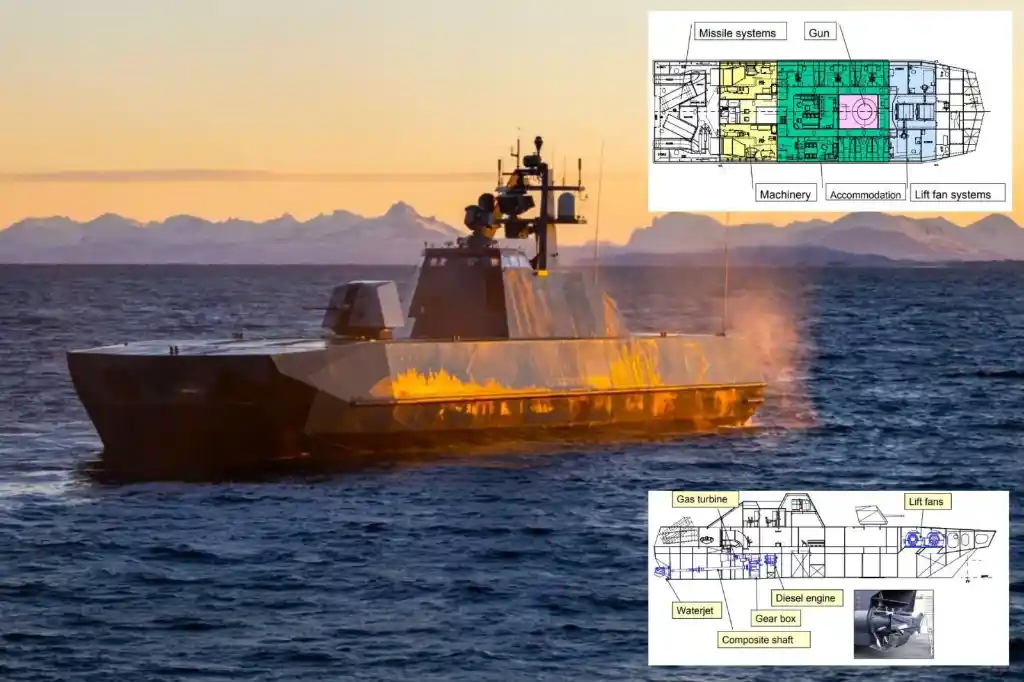
The Skjold class is not merely a fast boat with missiles. It is a Surface Effect Ship (SES), an engineering hybrid between catamaran and hovercraft. Twin rigid sidewalls trap a cushion of air generated by lift fans, reducing hydrodynamic drag and enabling extraordinary speed. Flexible seals at the bow and stern contain the air cushion, while an advanced ride-control system manages cushion pressure to reduce slamming and improve stability.
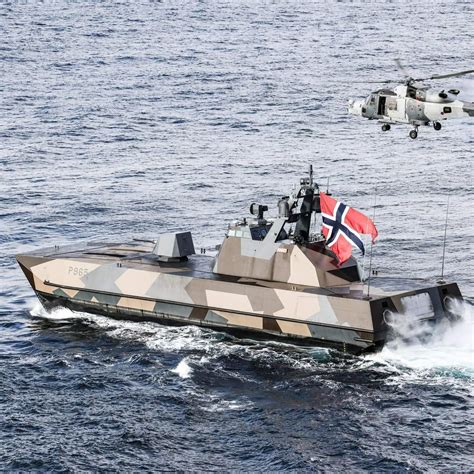
The hull and superstructure are built from glass-fiber and carbon-fiber composites, using sandwich construction with lightweight cores. This approach dramatically reduces weight while maintaining structural strength. Even more significant, radar-absorbing materials are integrated directly into load-bearing structures as structural RAM. Instead of applying stealth as a superficial coating, it is embedded into the ship’s architecture.
The result is a vessel with minimal radar cross-section, smooth angular surfaces, and very few protrusions. In a world where radar signatures are catalogued and cross-referenced within seconds, this low observability remains a critical advantage.
Extreme Speed as Tactical Doctrine
Propulsion is provided by a combined gas-and-gas (COGAG) configuration of Pratt & Whitney gas turbines driving waterjets. The numbers are striking: sprint speeds above 60 knots in calm conditions, sustained speeds around 45 knots in moderate seas, and a range of approximately 800 nautical miles at 40 knots. For a combatant displacing roughly 274 tonnes, these figures are exceptional.
Speed is not pursued for spectacle. It enables rapid repositioning between fjords, swift pop-up missile launches, and immediate displacement before enemy sensors can complete targeting solutions. In a littoral missile duel, seconds matter. The ability to relocate faster than an adversary can refine a firing solution complicates any opponent’s operational planning.
Despite its compact dimensions, the Skjold class carries formidable armament. Each vessel houses eight Naval Strike Missiles (NSM) within internal bays. The NSM is a sea-skimming, long-range anti-ship missile optimized for complex coastal terrain. Its imaging infrared seeker and advanced flight profiles allow it to discriminate targets amid land clutter, making it especially suited to Arctic archipelagos.
Forward, a 76 mm OTO Melara Super Rapid gun provides multi-role capability with high rates of fire. For close-in air defense, the ships deploy Mistral short-range surface-to-air missiles, supplemented by heavy machine guns and optional remote weapon stations.
Modernizing the Digital Spine: Combat System Evolution
The heart of the upgrade lies in the CMS and its associated data-processing environment. The existing Senit 2000 combat management system, integrated with Thales 3D surveillance radar, Saab Ceros fire-control trackers, electro-optical sensors, electronic support measures, and Rheinmetall MASS decoys, has proven effective. Yet rapid advances in electronic warfare, unmanned systems, and sensor density demand higher processing power and improved software architecture.
The modernization introduces updated processors, refined algorithms for sensor fusion, and enhanced threat evaluation routines. Sensor fusion is the art of merging multiple data sources—radar tracks, electronic emissions, optical imagery—into a coherent maritime picture. In littoral waters where false contacts abound, accurate fusion reduces cognitive load on operators and speeds decision-making.
Improved fire-control solutions will optimize missile launch parameters and engagement timelines. Enhanced electromagnetic-spectrum management strengthens resilience against jamming and deception. In contested waters, information dominance determines survivability as surely as armor once did.
The emphasis on technical availability also addresses obsolescence and lifecycle support. High readiness rates are essential for small fleets. With only six hulls, downtime directly reduces operational presence. The upgrade aims to maintain predictable maintenance cycles and minimize mission-disrupting failures.
Operational Validation and NATO Integration
The Skjold class has demonstrated its value in multinational exercises. During NATO’s Trident Juncture 2018, these corvettes operated alongside a U.S. carrier strike group, validating their role in collective defense scenarios. Earlier, the U.S. Navy leased HNoMS Skjold for trials, examining its potential in special operations and coastal warfare contexts.
These experiences confirmed that high-speed, low-signature missile ships can act as screening elements, rapid-reaction strike platforms, and asymmetric deterrents. In alliance operations, their ability to operate under emissions control and receive targeting data via Link 16 enhances distributed maritime operations.
The modernization ensures that Skjold remains interoperable within NATO networks. Secure datalinks and updated CMS architecture allow seamless participation in joint kill chains. In practical terms, a target detected by a maritime patrol aircraft or satellite can be relayed to a Skjold unit for rapid engagement.
Sea Denial as a National Strategy
Norway’s maritime doctrine emphasizes sea denial rather than traditional sea control. With an extensive coastline stretching into Arctic waters, defending chokepoints and coastal approaches is paramount. The Skjold class complements new submarines and future frigates by providing fast-response strike capability in confined waters.
In a typical operational scenario, Skjold units operate under emissions control, relying on external sensors for targeting data. They maneuver through fjords, launch NSM salvos, and withdraw at high speed. This approach complicates enemy planning, forcing adversaries to allocate disproportionate resources to counter relatively small platforms.
Compared with conventional corvettes, Skjold trades endurance for agility. Where displacement hulls prioritize range and sustained patrol capability, the SES design prioritizes rapid bursts of speed and maneuverability. The combination of stealth, speed, and missile power creates a “micro-capital ship” effect: small hull, disproportionate punch.
Sustaining Relevance Into the 2030s
The NOK 400 million investment is modest relative to new-build warships, yet strategically significant. It ensures that a proven platform remains viable in an era of precision-guided munitions and pervasive surveillance. By refreshing the combat system, Norway avoids capability gaps while larger procurement programs unfold.
In the High North, geography and technology intersect in unforgiving ways. Long-range missiles, drones, submarines, and ISR networks form a layered battlespace where vulnerability is constant. Against this backdrop, small stealthy vessels equipped with advanced missiles and modernized digital systems provide flexibility and deterrence.
The Skjold-class corvettes represent a distinctly Norwegian approach to naval warfare: exploit geography, prioritize agility, integrate seamlessly with allied networks, and maintain credible strike power. With this upgrade, Kongsberg ensures that these high-speed littoral combatants remain central to Norway’s defense posture, ready to operate in fjords, archipelagos, and Arctic approaches where larger warships hesitate to tread.
In the evolving calculus of Arctic security, size alone does not determine influence. Speed, stealth, and networked precision increasingly define maritime power. The modernization of the Skjold class underscores that in the High North, a fast and elusive corvette armed with advanced missiles can shape strategic outcomes far beyond its displacement.