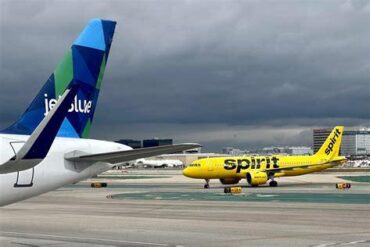
JetBlue Airways has won a major opportunity to expand its presence at New York LaGuardia Airport (LGA) after securing a $58.5 million bid for 22 former Spirit Airlines slots. The acquisition gives the hometown carrier access to an additional 11 daily round-trip flights, strengthening its position at one of the most tightly controlled airports in the United States.
The deal follows Spirit Airlines’ shutdown of operations in May, which left behind a valuable portfolio of airport slots at LaGuardia. Because of strict capacity limits at the airport, these slots are considered highly valuable assets that rarely become available. JetBlue’s successful bid placed it ahead of competing offers, including a $57.5 million proposal from Frontier Airlines.
The transaction remains subject to final court and regulatory approvals, including authorization from the Federal Aviation Administration (FAA). Current expectations suggest that approval could arrive by August 5, with the closing process continuing into October. If completed, the transfer would allow JetBlue to begin planning additional LaGuardia services, although any significant expansion is unlikely to happen until 2027.
JetBlue Eyes Return to LaGuardia’s Historic Marine Air Terminal
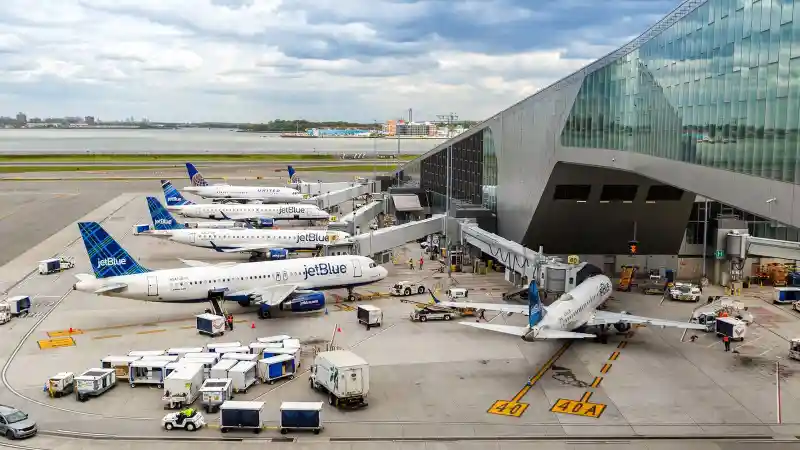
One of the most important elements of the agreement is the potential opportunity for JetBlue to take over operations at Terminal A, also known as the Marine Air Terminal. The Art Deco-style facility is one of LaGuardia’s most recognizable buildings and has a special connection with JetBlue, as the airline previously operated from the terminal before moving into newer facilities.
JetBlue has described the Marine Air Terminal as a passenger-friendly location that travelers appreciate. The terminal’s smaller scale and lower operating costs could help the airline improve efficiency at an airport where profitability has been challenging.
The Port Authority of New York and New Jersey required the winning bidder to assume the lease responsibilities for the Marine Air Terminal. For JetBlue, this requirement could create an opportunity to operate a more economical LaGuardia presence while reducing some of the financial pressure associated with airport operations.

LaGuardia is one of the most constrained airports in the country, operating under strict slot controls, a flight perimeter rule, and nighttime restrictions. Airlines have limited opportunities to add flights, meaning gaining a large group of slots can significantly reshape an airline’s network strategy.
Filling the Gap Left by Spirit Airlines at a Strategic Airport
JetBlue’s strategy reflects a broader effort to capture opportunities created by Spirit Airlines’ withdrawal from certain markets. The airline previously demonstrated a similar approach at Fort Lauderdale-Hollywood International Airport (FLL), where it moved quickly to strengthen its operations after Spirit reduced its presence.
The LaGuardia slot acquisition shows JetBlue is looking to repeat that strategy in New York. However, the airline faces a complicated challenge: expanding at LaGuardia while improving financial performance.
JetBlue Chief Executive Officer Joanna Geraghty has acknowledged that the airline has struggled to generate strong returns at LaGuardia because of high operating costs. Before this acquisition, JetBlue operated around 13 routes from the airport, with many producing only limited profits.
The additional slots provide room for growth, but the airline will need to carefully select routes that generate stronger revenue. Rather than simply adding flights, JetBlue will likely focus on improving network quality and maximizing aircraft utilization.
A Rare Expansion Opportunity in a Highly Competitive Market
The new slots represent a significant increase in JetBlue’s influence at LaGuardia, although the airline will remain smaller than the airport’s largest operators. Before the acquisition, JetBlue controlled approximately 3.4% of LaGuardia’s flight activity. The additional slots will increase its share to around 4.6%.
Delta Air Lines remains the dominant carrier at LaGuardia, controlling more than 40% of flights, while American Airlines and Southwest Airlines also maintain substantial operations. JetBlue’s expanded presence will not immediately challenge those larger competitors, but it provides the airline with a stronger foundation in one of the most important aviation markets in the world.

The purchase price also highlights the rarity of the opportunity. The $58.5 million winning bid was significantly below the estimated slot valuation of approximately $86.74 million, making the acquisition an attractive strategic investment for JetBlue if it can successfully improve profitability.
JetBlue’s Next Move Could Reshape Its New York Strategy
The final decision on whether JetBlue moves fully into the Marine Air Terminal or maintains operations across multiple LaGuardia facilities remains open. The airline will evaluate how to organize its airport presence while balancing passenger convenience, operational efficiency, and cost control.
For JetBlue, securing these former Spirit Airlines slots represents more than a simple increase in flight numbers. It provides access to rare airport capacity at a time when growth opportunities at major U.S. airports are increasingly limited.
LaGuardia’s importance within the New York metropolitan market makes the deal especially valuable. As JetBlue works to strengthen its network and improve financial performance, these newly acquired slots could become a key part of the airline’s long-term strategy in its hometown market.