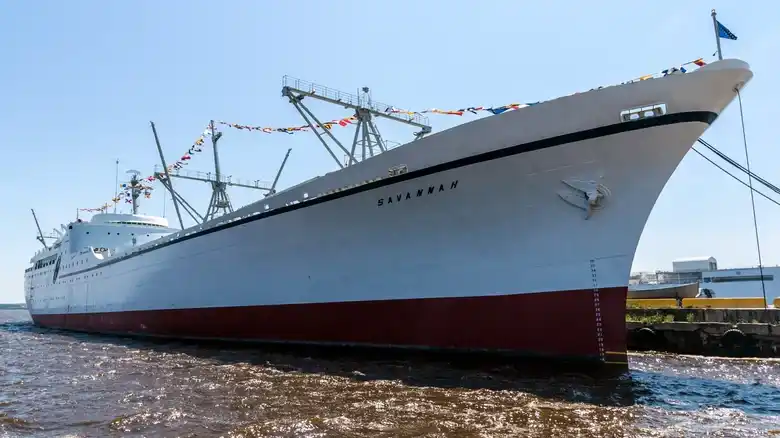
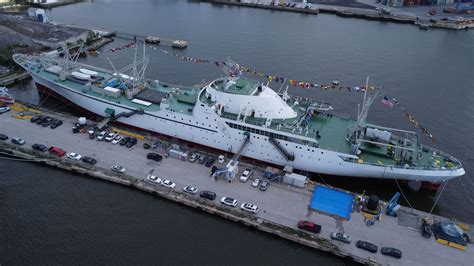
The story of nuclear power at sea almost always begins with submarines and aircraft carriers, yet the most quietly radical vessel ever to sail under a mushroom-cloud legacy was never built to fight. The NS Savannah was a merchant ship, a floating diplomatic argument that the atom could carry cargo, passengers, and above all hope across the world’s oceans. Today that argument sits motionless at the Port of Baltimore, stripped of its reactor, its license running out, and its future narrowing to three grim possibilities.
How the NS Savannah Became the First Nuclear-Powered Merchant Vessel
Long before the Savannah slipped into the water, the Soviet Union had already proved that nuclear energy could push a hull through ice. The Lenin, an icebreaker launched in 1957 and operated until 1989, holds the distinction of being the first nuclear-powered non-military vessel afloat. But icebreaking is a narrow mission, and the real test of atomic propulsion was commerce. That test arrived in 1959, when the NS Savannah entered service as the first civilian merchant vessel powered by nuclear energy. The “NS” prefix told the whole story in two letters, standing for nuclear ship.
The vessel owed its existence to President Eisenhower’s “Atoms for Peace” program, an initiative designed to rebrand the atom as a tool of prosperity rather than annihilation. The Savannah was its most visible instrument, a cargo ship that doubled as an ocean liner and tripled as a traveling exhibit of American technological ambition. It carried freight, it carried dignitaries, and it carried a message into every port it visited. Full-scale operation began in 1962, and for nearly a decade the ship sailed as the world’s only nuclear-powered merchant vessel.
A Marvel of Engineering That Never Turned a Profit
By any commercial measure, the Savannah was a beautiful failure. It was an awkward hybrid, neither a pure freighter nor a true passenger liner, and its cargo capacity suffered for it. The ship never generated a profit, and shipping companies never ordered a follow-up. What it lacked in earnings it repaid in symbolism and endurance. Across its career the Savannah crossed the Atlantic repeatedly and logged roughly 450,000 nautical miles under the Atoms for Peace banner.
Its fuel economy remains the most striking statistic in its history. The ship consumed about 163 pounds of uranium, an amount of nuclear fuel that delivered the equivalent energy of approximately 28.6 million gallons of bunker fuel. No oil tanker of the era could match that ratio, and no oil tanker could match the political weight of a reactor operating in plain sight on a civilian deck. For all its inefficiency as a business, the Savannah was an extraordinary proof of concept.
The ship’s retirement was unusually slow, and the reason was its power source. The uranium was removed in 1971, leaving an empty reactor sitting inside the hull like a sealed heart. For decades afterward, the vessel lingered in a strange bureaucratic limbo, too historically significant to dismantle and too complicated to reopen.
Why Removing the Reactor Took Fifty Years
Decommissioning a nuclear ship is not the same as decommissioning an office building. The Savannah’s reactor and the machinery that had contact with nuclear material had to be extracted without destroying a hull that carried the designation of National Historic Landmark. That landmark status created a genuine paradox: the ship was required to remain intact while its interior was gutted of the very systems that made it historically important.
Congress finally funded the reactor’s removal in 2017, and the extraction was completed on November 8, 2022, more than half a century after the reactor was shut down in 1971. In 2019, sixty years after its launch, the NS Savannah was formally decommissioned. Even then, its story refused to end cleanly. The ship remained moored and unused, a landmark without a mission and a museum without a door.
Three Fates and a License That Expires in 2026
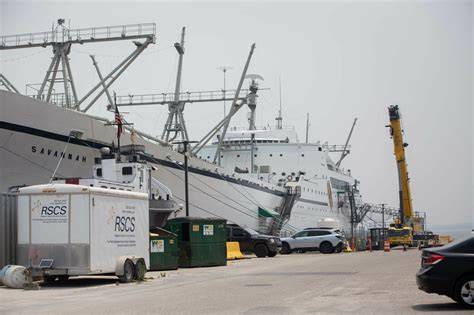
The Nuclear Regulatory Commission is expected to terminate the vessel’s license at the end of 2026, and that deadline transforms an open-ended problem into a decision. Without a license, the Savannah cannot legally remain a nuclear-licensed facility, and without a new plan, its options collapse into three. It can be preserved as a museum ship, sunk deliberately to create an artificial reef, or cut apart and scrapped. Each path carries a price, and the cheapest one is the one that erases the ship entirely.
For years, the most hopeful outcome was a return to Savannah, Georgia, where the vessel was expected to become a permanent museum exhibit. That plan collapsed at the last moment, taking with it the ship’s most credible future home. Preservation advocates at the NS Savannah Association have continued fighting to save the first nuclear-powered merchant ship, but they are working against a hard regulatory clock and an even harder budget.
What Losing the Savannah Would Mean
Scrapping the Savannah would not simply remove one old hull from a dock. It would erase the only physical artifact of a moment when nuclear power was aimed at bread rather than bombs. The ship is the last surviving embodiment of the Atoms for Peace vision, a vessel that carried cargo and countries in equal measure, and its destruction would leave that chapter documented only in photographs and archives. The NS Savannah is not merely a historic ship; it is the origin point of an entire category of technology, and the world is now deciding whether that origin deserves to exist.
With the NRC license expiring and no confirmed home, the Savannah’s survival depends on money, urgency, and public attention arriving at the same time. The first nuclear-powered civilian ship in history may soon be reduced to scrap metal, and once it is gone, nothing comparable can be rebuilt.