China has moved a step deeper into the era of maritime directed-energy warfare, mounting its LY-1 high-energy laser weapon system on a civilian roll-on/roll-off (Ro-Ro) cargo ship during sea trials in late November 2025. The installation signals a deliberate shift in how Beijing blends commercial maritime capacity with naval combat functions, creating a grey zone where cargo decks and passenger compartments may serve as improvised combat modules in time of crisis.
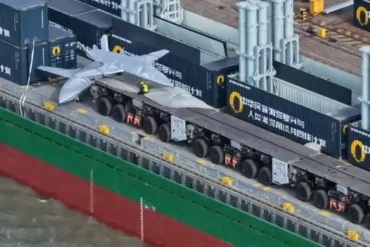
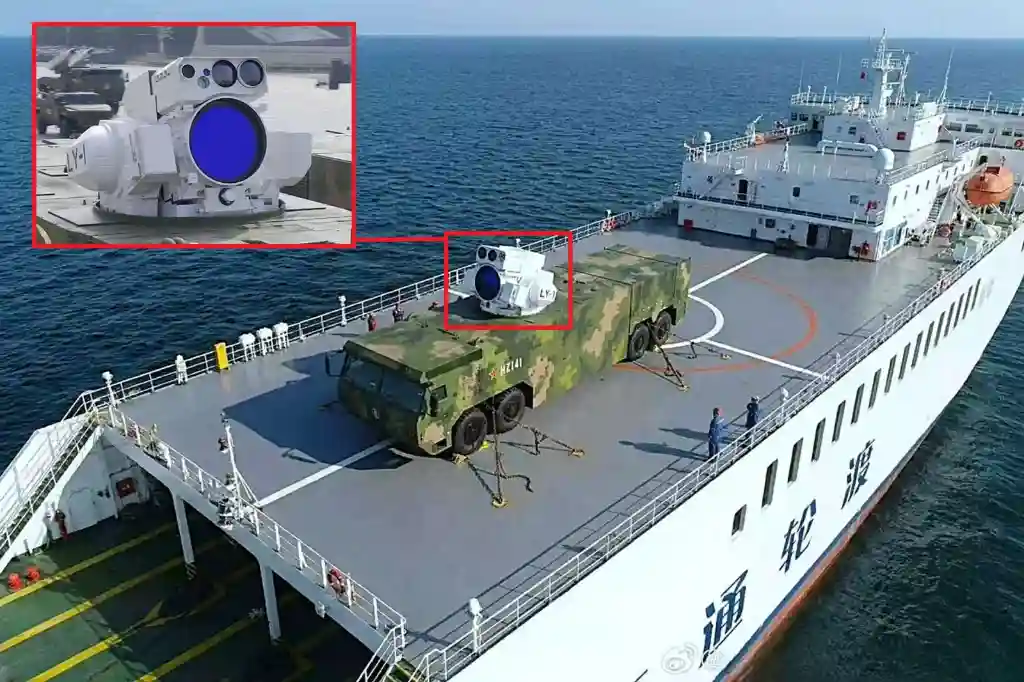
Images circulating across Chinese social media platforms on November 30 reveal the laser system perched on the forward helicopter deck of a white passenger-cargo ship, its camouflage-coated carrier vehicle chained securely to the lashing points. The vessel appears structurally unmodified, underscoring how quickly a civilian hull can become an operationally relevant weapons platform.
LY-1 Laser Weapon: China’s Shipborne Counter-Drone Layer
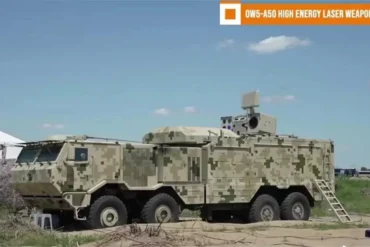
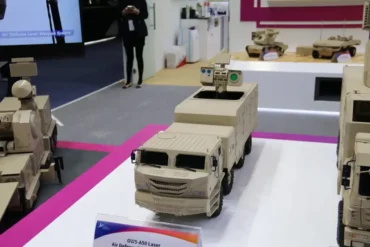
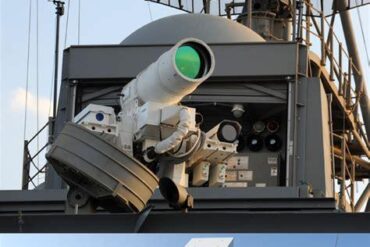
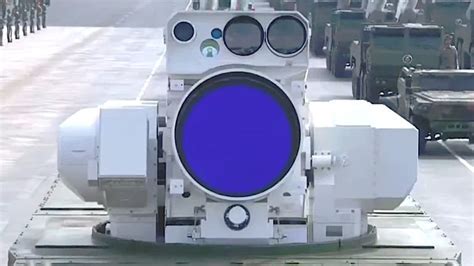
The LY-1, publicly unveiled during the 2025 Victory Day parade in Beijing, represents China’s most advanced shipborne laser for close-range air defense. Built around a large-aperture beam director and a ring of electro-optical and infrared sensors, the system is designed to engage drones, loitering munitions, helicopters and potentially low-flying cruise missiles at the speed of light. Open-source estimates place its output in the 180–250 kW class, with anticipated growth as China scales power generation and thermal management across larger hulls.
Although its official specifications remain undisclosed, the LY-1 has already appeared on Type 071 amphibious transport docks, including Simingshan and Qilianshan, suggesting a shift from prototype testing toward fleetwide integration. The move onto a commercial Ro-Ro ship marks a new chapter: the migration of high-energy weapons from warships into China’s vast merchant marine.
A Civilian Vessel Turned Combat Node
Photos from the latest trials show the laser mounted on its native 8×8 carrier vehicle, positioned toward the bow, surrounded by crew in blue coveralls. The vehicle is locked down using standard maritime chain tensioners, but the ship lacks any visible structural reinforcement, armored shielding or specialized power conduits. The weapon appears to operate as a self-contained module, drawing on integrated onboard power and cooling instead of relying on host-vessel systems.
This matters. It demonstrates that China can deploy directed-energy capabilities aboard virtually any suitable merchant vessel, with minimal preparation. A Ro-Ro with a wide-open deck and vehicle ramps becomes a ready-made laser platform, capable of hosting counter-UAS capabilities instead of simply ferrying tanks and trucks.
Implications for Amphibious Operations and Convoy Defense
Amphibious planners have long recognized that slow, heavily loaded civilian transports are among the softest targets in any contested environment. The ubiquity of cheap kamikaze drones and loitering munitions in current conflicts only magnifies the threat. By equipping Ro-Ro vessels with directed-energy emitters, China creates distributed defensive nodes across an amphibious convoy, reducing reliance on escort ships and complicating adversary targeting.
A laser-equipped cargo ship is capable of engaging multiple low-signature airborne threats without expending missiles. In a Taiwan Strait scenario, this would allow China to push more civilian tonnage into contested waters while providing organic protection against the type of drone swarms likely to be employed by defenders.
Civil–Military Fusion at Sea
For years, Beijing has used civilian ferries and Ro-Ro ships in beach-landing drills, rapid military loading exercises and long-range troop movements. Many have undergone ramp reinforcements or deck strengthening to accommodate armored vehicles.
Integrating a directed-energy weapon into this mix crosses a doctrinal threshold. The vessel is still legally civilian in peacetime, yet functionally militarized. Such ambiguity challenges traditional assumptions about maritime identification and classification, potentially forcing foreign commanders to treat every approaching Chinese merchant hull as a dual-use threat.
Accelerating Naval Laser Adoption
Globally, high-energy lasers are transitioning from experimental add-ons to frontline defensive tools. The U.S. Navy’s HELIOS program, Israel’s Iron Beam and European demonstrators are all converging on the same mission set: cheap, repeatable, precise engagement of drones and small craft.
China’s adaptation stands out because of the platform chosen. Instead of restricting lasers to major combatants, Beijing is testing them on auxiliary and civilian ships, expanding their role in maritime defense networks. If adopted widely, any Chinese Ro-Ro entering a flashpoint could silently add sensor-blinding and counter-UAS capacity to local forces.
A Strategic Message Wrapped in Civilian Paint
The appearance of LY-1 on a civilian cargo ship is not a one-off stunt. It is a deliberate experiment in hardening the softest elements of China’s amphibious architecture. A merchant vessel capable of burning drones from the sky shifts the calculus of convoy interdiction and escalates the risks of misidentification in dense maritime traffic.
China’s message is clear: in future Western Pacific crises, the distinction between civilian transport and combat asset will grow thinner, the drone threat will grow sharper, and the tools designed to counter that threat will increasingly travel on ships not traditionally counted as warships.