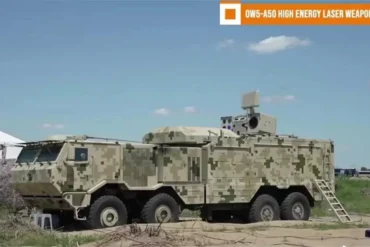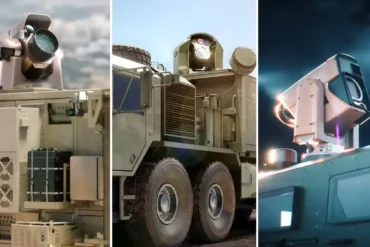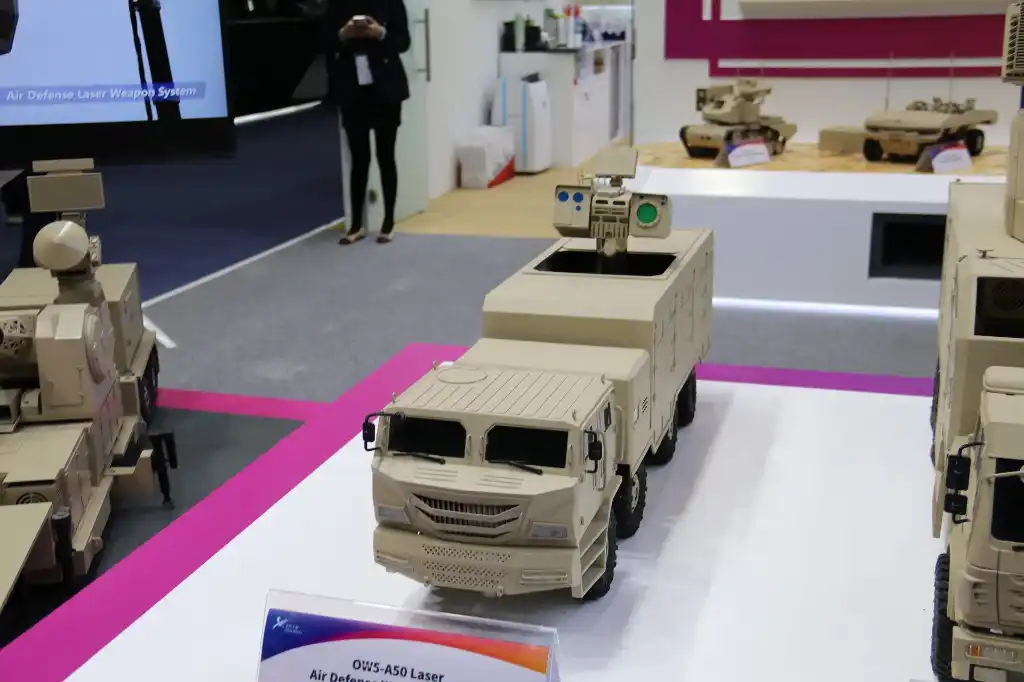
China has taken a decisive step in the global arms market by formally presenting the OW5-A50 high-energy laser air defense weapon system to international buyers, signaling a new phase in the export of directed-energy military technologies. Displayed publicly at UMEX 2026 in Abu Dhabi, the system represents one of the most mature laser-based counter-drone solutions currently offered outside Western defense programs. Its appearance underscores Beijing’s growing confidence that laser air defense has moved from experimental promise to deployable battlefield capability.
Developed by the state-owned defense conglomerate NORINCO, the OW5-A50 enters a global market shaped by the harsh lessons of modern conflict. Drone warfare has rewritten the rules of air defense, forcing militaries to seek alternatives to missile-centric interception models that are increasingly unsustainable in both cost and scale. The OW5-A50 is positioned as a response to this new reality, combining mobility, high output power, and operational autonomy into a single export-ready platform.
The system’s international debut comes only months after its first domestic appearance during China’s July 2025 Victory Day Parade, where it was showcased as part of a broader display of next-generation capabilities. At UMEX, however, the emphasis has clearly shifted from symbolic demonstration to commercial outreach. NORINCO’s presentation framed the OW5-A50 not as a conceptual prototype, but as a mature system designed for immediate integration into layered air defense architectures worldwide.
A 50-Kilowatt Laser Designed for the Drone Age
At the core of the OW5-A50 is a 50-kilowatt class high-energy laser, placing it among the most powerful mobile laser air defense systems currently marketed for export. This output level allows the system to physically disable or destroy aerial threats by burning through airframes, sensors, propulsion units, or control surfaces with sustained, precisely focused energy. Unlike kinetic interceptors, the laser engages targets at the speed of light, eliminating reaction delays and drastically reducing engagement timelines.
The OW5-A50 is engineered to counter a wide spectrum of low-altitude aerial threats, including small unmanned aerial vehicles, loitering munitions, rotary-wing aircraft, and certain short-range indirect fire threats such as mortar rounds. Its effectiveness against slow, low, and small targets reflects a deliberate design focus on the threat profiles dominating current and near-future battlefields rather than traditional fast jets or ballistic missiles.
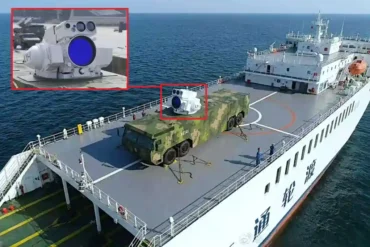
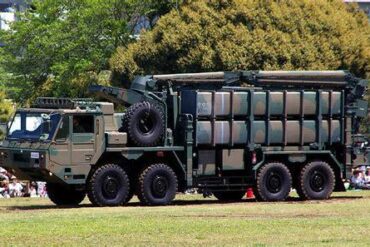
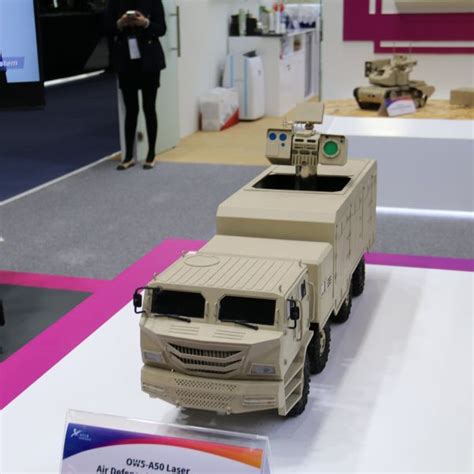
Crucially, the system is mounted on a heavy 8×8 wheeled tactical truck, giving it strategic and tactical mobility. This configuration allows rapid redeployment across road networks, desert terrain, or dispersed defensive sites. Integrated stabilizers and sensor masts enable firing from short halts, reducing exposure time and improving survivability against counter-battery or loitering munition attacks.
Autonomous Power and Sensor Integration
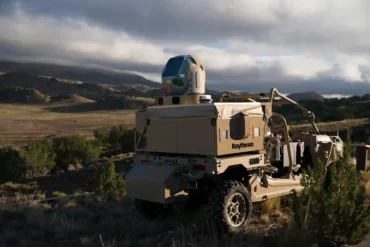
One of the most significant differentiators of the OW5-A50 is its self-contained power generation module. Earlier generations of laser systems often relied on external generators or fixed infrastructure, creating logistical dependencies and single points of failure. By integrating power generation directly into the vehicle, NORINCO has produced a system capable of sustained independent operation in austere environments, forward areas, or rapidly shifting operational theaters.
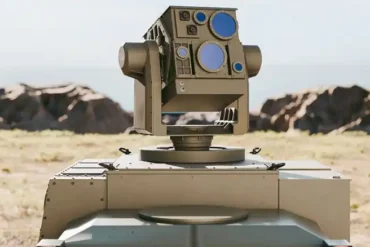
The laser weapon is paired with an electro-optical and infrared tracking suite, enabling precise target acquisition and continuous tracking without reliance on emissions-heavy radar systems. This passive sensing approach enhances survivability in contested electromagnetic environments while improving detection of small drones with minimal radar cross-sections. Although NORINCO has not publicly released detailed engagement ranges, defense analysts estimate effective engagement distances extending several kilometers, depending on atmospheric conditions and target characteristics.
Lessons Drawn from the Russia–Ukraine War
The OW5-A50 is a product of battlefield observation as much as technological development. Chinese defense planners have closely studied the Russia–Ukraine conflict, where inexpensive drones have repeatedly penetrated layered defenses and inflicted disproportionate damage. Commercial quadcopters, FPV kamikaze drones, and loitering munitions costing a few thousand dollars have forced the use of interceptor missiles worth orders of magnitude more.
This imbalance has exposed a structural weakness in conventional air defense doctrine. Missile systems such as Buk, Tor, and NASAMS are technically capable of intercepting drones, but doing so at scale is economically and logistically unsustainable. Reload times, missile stockpiles, and cost-per-shot ratios all work against defenders when confronted with persistent or swarming drone attacks.
Directed-energy weapons like the OW5-A50 address this mismatch directly. As long as power is available and line of sight is maintained, the system can engage targets repeatedly with near-zero marginal cost per shot. This fundamentally alters defensive economics, allowing commanders to reserve missiles for high-value targets while relying on lasers to neutralize mass drone threats.
Evolution of the OW5 Family
The OW5-A50 represents the highest-powered variant in NORINCO’s OW5 laser air defense family, which has been under development for several years. Earlier models such as the OW5-A10 and OW5-A30 were designed for lighter vehicles and point-defense roles, offering lower power outputs suitable for infrastructure protection or convoy defense. These systems emphasized portability and rapid deployment but were limited in their ability to counter hardened or swarming threats.
The A50 variant marks a clear escalation in capability. Its higher output power enables faster kill times and engagement of more resilient targets, while its heavy chassis supports longer operational cycles and enhanced thermal management. This progression reflects a broader trend within China’s defense industry toward scalable modular systems that can be tailored to different operational requirements and export customers.
Strategic Implications for the Global Arms Market
China’s decision to market the OW5-A50 internationally carries implications beyond the system itself. Directed-energy weapons have long been dominated by U.S. and Israeli research programs, many of which remain restricted or limited in export scope. By contrast, NORINCO’s willingness to offer a high-power laser system on the open market positions China as a potential first mover in supplying affordable laser air defense to developing and mid-tier militaries.
For regions facing persistent drone threats—particularly the Middle East, North Africa, and parts of Asia—the OW5-A50 offers an attractive combination of capability, autonomy, and cost efficiency. Its appearance at UMEX, a venue strongly focused on unmanned systems and counter-UAS technologies, was a calculated move aimed at customers already grappling with drone proliferation.
The OW5-A50 also signals a broader shift in China’s defense export strategy. Rather than competing solely on price with conventional platforms, Beijing is increasingly promoting next-generation technologies as export differentiators. Laser air defense, once viewed as futuristic, is now being presented as a practical solution to real-world operational problems.
As drone warfare continues to evolve, systems like the OW5-A50 illustrate how directed energy is moving from experimental novelty to operational necessity. China’s entry into this market suggests that the global balance in air defense technology is entering a new phase—one defined not by explosive interceptors, but by concentrated beams of light capable of reshaping how the skies are defended.