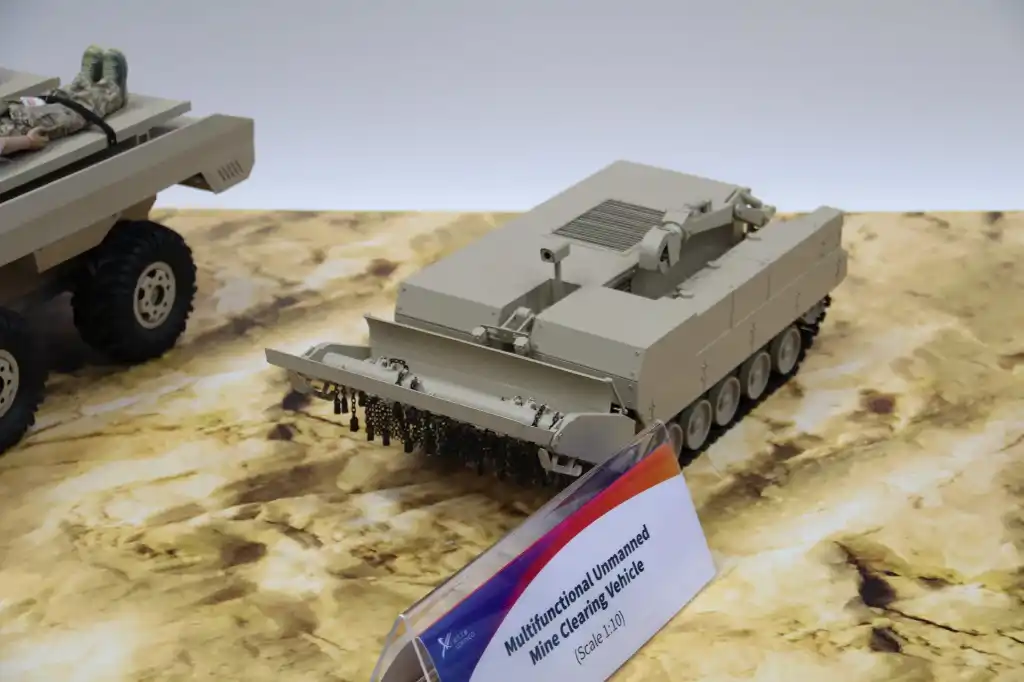
China has revealed a new tracked Multifunctional Unmanned Mine Clearing Vehicle at UMEX 2026 in Abu Dhabi, marking a significant evolution in its autonomous ground warfare and combat engineering capabilities. Presented as a next-generation unmanned system, the vehicle highlights Beijing’s accelerating investment in robotic platforms designed to operate in the most hazardous battlefield environments while minimizing human exposure to lethal threats.
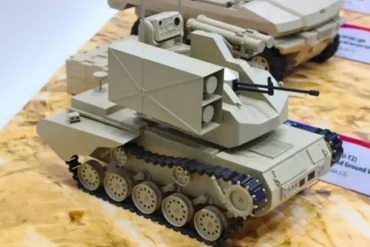
Unveiled during the UMEX 2026 unmanned systems exhibition, the platform was displayed as a 1:10 scale model at the NORINCO booth, offering rare insight into the future direction of Chinese military engineering systems. The concept reflects a deliberate shift toward highly adaptable unmanned ground vehicles capable of both combat breaching and post-conflict demining, aligning with modern doctrines that prioritize survivability, tempo, and operational flexibility.
The new system is designed to detect, neutralize, and remove landmines while simultaneously clearing obstacles such as debris, fortifications, and vegetation. Unlike legacy mine-clearing vehicles that are often constrained to a single task, this unmanned platform integrates multiple engineering functions into one tracked chassis, suggesting it is intended to operate at the forefront of maneuver formations rather than in rear-area support roles.
Modular Engineering System Built for Modern Battlefields
At the core of the vehicle’s design is a multi-tool front assembly capable of accommodating up to five different mine-clearing and obstacle-breaching systems. These include a 1.8-meter bulldozer blade, a self-propelled Boikova mine sweeper, solid milling cutters, a rotating tiller, and the Katkov demining trawl. This modular architecture allows rapid reconfiguration depending on terrain, threat type, and mission objectives, a key requirement for modern multi-domain operations.
The primary rotating tiller, mounted at the front, is engineered to destroy buried mines using hardened rotating chisels, enabling the system to neutralize both anti-personnel and anti-tank mines. Its mechanical force and depth penetration suggest an emphasis on reliability against hardened explosive devices commonly encountered in contested zones, including improvised and legacy minefields.
Precision Robotics for Complex Terrain
Mounted above the main chassis is a compact robotic “crab” manipulator arm designed for precision tasks beyond the reach of heavy tools. This arm enables the vehicle to clear light obstacles, manipulate debris, cut vegetation, and perform preparatory actions in confined or urban environments. Such fine motor capability significantly enhances the platform’s effectiveness in dense terrain where traditional mine-clearing vehicles struggle to operate.
The inclusion of both heavy breaching tools and delicate manipulation systems demonstrates a clear intent to create a true multifunctional engineering UGV, capable of transitioning seamlessly between brute-force clearance and precision support roles during the same mission.
Tracked Mobility and Autonomous Architecture
The vehicle is built on a fully tracked chassis, optimized for stability and mobility across sand, rubble, mud, and uneven ground. The absence of a crew compartment indicates a fully unmanned design, likely operated remotely or in a semi-autonomous mode from a secure control station. This configuration allows the platform to enter minefields and kill zones without risking personnel, a decisive advantage in high-intensity conflicts.
Sensor modules positioned above the front hull suggest integration of electro-optical systems, LIDAR, and ultrasonic sensing, enabling real-time terrain mapping, obstacle detection, and route planning. These sensors are essential for autonomous navigation and precise mine-clearing operations, particularly in degraded visual environments or at night.
Strategic Implications for Future Warfare
China’s unveiling of this system at UMEX 2026 underscores its ambition to reshape battlefield engineering through unmanned systems. By combining mine clearance, obstacle removal, and route preparation into a single robotic platform, the People’s Liberation Army gains the ability to breach defenses faster and with significantly reduced risk to soldiers.
Such vehicles are likely to play a critical role in future combined arms operations, clearing paths for infantry, armored units, and logistics convoys under fire. The debut also signals potential export ambitions, positioning China as a major supplier of advanced unmanned engineering solutions to international partners seeking cost-effective alternatives to manned systems.
As autonomous ground warfare continues to evolve, this tracked unmanned mine-clearing vehicle represents a clear statement of intent: China is moving decisively toward a future where machines lead the most dangerous missions on the battlefield.