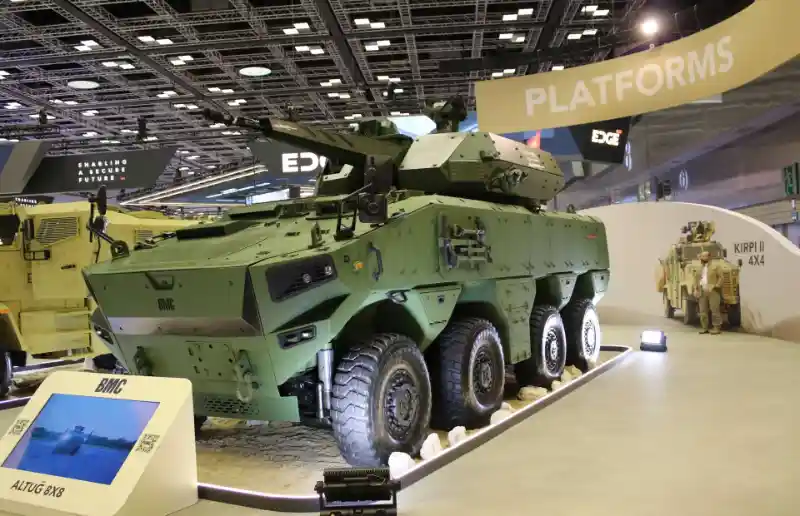
Türkiye has taken a decisive step in showcasing the evolution of its land combat systems with the public unveiling of the Altuğ 8×8 Infantry Fighting Vehicle (IFV) armed with the ASELSAN SARP 100/35 unmanned turret. Revealed at DIMDEX 2026 in Doha, the platform reflects a calculated response to the operational realities shaping modern battlefields in the Gulf and wider Middle East, where mobility, protection, and layered firepower increasingly define frontline survivability.
Displayed in Barzan Holdings’ exhibition hall, the Altuğ 8×8 represents the latest armored vehicle solution from Turkish manufacturer BMC, positioned as a fully fledged infantry carrier rather than a lightly protected fire support vehicle. Its configuration underscores Türkiye’s intent to offer export-ready systems tailored to environments dominated by urban density, asymmetric threats, and the rapid proliferation of drones and precision-guided weapons.
The vehicle’s presentation at DIMDEX is not incidental. Qatar’s defense exhibition has become a focal point for Gulf militaries seeking adaptable platforms that balance strategic mobility with tactical overmatch, and the Altuğ’s design philosophy clearly aligns with these demands. By integrating an unmanned 35 mm turret, Türkiye signals a shift toward crew-protected lethality, where sensors, weapons, and digital architecture operate as a unified combat system.
A True Infantry Fighting Vehicle Built Around Mobility and Capacity
At its core, the Altuğ 8×8 is engineered as a full-capacity infantry fighting vehicle, capable of transporting up to 12 personnel, including a three-person crew and nine dismounts. This capacity distinguishes it from many wheeled platforms that sacrifice troop space for firepower, instead enabling mechanized infantry operations where soldiers arrive protected, networked, and ready to fight.
Powering the vehicle is a 711-horsepower Caterpillar C13 diesel engine coupled to an Allison 4000-series automatic transmission, delivering a top road speed of 110 km/h and an operational range exceeding 800 kilometers. These figures translate into sustained operational reach across vast desert distances, a critical requirement for Gulf theaters where infrastructure nodes and energy assets are widely dispersed.
The Altuğ’s four-axle hydraulic steering system enhances maneuverability in constrained urban environments, while its off-road performance metrics are tuned for mixed terrain. A 1.2-meter fording depth, 60-centimeter vertical obstacle clearance, 2.2-meter trench crossing capability, and over 40 centimeters of ground clearance collectively enable the vehicle to transition seamlessly between paved city grids and rugged desert outskirts.
SARP 100/35: Unmanned Firepower with Multi-Domain Reach
Central to the Altuğ’s combat identity is the ASELSAN SARP 100/35 unmanned turret, a stabilized weapon system designed for both wheeled and tracked platforms. By relocating the crew entirely within the armored hull, the turret significantly enhances survivability while preserving full combat effectiveness.
The system is built around a 35 mm automatic cannon offering single-shot, slow-burst, and rapid-burst firing modes. A ready-to-fire load of 100 rounds, supported by 200 additional stowed rounds, is managed through a linkless automatic ammunition feeding mechanism. This design allows multiple ammunition types to be carried simultaneously, enabling instantaneous selection based on the target profile.
Operationally, this translates into a flexible mix of armor-piercing, airburst, and high-explosive destructive munitions, giving the Altuğ credible engagement options against light armored vehicles, dismounted infantry, troops behind cover, and low-flying aerial threats, including small unmanned aerial systems.
Secondary Weapons and Close-Combat Adaptability
Beyond its main gun, the SARP 100/35 is designed to manage escalation efficiently. The turret supports a coaxial machine gun, configurable as either a 7.62 mm weapon with up to 3,750 rounds or a 12.7 mm heavy machine gun with 200 rounds. This capability allows crews to engage soft targets without unnecessarily expending 35 mm ammunition, preserving high-value rounds for priority threats.
An optional independent remote weapon station can also be integrated, supporting 12.7 mm machine guns, 40 mm automatic grenade launchers, or 7.62 mm systems. This layered armament enables simultaneous engagements and enhances the commander’s ability to control complex urban fights. Integrated smoke grenade launchers further support rapid concealment, a vital feature for vehicles operating under constant surveillance.
The turret’s engagement envelope is optimized for dynamic battlefields, offering 360-degree rotation and elevation ranging from –10 to +45 degrees. High traverse and elevation speeds allow rapid reaction against pop-up threats, particularly drones and rooftop positions, which have become defining features of recent conflicts.
Survivability, Sensors, and Networked Warfare
Weighing between 3.75 and 4.5 tonnes, depending on configuration, the SARP 100/35 provides STANAG 4569 Level 2 ballistic protection, balancing armor coverage with the mobility constraints of an 8×8 platform. This protection level is complemented by the Altuğ’s broader survivability architecture, which can include laser warning receivers, gunshot detection systems, active protection options, and 360-degree situational awareness cameras.
Together, these systems position the Altuğ as a sensor-driven fighting platform, capable of operating within networked command-and-control environments. This integration reflects a broader regional shift toward vehicles that are not merely armored carriers but active nodes in joint and combined operations.
Strategic Significance for the Gulf and Beyond
The debut of the Altuğ 8×8 with a 35 mm unmanned turret at DIMDEX carries implications beyond a single vehicle reveal. It highlights how medium-weight armored forces are being reshaped to counter a threat spectrum that now includes drones, loitering munitions, and precision-guided weapons alongside traditional ground combat challenges.
For Qatar, the platform aligns with national priorities centered on infrastructure protection, rapid reaction forces, and interoperability with allied formations. For Türkiye, it reinforces the country’s role as a supplier of export-oriented, combat-proven defense systems tailored to regional operational realities.
As Gulf militaries continue to modernize, the Altuğ 8×8 armed with the SARP 100/35 stands as a clear statement of intent: future frontline combat vehicles must be fast, digitally connected, and capable of delivering decisive firepower while keeping crews protected in increasingly transparent and contested battlespaces.