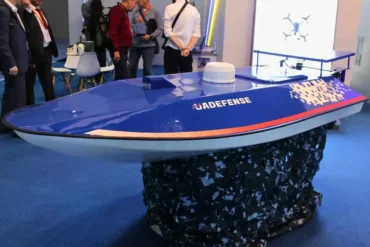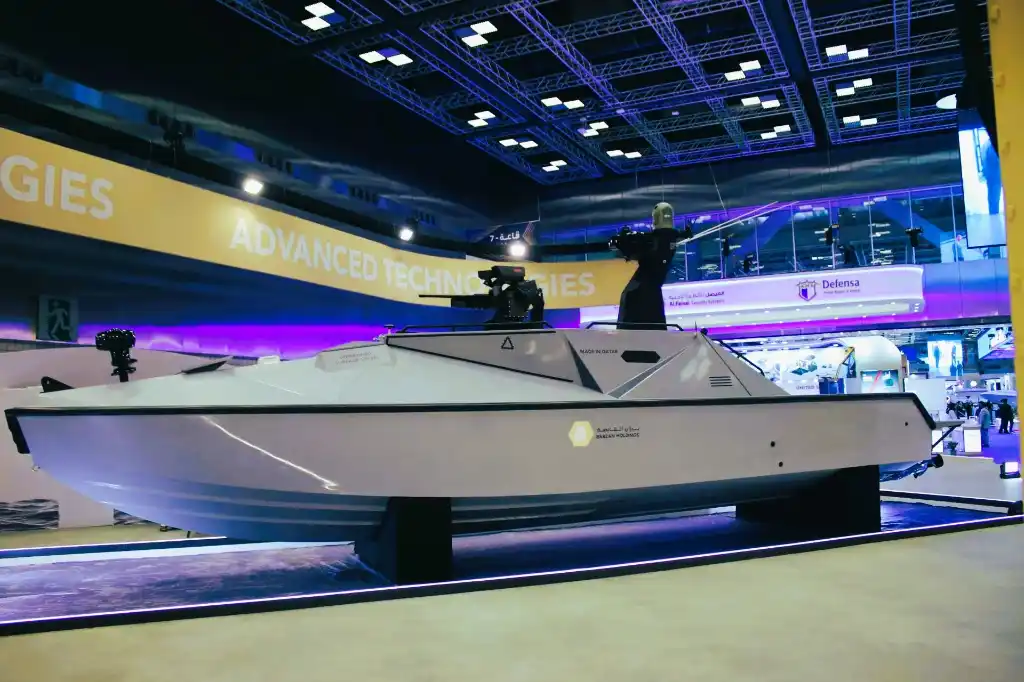
Qatar’s defense industry marked a decisive milestone at DIMDEX 2026 with the public debut of an armed unmanned surface vessel (USV) developed by Barzan Holdings, underscoring the country’s strategic intent to secure its maritime domain through autonomous, networked systems. Unveiled in Doha amid heightened regional focus on sea lines of communication and critical offshore infrastructure, the platform reflects a deliberate shift toward unmanned solutions capable of delivering persistent surveillance and calibrated firepower without exposing crews to danger.
The introduction of this vessel places Qatar firmly within a global movement reshaping naval doctrine, where autonomy, modularity, and data-driven command-and-control increasingly define maritime superiority. For a coastal state whose economic lifelines depend on offshore energy assets and uninterrupted shipping, the operational logic behind an armed USV is compelling: sustained presence, rapid response, and scalable lethality tailored to complex, often ambiguous threat environments.
Designed domestically from the outset, the Barzan USV is not presented as a technology demonstrator but as a mission-ready platform engineered for real-world deployment. Its appearance at DIMDEX 2026 signals confidence in indigenous engineering and a clear ambition to integrate unmanned surface combatants into national and cooperative security architectures.
Indigenous Design Focused on Littoral Dominance
The Barzan unmanned surface vessel measures 39 feet (11.9 meters) in length, a size carefully chosen to balance speed, payload capacity, and access to shallow coastal waters. Constructed from fiber-reinforced plastic using vinylester and ISO-grade resins, the hull is optimized for durability and corrosion resistance in the Gulf’s warm, saline environment. A beam of 3.1 meters and a shallow 0.76-meter draft enable operations close to shorelines, ports, and offshore installations where larger warships face limitations.
Propulsion is delivered by twin 350-horsepower FNM 42HPE inboard diesel engines coupled to Castoldi TD284 HCT water-jet units, pushing the vessel beyond 30 knots while maintaining exceptional maneuverability. Water-jet propulsion also reduces vulnerability in confined or debris-laden waters and allows precise handling at low speeds during patrol or inspection missions. With an approximate displacement of 8,200 kilograms, the platform carries 1,200 liters of fuel and supports a payload capacity of 940 kilograms, providing flexibility for diverse mission configurations.
Stability and endurance are enhanced by a Quick Gyro MC X7 stabilizer, ensuring steady sensor performance even in challenging sea states. Electrical power for mission systems comes from a 15 kVA generator, while onboard climate control supports sensitive electronics during extended operations in high-temperature conditions.
Modular Combat and Sensor Architecture
At the core of the Barzan USV’s design philosophy is a payload-agnostic, modular architecture that allows rapid reconfiguration for different operational roles. The baseline configuration includes a four-axis gyro-stabilized electro-optical/infrared (EO/IR) sensor providing high-resolution day and night surveillance, target identification, and tracking. This is complemented by a 12.7 mm remote-controlled weapon station, delivering stabilized, precision fire suitable for engaging fast attack craft or asymmetric maritime threats.
A ruggedized multi-spectral maritime searchlight with real-time filter selection enhances target illumination and identification during low-visibility operations. Together, these systems form a tightly integrated sensor-shooter loop optimized for unmanned employment.
Beyond the standard fit, the vessel supports an array of optional payloads tailored to mission demands. These include long-range acoustic devices for non-lethal deterrence, sonar systems for underwater awareness, anti-submarine warfare packages, electronic warfare modules, and mission kits dedicated to patrol and area security. The generous payload capacity and available 240-volt AC power allow operators to combine lethal and non-lethal effects on a single platform, enabling nuanced responses across the escalation spectrum.
Unified Command-and-Control Backbone
Equally significant is the Barzan command-and-control (C2) system that underpins the USV’s operation. Designed as a multi-domain management environment, the system is capable of overseeing unmanned platforms across maritime, air, and land domains from a unified interface. It delivers a comprehensive operational picture by fusing sensor feeds, navigation data, and platform health information for users ranging from tactical operators to national-level decision-makers.
Mission planning, execution, and post-mission analysis are fully integrated, allowing commanders to review recorded data and refine tactics through analytics. Built-in video management and automated threat detection, coupled with geographic information systems, support accurate navigation and situational awareness in congested sea lanes. Obstacle-avoidance functions compliant with international maritime collision regulations enable safe semi-autonomous or autonomous navigation, a critical requirement for operations near commercial traffic.
The system’s multi-language support and compliance with NATO and ISO 9001/12207 standards highlight an emphasis on interoperability and export readiness, positioning the platform for cooperative security missions and potential international customers.
Operational Advantages in Contested Waters
In operational terms, the Barzan USV offers coastal forces a potent combination of persistence, speed, and survivability. High sprint speeds and agile maneuvering allow rapid interception or shadowing of suspicious contacts, while the shallow draft supports close-in protection of ports, offshore platforms, and subsea infrastructure. Unlike manned patrol craft, the USV can sustain long loiter missions without fatigue, maintaining continuous surveillance over critical areas.
The layered sensor suite enables early detection and identification, while the availability of non-lethal options provides commanders with tools to manage encounters below the threshold of armed conflict. When escalation is unavoidable, the stabilized 12.7 mm weapon station and optional anti-surface payloads deliver precise, controlled firepower, reducing collateral risk and preserving human life.
These attributes are particularly relevant in environments characterized by grey-zone activity, where state and non-state actors employ ambiguous tactics that demand persistent presence and rapid, proportionate response rather than overwhelming force.
Strategic Implications for Qatar and the Region
The unveiling of an indigenous armed USV reinforces Qatar’s broader strategy to expand its domestic defense-industrial base while addressing specific national security requirements. By developing a modular, standards-compliant platform capable of ISR, patrol, electronic warfare, and anti-submarine roles, Barzan Holdings positions itself as a provider of tailored solutions for Gulf and regional navies facing diverse maritime threats.
The emphasis on networked operations and multinational-ready C2 aligns with evolving naval concepts that integrate unmanned systems as force multipliers alongside traditional surface combatants. In a region where maritime security is increasingly contested by drones, fast attack craft, and covert sabotage, distributed unmanned platforms complicate adversary targeting and enhance resilience.
A Marker of Evolving Naval Doctrine
Barzan Holdings’ armed unmanned surface vessel is more than a single platform debut; it is a tangible expression of how autonomous systems are reshaping maritime defense. By combining a robust hull, modular payloads, and an integrated C2 ecosystem, Qatar has presented a coherent vision for unmanned surface operations tailored to the operational realities of the Gulf.
As regional navies reassess how to protect critical infrastructure and shipping against increasingly sophisticated threats, the Barzan USV stands as a model for how indigenous industry can deliver scalable, exportable capabilities. Its debut at DIMDEX 2026 signals that unmanned surface combatants are no longer peripheral assets but emerging cornerstones of modern maritime security architectures.