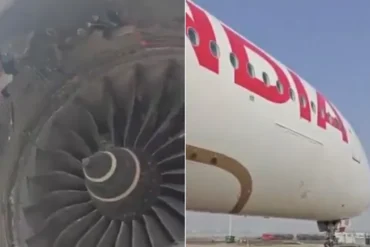
A British Airways Airbus A321neo narrowly avoided a potentially serious aviation incident at Milan Malpensa Airport after a baggage container caught fire moments before it was due to be loaded onto the aircraft. The incident occurred while flight BA585 was preparing to depart for London Heathrow, turning an otherwise routine ground operation into a rapidly developing emergency on the airport apron.
Video shared on X by Jon Sopel showed fire engines and emergency crews rushing toward the burning baggage container, with thick smoke rising from the growing blaze. Ground personnel moved quickly to evacuate nearby baggage containers while airport firefighters tackled the flames. Their rapid response prevented the fire from spreading farther across the ramp or reaching the aircraft itself.
The cause of the fire had not been definitively established, although lithium-ion batteries inside passenger luggage were initially suspected. Consumer electronics containing rechargeable batteries have become an increasingly important aviation safety concern because damaged or defective cells can enter thermal runaway, generating intense heat and potentially igniting surrounding materials. Despite the dramatic incident, BA585 eventually reached Heathrow after a delay of just under two hours.
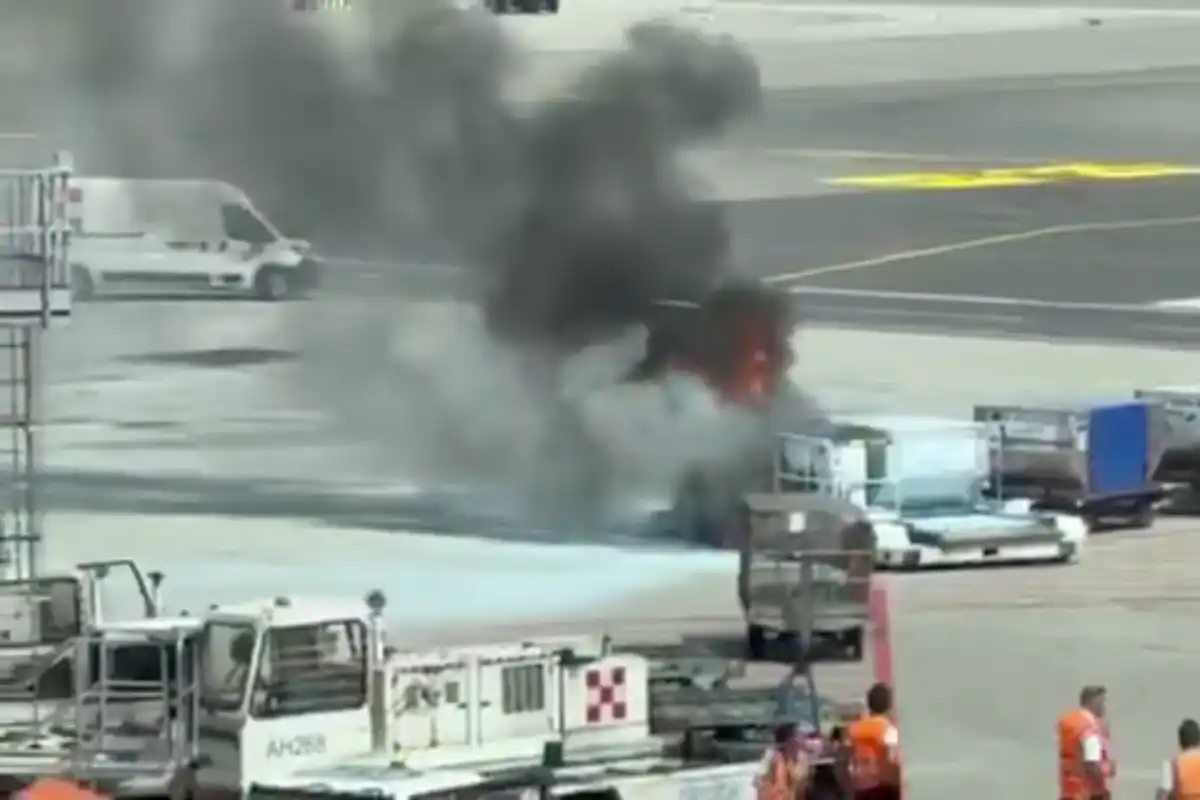
Fire Erupts Before Baggage Reaches the British Airways A321neo
The location of the fire was crucial. Because the baggage container had not yet been loaded onto the British Airways A321neo, firefighters could approach it directly and crews could move surrounding equipment away from the flames. Airport emergency responders extinguished the blaze within minutes, preventing a potentially much more difficult situation inside the aircraft.
A fire involving lithium-ion batteries presents particular challenges because thermal runaway can continue even after conventional firefighting efforts begin. Once a cell enters this condition, its temperature can rise rapidly, potentially causing neighboring cells to fail in succession. The resulting chain reaction can produce flames, toxic gases and substantial heat, making battery-related fires fundamentally different from many ordinary baggage fires.
On an airport apron, firefighters have immediate access to the affected container and can isolate nearby equipment. Inside an aircraft, however, the circumstances would be dramatically different. A fire concealed within a tightly packed cargo compartment could be difficult to locate, while smoke and heat could develop faster than the crew can identify the precise source.
Why Lithium-Ion Batteries Remain a Major Aviation Hazard
Lithium-ion batteries are now found in an enormous range of everyday devices, including smartphones, laptops, tablets, cameras, power banks and other portable electronics. The growing popularity of high-capacity battery packs has increased the quantity of stored chemical energy traveling aboard commercial aircraft every day.
The danger becomes particularly significant when batteries are damaged, defective, improperly protected or accidentally activated. A battery can be crushed inside luggage, short-circuited by loose metal objects or compromised during handling. In the wrong circumstances, those conditions can trigger thermal runaway and ignite materials surrounding the battery.
Aviation authorities and airlines therefore impose restrictions on certain battery types and require passengers to carry many lithium-powered devices in the cabin rather than checked baggage. The reason is straightforward: a battery fire is easier to identify and address in the passenger cabin than in an inaccessible baggage compartment.
The seriousness of the threat was demonstrated by UPS Airlines Flight 6 in 2010. The Boeing 747-400 freighter crashed near Dubai after a lithium-battery fire developed in its cargo compartment. Investigators determined that the fire rapidly intensified, producing severe smoke and heat that ultimately overwhelmed the aircraft and its two-person crew.
Another tragic example followed in 2011, when Asiana Airlines Flight 991 suffered an uncontrolled cargo fire involving hazardous materials, including lithium-ion batteries. The Boeing 747 freighter crashed into the sea while attempting to divert, killing both crew members. These accidents remain important reminders of how quickly an onboard cargo fire can become an existential threat.
A Ground Fire Is Safer Than an In-Flight Battery Fire
The Milan incident illustrates an important distinction between a baggage fire on the ground and one discovered after an aircraft has departed. On the ground, emergency crews can immediately access the container, deploy firefighting equipment and remove surrounding baggage. The aircraft itself can also remain safely parked while responders investigate the source.
At cruising altitude, pilots have far fewer options. Aircraft cargo compartments contain fire detection and suppression systems designed to detect and suppress fires, but these systems are not intended to magically eliminate every type of chemical reaction. A lithium-ion battery undergoing thermal runaway can continue producing heat even when conventional flames are suppressed.
According to UL safety research referenced in discussions of aviation battery fires, crews facing a severe in-flight lithium battery fire may have a very limited window to land the aircraft safely. The combination of heat, smoke and potentially toxic gases can rapidly degrade conditions, making an immediate diversion essential.
That reality explains why airlines can sometimes make seemingly conservative decisions when the location or condition of a lithium-powered device becomes uncertain. A notable example involved United Airlines Flight 126, which returned to Washington Dulles after a laptop reportedly fell into an inaccessible area near the cargo compartment. With the crew unable to determine whether the battery could become a fire hazard, returning to the airport represented the safest available option.
British Airways Incident Highlights Importance of Battery Safety
The fire at Milan Malpensa did not result in injuries or an aircraft emergency, but its timing made it an important aviation safety warning. The baggage container caught fire before it could be loaded onto the British Airways A321neo, allowing airport responders to deal with the problem under controlled conditions.
For passengers, the incident reinforces why airline battery rules should be taken seriously. Keeping spare lithium batteries and power banks in carry-on baggage allows cabin crew to identify abnormal heat, smoke or other warning signs much sooner than would be possible if the device were buried inside checked luggage.
The BA585 incident ultimately ended with a delay rather than a disaster. Yet the smoke rising beside an aircraft serves as a powerful reminder that modern air travel depends not only on sophisticated aircraft systems, but also on careful handling of increasingly powerful consumer batteries. What happened at Milan remained a ground incident. Had the same fire begun after takeoff, the consequences could have been far more serious.