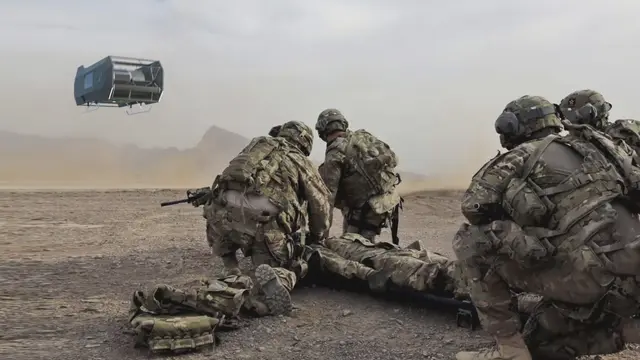
The race to redefine aerial logistics and tactical mobility has entered a bold new chapter. Airvolve, a Lithuanian aerospace startup, is developing a hybrid-electric aircraft called the Airlift — a 20-foot flying container-style drone poised to revolutionize how militaries conduct cargo transport, casualty evacuation, and operations in high-risk zones. With promises to cut operational costs by up to 90% compared to traditional rotorcraft, this innovation isn’t just futuristic — it’s urgently relevant.
The Birth of a New Tactical Aircraft: Simpler, Safer, and Smarter
Amid rising conflict zones and natural disasters, existing aircraft like helicopters have shown their age. Vulnerable to cheap, shoulder-fired missiles and burdened by enormous operating costs, conventional rotorcraft are no longer agile enough for modern combat or disaster response. Airvolve’s Airlift is designed to be the answer. It fuses the operational flexibility of a drone with the load-bearing capacity of small helicopters — all packed into a compact, modular form.
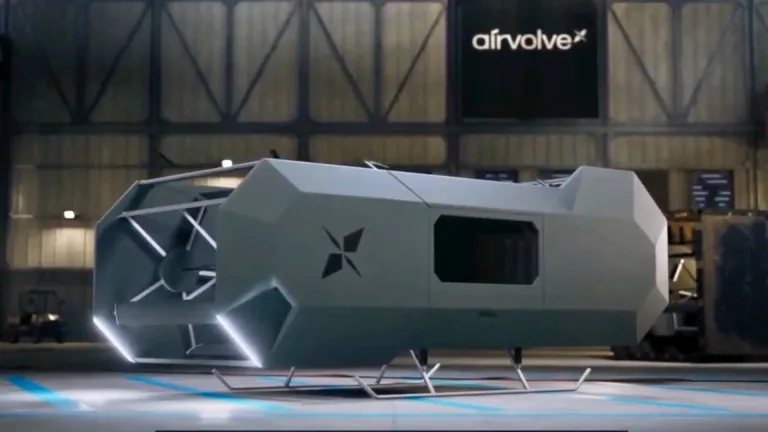
This container-style aircraft spans 20 feet and is engineered with a lightweight, hybrid-electric propulsion system. It can carry up to 200 kilograms (441 pounds) of cargo with a range of 100 kilometers (62 miles), boasting an impressive five cubic meters of internal space. The Airlift is specifically being tailored for military clients in countries like Ukraine, Greece, Poland, and Lithuania, where budget constraints meet a high demand for reliable, rugged transport platforms.
Cutting-Edge Rotor Design Inspired by the Past
At the heart of Airvolve’s innovation is its unique rotor configuration. Departing from the standard vertical-axis rotors of helicopters, the Airlift employs horizontal-axis rotors — a design concept that dates back to Boeing experiments in the 1930s. These “helicopter blades that fold like a big umbrella,” as Airvolve CEO Donatas Gendvilas describes them, were once abandoned due to material limitations. Today, advanced composites and aerodynamic modeling have resurrected this design into a viable, efficient, and more survivable architecture.
Mission-Ready Efficiency: Built for the Battlefield and Beyond
Designed for seamless integration with existing military infrastructure, the Airlift requires no specialized charging systems or extensive pilot training. It can land in tight spaces, fly autonomously or with a human operator, and be rapidly deployed for combat support, humanitarian aid, or logistics missions. The aircraft is built to NATO standards, supporting standardized loading systems for fast deployment.
Crucially, the Airlift avoids the weight penalties of large batteries by using a hybrid-electric system where electric motors are powered primarily by a compact, conventional aircraft engine. Lightweight batteries are only included for backup functionality. The team is currently evaluating certified light aircraft engines capable of delivering around 100 kilowatts, sidestepping the complexity and cost of traditional turbine powerplants.
Aviation Disrupted: 10x Cost Reduction is the Goal
Traditional helicopters are incredibly expensive to operate and maintain. With estimates suggesting that Airlift’s operation will be ten times cheaper, military forces can significantly expand their mission capabilities without ballooning budgets. Gendvilas underscores the urgency: “Some of our partners now say helicopters are history.” The Airlift is built for the modern battlefield, where agility, affordability, and survivability dominate the requirements list.
Multi-Mission Flexibility and Autonomous Options
The Airlift isn’t just about cargo. Its design supports future roles such as ship-to-shore operations, medevac flights, and even surveillance — depending on the needs of defense partners. Its optionally piloted capability allows for both fully autonomous missions and human-in-the-loop control, which is especially valuable in hostile environments where GPS jamming or unpredictable dynamics could affect performance.
Even in peacetime, the Airlift can provide logistical support in remote areas, deliver medical supplies, or assist in firefighting missions. The flexibility of use cases, combined with low training and maintenance requirements, makes it a high-return investment for militaries.
Funding, Development Milestones, and EU Backing
Airvolve has already made significant progress. With a lean team of eight experts, the company has secured over €2 million in EU research funding, enabling them to build two scale models and reach Technology Readiness Level 5 — a crucial milestone in aerospace development. In 2025, the startup closed an additional €825,000 early-stage investment round, with plans to seek more substantial backing in 2026.
This roadmap includes the construction of a full-scale prototype, which is expected to draw attention from multiple European defense stakeholders. As the geopolitical climate in Europe becomes more volatile, innovations like the Airlift may shift from experimental to essential.
Why the Military Sector Is Eager for Disruption
Military logistics is undergoing a paradigm shift. Traditional aerial transport systems are constrained by cost, complexity, and vulnerability. The Airlift answers each of these challenges:
- Cost Efficiency: With simplified mechanics and reduced fuel and maintenance requirements, the Airlift is financially sustainable for mid-sized and smaller nations.
- Operational Simplicity: Requiring minimal pilot training and no unique launch/recovery systems, it’s ideal for rapid deployment.
- Survivability: Horizontal rotors and lower thermal signatures reduce visibility to adversaries.
- Autonomy-Ready: Fits seamlessly into evolving doctrines emphasizing unmanned and optionally manned platforms.
Next Steps: Demonstration, Deployment, and Defense Integration
As global defense agencies prepare for a new era of tactical warfare, platforms like the Airlift could become indispensable assets. In 2025 and 2026, the emphasis will be on validating the design through full-scale testing and securing integration into NATO logistics systems.
Airvolve has crafted a vision that moves beyond hypothetical innovation. With practical engineering, modular design, and real-world combat needs in mind, the Airlift is more than a flying container — it’s a cost-slaying, multi-role aerial workhorse for a world that demands more with less.
In an age where drones are transforming the theater of operations, the Airlift stands out not just for what it is, but for what it replaces: a more expensive, less flexible, and increasingly vulnerable generation of helicopters.
As defense and humanitarian agencies look to modernize their fleets, Airvolve’s 20-foot flying container drone may well become the blueprint for aerial logistics in the 21st century.