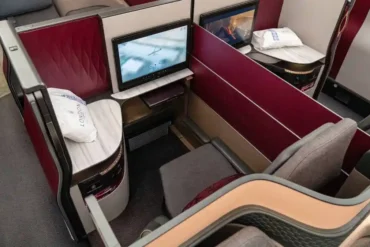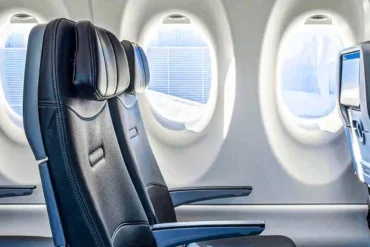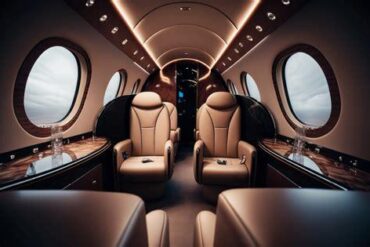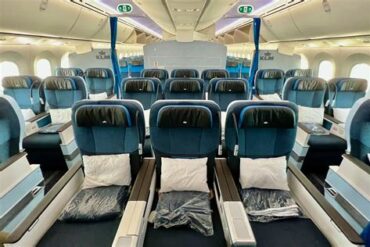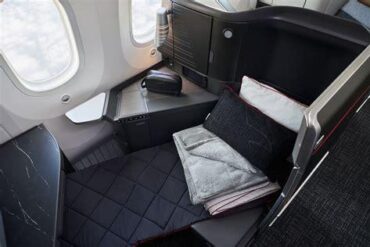
First class has changed dramatically over the past three decades. What was once defined primarily by a wider reclining seat, premium dining, and attentive service has become something much more ambitious: a private room in the sky. Airlines increasingly design their most expensive cabins around doors, walls, dedicated beds, personal dining spaces, and controlled environments that allow passengers to disappear from the rest of the aircraft.
The transformation is particularly striking because modern first class is no longer simply about having more space than business class. It is about controlling that space. A passenger can close a door, dim the lights, order a meal whenever convenient, work without interruption, and sleep behind a physical barrier. In the most sophisticated suites, the aircraft cabin almost stops feeling like a shared environment.
Privacy has therefore become one of the strongest currencies in luxury aviation. A beautifully plated meal is impressive, but a passenger who can enjoy it without seeing another traveler may remember the experience differently. The seven first class products below demonstrate just how far airlines have pushed this idea, ranging from sophisticated enclosed seats to a genuine three-room apartment with its own shower.
1. SWISS First Grand Suite: A Personal Sanctuary Above the Clouds
SWISS may not always receive the same attention as Emirates or Singapore Airlines, but its first class strategy deserves considerably more recognition. The airline has traditionally offered an intimate first class environment built around personalization, discretion, and flexibility, and its First Grand Suite takes that philosophy much further.
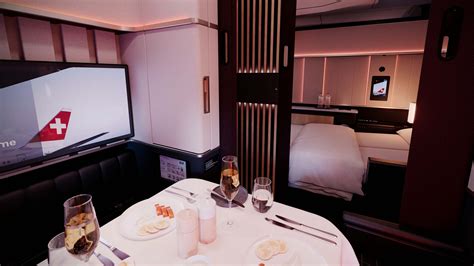
The new First Grand Suite is being introduced in 2026 on selected Airbus A350 and Boeing 777 aircraft. Rather than treating first class as simply an upgraded seat, SWISS has developed a configurable personal environment that can function as an office, bedroom, dining room, or private sanctuary. That flexibility matters because premium passengers do not necessarily want the same thing during a long-haul flight. One traveler may need a quiet workspace, while another wants to eat slowly and then sleep for several hours.
SWISS also allows first class passengers considerable control over the timing of their meals. Instead of forcing every passenger into a rigid cabin-wide dining schedule, the experience can be adapted around the individual. Combined with an enclosed suite, this creates something closer to a private hotel room than a conventional aircraft seat.
The concept is especially interesting because SWISS is approaching privacy through adaptability rather than spectacle. There is less emphasis on gold finishes or theatrical presentation and more attention to making the cabin work around the passenger. With only eight traditional first class seats on long-haul aircraft, the atmosphere is already intimate, while the First Grand Suite pushes personal space into another category.
2. Japan Airlines A350 First Class: Technology Inside a Private Cocoon
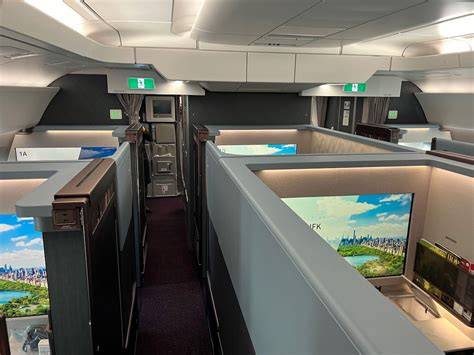
Japan Airlines takes a different route toward privacy. Its latest first class product combines physical separation with an unusually advanced entertainment and connectivity environment. On the Airbus A350, the suite is designed around a fully enclosed seat, but technology becomes an important part of the experience once the door closes.
The most visually striking feature is the 43-inch 4K personal display, one of the largest screens offered in an airline first class cabin. Instead of sitting in an open seat with a relatively small monitor in front of the passenger, travelers receive an entertainment environment that can dominate the private suite without compromising the feeling of enclosure.
JAL also integrates headrest-mounted speakers, a wireless smartphone charger, and a dedicated control tablet. A communication panel positioned outside the suite allows passengers to interact with the cabin environment without constantly reaching for a conventional control panel. The result is an experience that feels carefully engineered around personal convenience.
This is particularly valuable for travelers who want to remain productive while flying. Privacy is not merely about sleeping behind a door. It also means being able to work, watch a movie, communicate, or simply sit quietly without constantly being exposed to activity in the aisle.
Japan Airlines continues to operate its JAL Suite on Boeing 777-300ER aircraft, although the older product is smaller than the newer A350 design. The contrast demonstrates how quickly premium cabin technology has advanced. The A350 product feels less like an upgraded aircraft seat and more like a dedicated personal entertainment room.
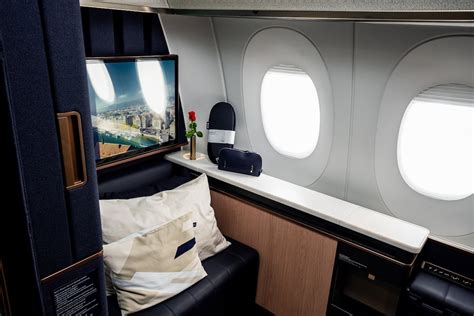
3. Lufthansa Allegris First Class: A Four-Walled Flying Living Room
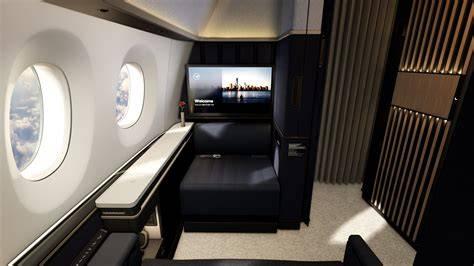
Lufthansa’s Allegris First Class takes one of the simplest ideas in premium aviation and makes it surprisingly powerful: give passengers four walls. On an aircraft where every traveler normally shares the same cabin, a private enclosure immediately changes the psychological experience of the journey.
The Allegris first class suite is designed as a genuine room rather than an oversized chair. Lufthansa has incorporated a dining table for two, allowing passengers to eat in a setting that feels much more like a restaurant or private lounge than an aircraft seat. For couples traveling together, the ability to share the space is especially attractive.
The suite also includes a tablet that controls the seat position, lighting, and other cabin functions. A dedicated do-not-disturb setting adds another important layer of privacy. Once activated, passengers can make it clear that they do not want unnecessary interruptions while working, resting, or sleeping.
The ability to accommodate two people gives Allegris First a distinctive character. For couples, it can be considerably more compelling than a conventional single-seat first class product because the suite becomes a shared private room. Instead of sitting beside each other in separate open seats, two travelers can experience the flight within a dedicated environment.
Lufthansa’s approach is therefore less theatrical than some Middle Eastern competitors. It focuses on space, walls, dining, and functionality, creating what can reasonably be described as a flying living room.
4. Air France La Première: Privacy Before the Aircraft Even Takes Off
Air France La Première is unusual because its privacy does not begin when the aircraft door closes. The entire journey is structured around separation from ordinary airport processes.
Passengers receive dedicated ground services, including private check-in, access to a dedicated security channel, and a La Première lounge experience. The journey can culminate with a private chauffeur transporting the passenger directly to the aircraft. By the time the traveler reaches the suite, the sense of exclusivity has already been established.
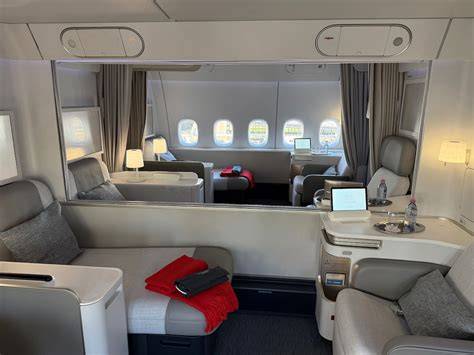
On board the Boeing 777-300ER, La Première continues this philosophy with enormous individual cabins enclosed by floor-to-ceiling curtains. The curtains provide a softer form of separation than a solid wall while maintaining an unusually private atmosphere. They also help create a quieter visual environment by shielding passengers from the movement of the cabin.
Only four La Première cabins are installed on the aircraft, reinforcing the product’s scarcity. Each cabin can accommodate two passengers, making the total first class capacity as low as eight travelers. That is an extraordinary amount of cabin real estate dedicated to a very small number of people.
La Première is consequently positioned somewhere between commercial first class and private aviation. The passenger is not merely buying a seat at the front of an airplane. They are buying an intentionally isolated travel experience that begins at the airport and continues until arrival.
5. Etihad The Residence: A Three-Room Apartment at 35,000 Feet
If privacy is measured by how completely a passenger can forget that an aircraft is flying with hundreds of other people, Etihad The Residence remains almost impossible to ignore. It is not simply a first class suite. It is a private three-room apartment installed inside an Airbus A380.
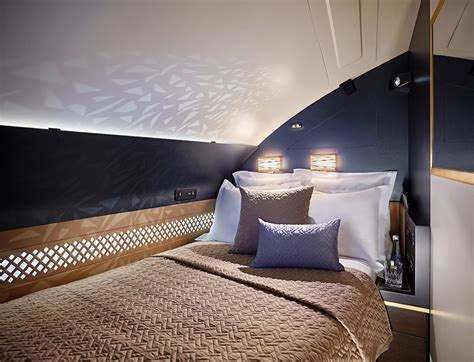
The Residence contains a living room, separate bedroom, and private shower room. The living room includes a sofa and entertainment system, creating a dedicated space for dining, relaxing, or simply sitting upright without being confined to a conventional aircraft seat.
The bedroom is separated from the living area and contains a full-size bed. This distinction is crucial. Many first class seats convert into beds, but The Residence does not require passengers to transform the same piece of furniture from chair into sleeping surface. Travelers can leave the living room behind and retreat to an actual bedroom.
Then there is the private shower room. A full-height shower allows passengers to freshen up during the flight, an amenity that remains exceptionally rare in commercial aviation. The experience is further elevated by a dedicated butler trained by the Savoy in London, whose role is to provide highly personalized service throughout the journey.
The Residence is available only on selected Airbus A380 aircraft, making it significantly less accessible than conventional first class. Yet that scarcity is part of the appeal. With a separate living room, bedroom, shower, and personalized service, the product does not merely imitate a private jet. It creates a miniature luxury residence inside a commercial airliner.
6. Emirates First Class: The Private Suite With a Shower Spa
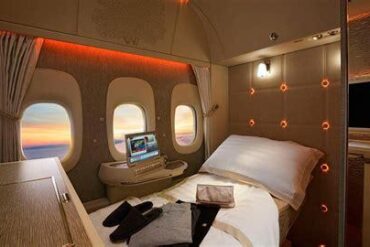
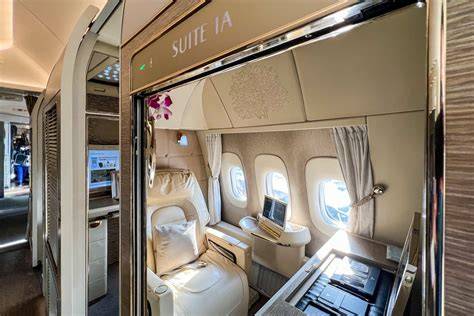
Emirates has arguably done more than any other major airline to make enclosed first class suites recognizable to the general public. Its Boeing 777 First Class suites introduced an exceptionally private environment, with floor-to-ceiling doors creating the sensation of having an individual room.
Inside the suite, passengers receive a wide leather seat that converts into a fully flat bed, a large entertainment screen, customizable lighting, temperature controls, and a personal minibar. The combination is designed around autonomy. Travelers can dine, sleep, watch entertainment, or simply sit in silence without needing to interact with the surrounding cabin.
The interior suites on certain aircraft also use virtual windows, displaying live images from external cameras. This is an ingenious solution for passengers sitting away from the fuselage windows. Instead of staring at a wall, the passenger can still maintain a visual connection with the outside world.
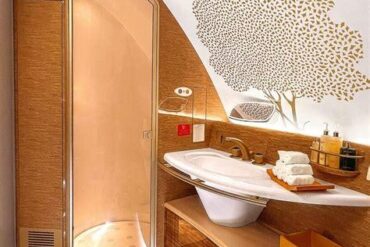
The Emirates A380 offers a somewhat different interpretation. Its first class suites are less completely enclosed than the newest 777 design, but the aircraft adds the famous Onboard Shower Spa and a dedicated Onboard Lounge elsewhere in the aircraft. The shower experience is particularly significant because it allows passengers to leave the suite, refresh themselves, and return feeling as though they have taken a break at a luxury hotel.
Emirates therefore combines privacy with spectacle. The suite is intimate, but the broader A380 experience remains social and extravagant. Passengers can choose isolation when they want it and interaction when they do not.
7. Singapore Airlines Suites: The Double-Bed Sanctuary
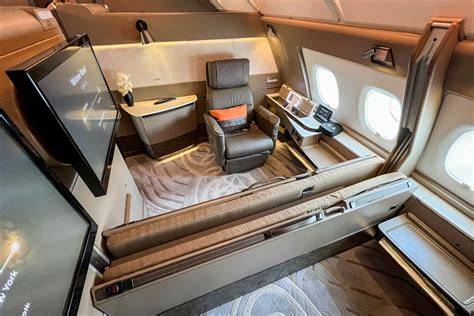
Singapore Airlines has developed one of the most refined interpretations of first class privacy with its A380 Suites. The concept is simple but extremely effective: give passengers a proper armchair, a separate full-size bed, and a sliding door that transforms the entire space into a private sanctuary.
Unlike many first class products, the seat does not need to be converted into a bed when it is time to sleep. The passenger can remain seated comfortably while the dedicated bed is prepared separately. That separation creates a surprisingly strong hotel-room sensation.
For couples, the experience becomes even more extraordinary. Two adjacent suites can be connected to form a double bedroom, producing a shared sleeping space that is almost impossible to reproduce in conventional first class. The design is particularly well suited to couples who value privacy but still want to experience the journey together.
Singapore Airlines also distinguishes itself through restraint. Where Emirates emphasizes glamour and Etihad focuses on sheer space, Singapore Airlines leans toward quiet sophistication. The materials, lighting, service style, and dining experience are designed to feel polished rather than theatrical.
The airline’s renowned service philosophy strengthens the effect. Cabin crew can provide attentive assistance without making the passenger feel constantly observed. Dining can include Book the Cook, while restaurant-style presentation gives the meal a sense of occasion without overwhelming the private atmosphere.
Although Etihad The Residence offers substantially more physical space, it operates on a much smaller network. Singapore Airlines Suites have consequently achieved a particularly strong balance between exclusivity and practical availability. For passengers who want a private room, a genuine bed, elegant service, and the option of sharing the space with a companion, the A380 Suites remain among the most complete first class experiences in commercial aviation.
Why These First Class Suites Feel Like Private Jets
The most remarkable feature shared by these seven products is not necessarily their food, champagne, or entertainment systems. It is the psychological separation created by private space. Once a door, curtain, or wall closes around a passenger, the rest of the aircraft becomes almost irrelevant.
That transformation explains why airlines continue investing heavily in premium cabin architecture even as some carriers reduce traditional first class offerings. A large seat is no longer enough. Travelers paying thousands of dollars for a long-haul journey increasingly expect an experience that feels fundamentally different from business class.
The seven suites achieve that goal in different ways. SWISS emphasizes flexibility, Japan Airlines integrates technology, Lufthansa builds a four-walled living room, and Air France extends privacy from the airport to the aircraft. Emirates combines isolation with theatrical luxury, Singapore Airlines creates an elegant hotel-like sanctuary, while Etihad goes furthest by creating a genuine multi-room residence.
In the end, the definition of first class has changed. The ultimate luxury is no longer simply having the best seat on the airplane. It is being able to forget there is an airplane around you at all. When a passenger can close the door, order dinner, retreat to a bed, control the environment, and enjoy several uninterrupted hours without seeing another traveler, commercial aviation begins to resemble private aviation in everything except the aircraft itself.