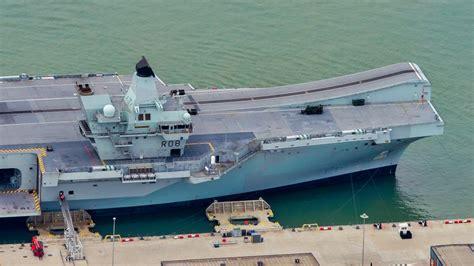
The United Kingdom’s Royal Navy boasts a pair of modern marvels that signify not only national pride but also global maritime prowess — the Queen Elizabeth-class aircraft carriers. These titanic vessels, HMS Queen Elizabeth and HMS Prince of Wales, serve as the floating epicenter of the UK’s Carrier Strike Group (CSG), standing as potent symbols of power projection, air superiority, and joint allied operations.
Commissioned on December 7, 2017, HMS Queen Elizabeth entered service 76 years after the attack on Pearl Harbor, embedding its legacy in naval history. Its sister ship, HMS Prince of Wales, followed on December 10, 2019, despite early mechanical issues that once threatened her future. Today, these two carriers represent the full might of the Royal Navy’s carrier strike capability.
Massive Design and Aircraft Capacity: The 72-Aircraft Benchmark
The Queen Elizabeth-class carriers are among the largest warships ever constructed by the Royal Navy, each displacing an astonishing 71,650 tons. Their design was meticulously optimized to maximize aviation capacity while retaining versatility for future operations.
With a flight deck measuring 919 feet in length and 230 feet in width, these ships can accommodate up to 72 aircraft in total. This includes a maximum of 36 F-35B Lightning II fighter jets, with the remainder made up of various rotary aircraft such as Merlin HM2 helicopters, Chinooks, or even UAVs depending on the mission.
This 72-aircraft capacity isn’t merely a theoretical number. The design incorporates two aircraft lifts capable of moving four F-35Bs simultaneously from the internal hangar to the deck in just 60 seconds — an engineering feat crucial for rapid sortie generation.
Why the F-35B is a Game-Changer for the Royal Navy
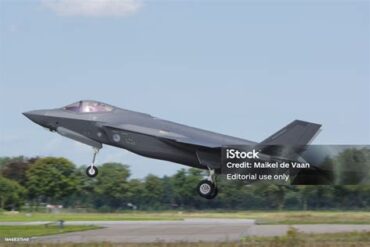
The fighter of choice aboard these carriers is the Lockheed Martin F-35B Lightning II, a fifth-generation, stealth, short takeoff and vertical landing (STOVL) aircraft. Unlike conventional carrier-launched fighters that require catapult-assisted takeoff, the F-35B is uniquely compatible with the Royal Navy’s operational strategy.
Each carrier’s deck features a ski-jump ramp — a 197-foot-long, 20-foot-high structure with a 12.5-degree angle, designed to aid STOVL aircraft in launching without catapults. This cost-effective and proven design has been used by the UK since the 1980s, beginning with the HMS Invincible.
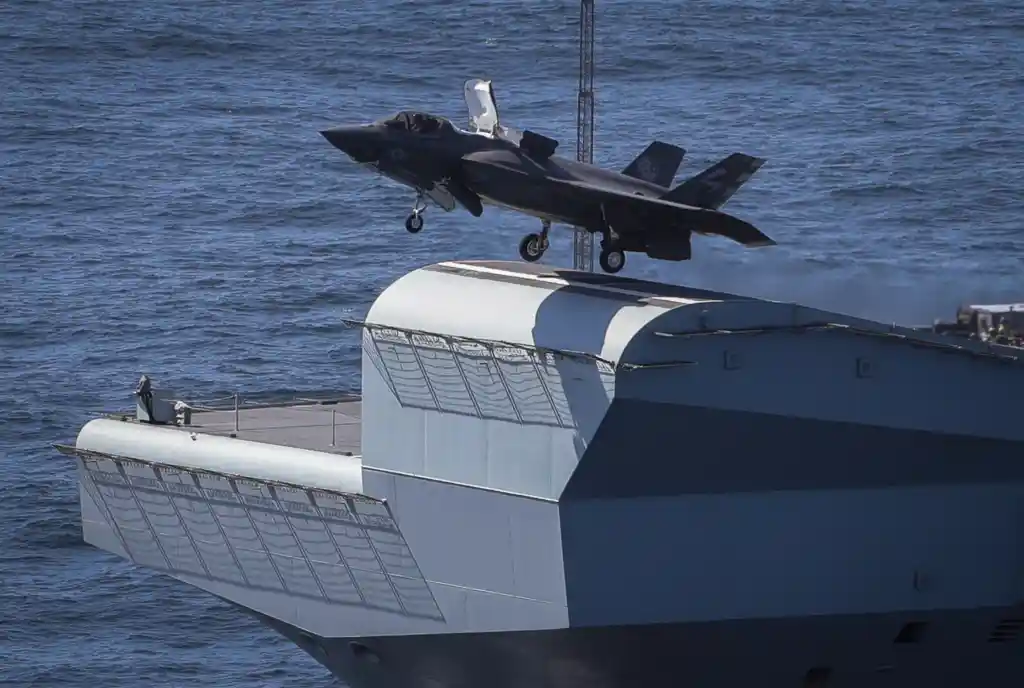
Operating the F-35B allows the Royal Navy to work seamlessly with allies like the United States Marine Corps, who also deploy the same aircraft. The interoperability extends beyond training and tactics to logistics and carrier strike operations — a key aspect of NATO readiness.
Inside the Carrier Strike Group: The Role of Aircraft
The Carrier Strike Group (CSG) is centered around a single carrier — unlike the U.S. Navy, which builds strike groups around multiple support ships. However, the Queen Elizabeth-class ships are well-equipped to command a wide range of missions, from humanitarian assistance to full-scale combat air operations.
In addition to the 36 F-35Bs, the full complement of 72 aircraft can include:
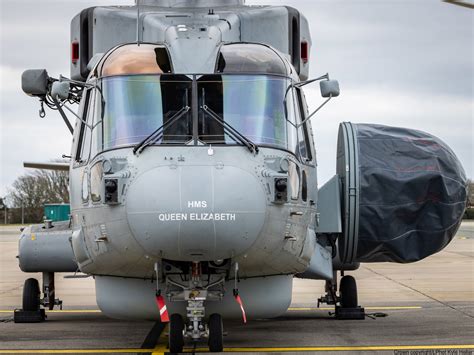
- Merlin HM2 helicopters for anti-submarine warfare (ASW) and airborne early warning (AEW)
- Merlin Mk4s or Chinooks for troop transport and logistics
- Wildcat helicopters for reconnaissance and attack roles
These aircraft collectively give the CSG the ability to launch 72+ sorties per day, supporting both defensive and offensive operations across air, land, and sea.
The Tactical Trade-offs: STOVL vs. CATOBAR Systems
It’s important to understand the strategic trade-offs the UK made in designing these ships. The Queen Elizabeth-class carriers lack a catapult-assisted take-off but arrested recovery (CATOBAR) system. As a result, they are restricted to STOVL aircraft only, such as the F-35B.
While this choice eliminated the need for nuclear propulsion and complex electromagnetic launch systems, it came with certain limitations. For example, fixed-wing airborne early warning (AEW) aircraft like the E-2 Hawkeye cannot be launched from UK carriers. Instead, the Royal Navy uses Crowsnest-equipped Merlin helicopters for AEW missions.
Engineering Beyond Aircraft: Power and Crew Capability
Although not nuclear-powered, these carriers are equipped with an electric propulsion system that generates enough electricity to power a large town. Their flank speed exceeds 25 knots, and with a mission-capable range of 10,000 nautical miles, they can deploy globally without the need for constant refueling or port visits.
Each vessel is typically crewed by 679 sailors, but can surge up to 1,600 personnel when including aircrew, Royal Marines, and support staff. The expansive internal volume also includes planning rooms, briefing centers, maintenance bays, and medical facilities — making them floating airbases capable of independent operation.
Comparing to U.S. Supercarriers: Size Isn’t Everything
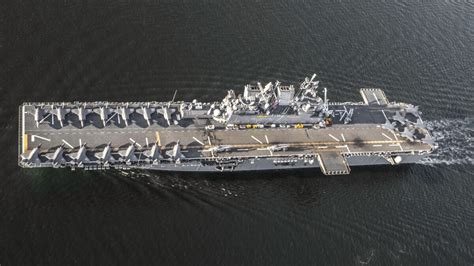
At first glance, the Queen Elizabeth-class may seem dwarfed by American Gerald R. Ford-class supercarriers, which can carry up to 90 aircraft. However, the UK’s decision to field two medium-sized carriers, instead of one ultra-large vessel, offers flexibility and redundancy.
In peacetime, both carriers can alternate between active service and maintenance cycles, ensuring year-round readiness. In wartime, both carriers could be deployed simultaneously, doubling the number of F-35Bs in the air. The dual-island design also contributes to operational efficiency: one superstructure handles ship navigation, while the other oversees flight operations.
Future Upgrades: What Lies Ahead
Looking to the future, there is active discussion about integrating drones into the carrier air wing. Concepts like the Vixen unmanned combat air vehicle (UCAV) and other vertical take-off drones could further extend strike range, reduce risk to pilots, and diversify the mission set.
There’s also a push toward increasing the number of deployed F-35Bs. While the current operational load hovers around 18-24 jets per deployment, full capacity (36 jets) is well within reach as more F-35Bs are delivered to the Royal Navy and RAF.
Conclusion: Versatility, Power, and Partnership
The answer to how many fighter jets a UK aircraft carrier can hold is straightforward: up to 36 F-35B Lightning IIs per carrier, with a total maximum aircraft capacity of 72. Yet behind that number lies a story of innovation, international cooperation, and strategic foresight.
The Queen Elizabeth-class carriers are not just floating runways — they are strategic assets designed for power projection, rapid deployment, and multilateral mission capability. As global threats evolve, the ability to launch a high number of fifth-generation fighters from the sea gives the UK a decisive edge in modern naval warfare.
In the end, these carriers embody the future of British maritime power — flexible, scalable, and technologically advanced — with a flight deck built not just for today’s fighter jets, but for tomorrow’s challenges as well.