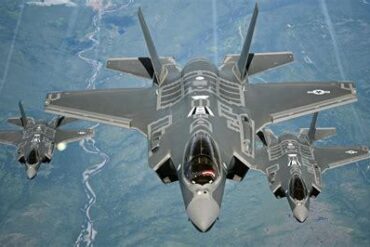
The F-22 Raptor, introduced in 2005, remains the most advanced and stealth-capable fighter aircraft in the U.S. Air Force arsenal. As the world’s first fifth-generation jet fighter, its design and operational capabilities prioritize air superiority above all else. Unlike multi-role platforms that emphasize ground attack, reconnaissance, or nuclear delivery, the F-22 is crafted for one primary mission: dominance of the skies. That said, the jet’s systems are versatile enough to allow limited ground attack functions, raising the question: Can the F-22 carry nuclear weapons? And more immediately, what missiles does it currently carry in real-world operations?
The Arsenal of the F-22 Raptor: Built for Air Superiority
At the core of the F-22’s mission profile is its ability to locate, track, engage, and destroy airborne threats before being detected. This advantage stems from its stealth airframe, advanced radar systems, and most importantly, its missile loadout.
A typical air superiority loadout for the F-22 includes:
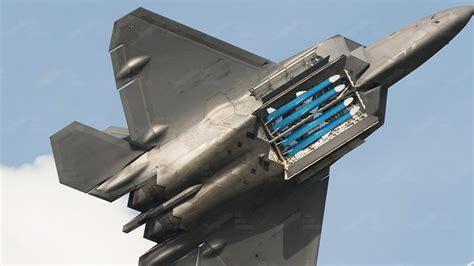
- Six AIM-120 AMRAAMs (Advanced Medium-Range Air-to-Air Missiles) stored in the main internal weapons bay. These radar-guided missiles are designed for beyond-visual-range (BVR) combat, allowing the Raptor to eliminate adversaries long before a close engagement is necessary.
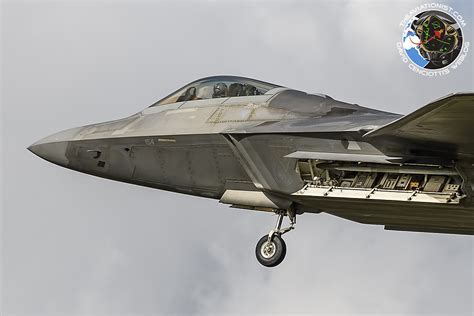
- Two AIM-9 Sidewinders, infrared-guided, short-range missiles stored in the side weapon bays. These are critical for dogfighting scenarios where stealth or distance is compromised.
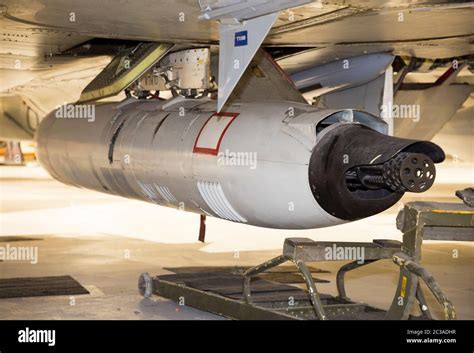
- A 20mm M61A2 Vulcan cannon with 480 rounds. Though considered a secondary option in modern jet combat, the Vulcan remains a potent close-range weapon, especially if missile systems fail or are depleted.
This loadout maximizes first-strike capability while preserving the F-22’s stealth profile. All weapons are internally housed, reducing radar cross-section significantly — a hallmark of fifth-generation fighter design.
Can the F-22 Carry Bombs?
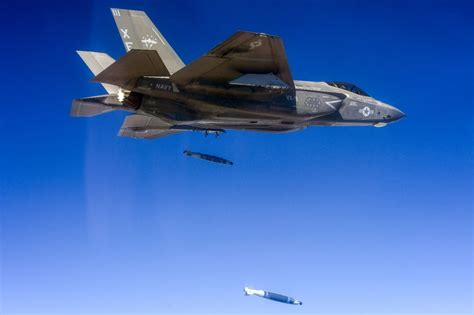
Though optimized for air-to-air engagements, the F-22 is not strictly limited to that role. The aircraft was engineered with flexibility in mind, able to carry a small payload of air-to-ground munitions without compromising stealth entirely.
In a strike role, the F-22 can carry:
- Two GBU-32 JDAMs (Joint Direct Attack Munitions) — 1,000-pound GPS-guided bombs.
- Two AIM-120 missiles in tandem, to maintain air defense during bombing runs.
This dual-capability configuration allows the F-22 to perform Suppression of Enemy Air Defenses (SEAD) missions or precision strikes on high-value ground targets. Still, the aircraft’s bomb load is modest, and the F-35 Lightning II is generally preferred for multi-role missions involving ground targets due to its greater ordnance capacity and integrated targeting systems.
Why the F-22 Doesn’t Carry Nuclear Weapons
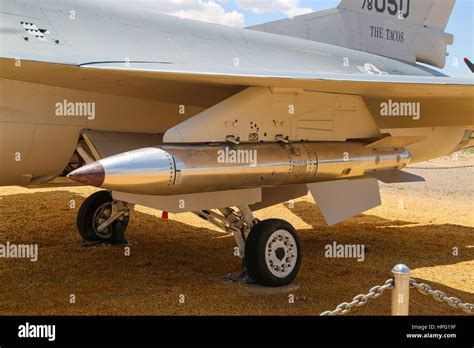
The idea of the F-22 delivering nuclear ordnance is compelling in theory but limited in practice. The jet was never designed or certified to carry nuclear bombs. It was meant to replace the nuclear-capable F-16 Fighting Falcon, but its air superiority role made the inclusion of nuclear delivery systems less of a priority.
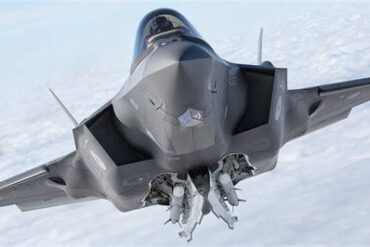
The U.S. currently uses the B-61 nuclear bomb as its primary air-delivered tactical nuclear weapon. This weapon is compatible with fighters like the F-16 and now the F-35, which has been officially certified for nuclear delivery. The B-61, originating from the Cold War era, has gone through extensive upgrades, with its latest variant — the B61-12 — being modernized for precision delivery and adjustable yields.
In order for the F-22 to carry a B-61:
- It would need physical modifications to its internal weapon bay.
- It would require nuclear certification, a long and complex process involving software changes, mission planning integration, safety checks, and Department of Energy approval.
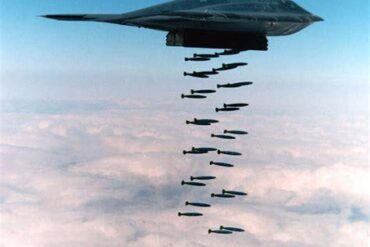
Given that the U.S. already possesses dedicated nuclear-capable platforms — including bombers like the B-2 Spirit, B-52 Stratofortress, and the dual-capable F-35 — the rationale for investing in F-22 nuclear capability is minimal.
Understanding the B-61 Tactical Nuclear Bomb
The B-61 bomb is a variable-yield nuclear weapon. Depending on configuration, it can detonate with as little as 0.3 kilotons or as much as 340 kilotons of explosive power. For reference, the bomb dropped on Hiroshima in 1945 had a yield of approximately 15 kilotons. Even at its lowest setting, a B-61 can produce catastrophic effects in urban environments.
If, hypothetically, the F-22 were modified to carry a B-61:
- At low yield, dropping the bomb on a city center like Central Park in New York would result in 0.75 square miles of direct devastation.
- At full yield, the blast radius could encompass over 81 square miles, annihilating nearly all of Midtown Manhattan and surrounding boroughs.
While the idea of an F-22 carrying such a weapon may provoke interest, the concept is largely academic. The aircraft’s stealth, speed, and survivability make it excellent for rapid strike missions, but the logistics and diplomatic implications of nuclear deployment via stealth fighter jet make this role unlikely — especially when other aircraft are better suited.
Operational History: Missiles Fired, But Not in Dogfights
Despite its cutting-edge missile systems, the F-22’s combat record does not include any confirmed air-to-air kills as of June 2025. While it has flown over 500,000 hours, these operations have largely focused on surveillance, air patrol, and limited ground strike missions.
Notably, the F-22 made headlines in February 2023 when it shot down a Chinese surveillance balloon over the Atlantic using an AIM-9X Sidewinder missile. Another unidentified object was downed over Alaska. These engagements demonstrated the jet’s precision strike capability, but fell far short of the traditional dogfight scenario it was built for.
Despite this, the mere presence of an F-22 in a contested airspace acts as a deterrent. Its stealth makes it nearly invisible to enemy radar, and its missile systems ensure that any detected target is quickly neutralized.
The Future of F-22 Armaments
There is ongoing discussion in U.S. defense circles regarding the future of the F-22 program. The Air Force has no plans to build new Raptors, and instead is focused on integrating the next-generation NGAD (Next-Generation Air Dominance) platform. Until then, the F-22 will continue to serve as the tip of the spear in American air combat strategy.
While upgrades continue — including avionics enhancements, sensor fusion improvements, and missile compatibility updates — the Raptor’s ability to carry nuclear weapons remains off the table. The Air Force has instead doubled down on using it for what it does best: dominating the skies with overwhelming air-to-air missile superiority.
In summary:
- The F-22 carries a lethal combination of AIM-120 and AIM-9 missiles, plus a powerful 20mm cannon.
- It has limited air-to-ground capability, including precision-guided GBU-32 JDAMs.
- It is not nuclear-capable, and there are no official plans to make it so.
- The nuclear-capable B-61 bomb remains the domain of the F-35 and long-range bombers.
As threats evolve and airspace becomes increasingly contested, the F-22 will continue to serve as a silent predator — invisible to radar, lethal in response, and unmatched in missile delivery when it matters most.