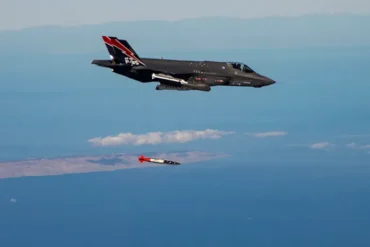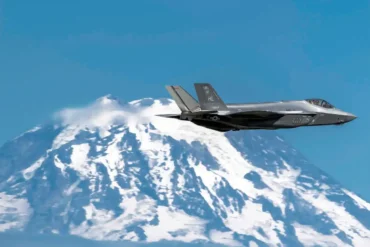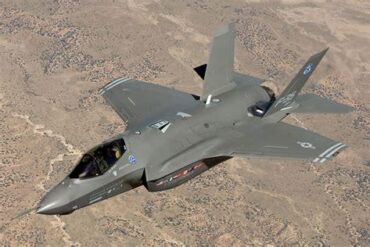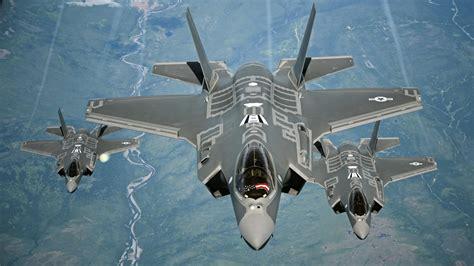
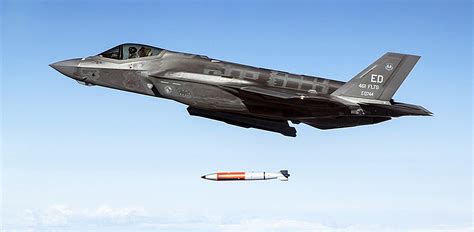
The F-35A Lightning II has officially become the first stealth fighter jet in United States history authorized to carry nuclear weapons, marking a monumental milestone in both military aviation and global deterrence policy. The stealth multirole fighter, already renowned for its advanced sensors, maneuverability, and networked battlefield capabilities, now adds another critical role: nuclear delivery platform. This capability is made possible by its recent certification to carry the B61-12 thermonuclear gravity bomb, a next-generation tactical nuclear weapon designed to be both powerful and precise.
The United States has long depended on the Nuclear Triad, a doctrine comprised of land-based intercontinental ballistic missiles (ICBMs), submarine-launched ballistic missiles (SLBMs), and strategic bombers capable of delivering nuclear payloads. While heavy bombers like the B-2 Spirit and the B-52H Stratofortress have served as the aerial component of the triad, they are aging platforms. The entry of the F-35A into this elite group represents a technological leap forward — one that combines nuclear capability with stealth, speed, and battlefield agility.
Nuclear Certification: A Strategic Milestone for the F-35 Program
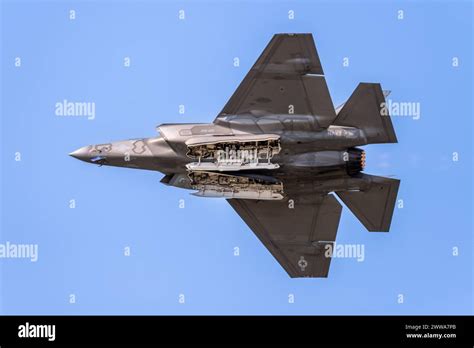
On October 12, 2023, the F-35A was officially certified to deliver the B61-12, ahead of the original schedule which projected certification by January 2024. According to Russ Goemaere, spokesperson for the F-35 Joint Program Office, “The F-35A is the first 5th generation nuclear-capable aircraft ever, and the first new platform (fighter or bomber) to achieve this status since the early 1990s.” This means it has met a stringent series of operational tests and safety evaluations needed to carry and deploy nuclear arms.
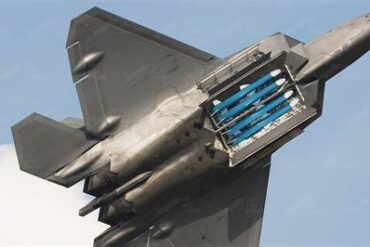
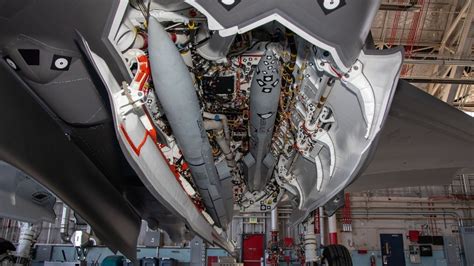
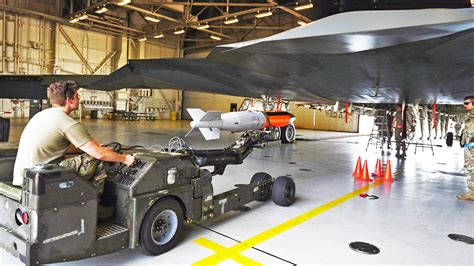
The F-35A can internally carry two B61-12 bombs, preserving its low radar signature while on nuclear strike missions. This development is particularly significant because no previous stealth fighter had been authorized for nuclear operations. The only other stealth aircraft with nuclear delivery capability, the F-117 Nighthawk, was categorized as an attack aircraft, not a true fighter.
Inside the B61-12: Tactical Precision with Strategic Impact
The B61-12 is the latest evolution of a nuclear weapons lineage that dates back to 1968. Unlike the massive, indiscriminate weapons of the Cold War, the B61-12 is a precision-guided nuclear bomb with a variable yield — offering commanders the flexibility to select the most appropriate level of destruction for a given scenario.
Key specifications of the B61-12 include:
- Length: 12 feet
- Weight: 825 pounds
- Selectable Yields: 0.3, 1.5, 10, and 50 kilotons
To put this in perspective, the bomb dropped on Hiroshima in 1945 had a yield of approximately 15 kilotons and resulted in over 140,000 fatalities. A single F-35A carrying two B61-12s could potentially deliver a combined yield of up to 100 kilotons, while still remaining stealthy and survivable in contested airspace.
Redefining the U.S. and NATO’s Nuclear Reach
This capability doesn’t only benefit the United States. Through the NATO nuclear sharing program, the F-35A’s nuclear certification is extended to other allied nations that operate the aircraft. NATO members such as Italy, Belgium, the Netherlands, and others that participate in the alliance’s nuclear posture now have access to a fifth-generation nuclear strike option, dramatically enhancing deterrence in a multipolar world where nuclear threats are no longer confined to the Cold War’s East-West dichotomy.
The forward-deployable nature of the F-35A allows for a more dynamic nuclear force posture, ensuring nuclear weapons can be deployed rapidly, unpredictably, and in concert with conventional missions. Unlike traditional bombers, which often rely on long, vulnerable flight paths and aerial refueling, the F-35A offers tactical mobility, speed, and survivability — essential traits for 21st-century conflict scenarios.
Strategic Deterrence in the 21st Century: Beyond Mutually Assured Destruction
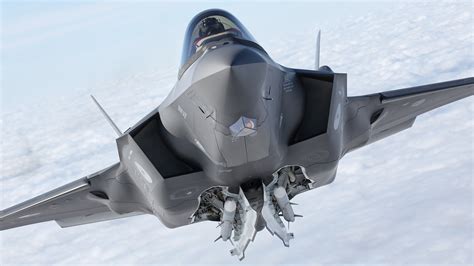
The doctrine of mutually assured destruction (MAD) has long been the bedrock of U.S. nuclear policy, particularly during the Cold War. However, the global security environment has changed dramatically. Today, emerging nuclear states, asymmetric warfare, and regional flashpoints necessitate more nuanced and flexible deterrence tools.
The F-35A’s role in this strategy is essential. As geopolitical tensions rise in Eastern Europe, the Indo-Pacific, and the Middle East, the presence of stealth nuclear-capable fighters within reach of adversarial regions increases both deterrence and diplomatic leverage. While the United States still relies on its ICBMs and SLBMs for large-scale retaliation, the F-35A offers a more tailored option that can be used — or signaled — without immediate escalation to full-scale nuclear war.
This capability also complicates adversaries’ calculations. A stealth aircraft with nuclear payloads is harder to detect, intercept, or preempt, creating uncertainty for any nation considering aggressive action. Thus, the F-35A adds another layer of strategic ambiguity to America’s nuclear posture — a factor known to enhance deterrence.
Bridging the Gap Between Tactical and Strategic Assets
One of the most significant aspects of the F-35A’s nuclear role is its ability to bridge the traditional divide between tactical and strategic nuclear weapons. The B61-12, with its low-yield options, can be used in battlefield scenarios where escalation control is essential. At the same time, its higher yield settings enable the weapon to serve in a more strategic capacity.
This dual-role functionality provides unparalleled flexibility for combatant commanders. It ensures that U.S. forces — and NATO allies — are not limited to choosing between a full-scale nuclear response and doing nothing in the face of nuclear aggression. Instead, they can respond proportionately, preserving escalation dominance.
A Turning Point in Fighter Evolution and Global Security
The F-35A’s nuclear certification also reflects broader trends in military technology and strategic planning. It signals a shift away from reliance on heavy, legacy bombers toward agile, multirole stealth platforms that can operate in denied environments. As near-peer competitors like China and Russia develop sophisticated anti-access/area-denial (A2/AD) capabilities, traditional bombers may face difficulties reaching their targets without significant support.
With its stealth design, advanced electronic warfare suite, and precision weapons capabilities, the F-35A is uniquely suited to penetrate contested airspace and deliver its payload. This makes it an indispensable tool not just for deterrence, but for actual combat operations — should the unthinkable become necessary.
Moreover, as the U.S. prepares to transition from the B-2 Spirit to the B-21 Raider, the F-35A serves as a vital stopgap and a complementary asset. It ensures that nuclear readiness remains continuous and credible through this period of modernization.
The Road Ahead: Integration and Global Implications
Now that the F-35A has been cleared for nuclear operations, the focus shifts to integration into operational doctrine, pilot training, and regional deployment planning. The aircraft must be incorporated into both U.S. Strategic Command planning and NATO’s nuclear deterrence posture.
Nations operating the F-35A under the nuclear sharing arrangement will begin retrofitting and certifying their airframes as part of this extended deterrence strategy. This means that American allies could soon be hosting forward-deployed F-35As with nuclear capabilities, a move likely to draw intense scrutiny from adversarial nations and international watchdogs.
At the same time, the certification sends a powerful message: the United States is not only modernizing its nuclear forces but is doing so in a way that is more flexible, survivable, and allied-integrated than ever before. This evolution enhances deterrence credibility, ensures interoperability within NATO, and serves as a counterbalance to the modernization of nuclear forces by nations like Russia, China, and North Korea.
Conclusion: Power, Precision, and Purpose in a Volatile World
The certification of the F-35A Lightning II as a nuclear-capable stealth fighter is not just a technical upgrade — it is a strategic inflection point in the balance of global military power. It arms the United States and its allies with a tool that is not only powerful, but also precise, stealthy, and highly survivable. In doing so, it reshapes what it means to deter adversaries in a world where nuclear weapons remain a grim yet enduring reality.
In a time when global instability and emerging threats test the limits of deterrence and defense, the F-35A stands as a new spearhead of credible, flexible nuclear power — a reminder that peace is best secured not just by strength, but by the wisdom to wield it with precision.