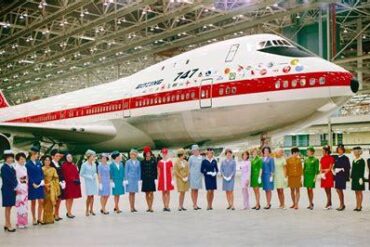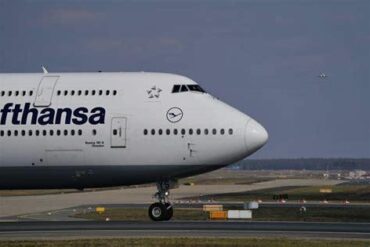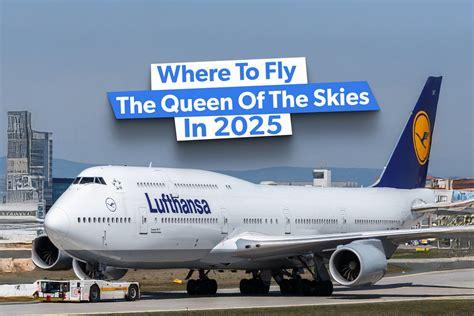
The Boeing 747 once ruled long-haul aviation with an authority no other aircraft could match. For decades, its unmistakable hump and four roaring engines defined global air travel. Yet in 2025, the numbers reveal a very different story. The era of the passenger jumbo jet is no longer dominant—it is selective, strategic, and increasingly rare.
Last year, airlines worldwide operated 15,334 passenger flights using the Boeing 747. Those flights collectively offered 5.69 million seats and generated over 28 billion available seat miles (ASMs). On the surface, that may sound impressive. In the broader context of global aviation—where tens of millions of flights occur annually—it represents a dramatic contraction. The Queen of the Skies now flies in carefully chosen roles rather than commanding the entire kingdom.
Only four airlines continued scheduled passenger service with the 747 in 2025: Lufthansa, Korean Air, Air China, and Aeroflot. And among them, one carrier towers above the rest.
Lufthansa: The Last True Passenger 747 Powerhouse
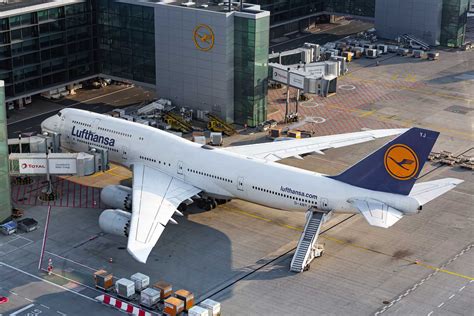
If the Boeing 747 still breathes in passenger service, it is largely because Lufthansa refuses to let it fade quietly. The German flag carrier operated 11,719 flights with the 747 last year—more than three-quarters of all global 747 passenger operations.
That dominance is not accidental. Lufthansa maintains two distinct 747 variants: the Boeing 747-400 and the more advanced Boeing 747-8 Intercontinental (747-8I). Each serves a specific strategic purpose within the airline’s network.
The 747-8I is the crown jewel. Lufthansa operates 18 of these aircraft, making it the world’s largest operator of the type. These jets are modernized, quieter, and more fuel-efficient than earlier 747 generations. They also offer a more premium-focused cabin configuration, including 8 First Class seats and 80 Business Class seats, catering to high-yield intercontinental markets.
Routes such as Frankfurt to Los Angeles, Buenos Aires, and Tokyo Haneda showcase the aircraft’s long-range capability and revenue optimization strategy. The 747-8I is not simply filling seats—it is maximizing profitability on trunk routes where demand remains strong and premium traffic is reliable.
Meanwhile, the older 747-400 fleet—currently eight aircraft scheduled for retirement around 2028—serves high-capacity routes where slot constraints demand larger aircraft. Airports like Frankfurt operate under tight slot controls, meaning airlines cannot simply add more frequencies. When you cannot add flights, you add seats. The 747 remains unmatched in this role within Lufthansa’s current fleet.
India-bound services such as Mumbai, Bengaluru, and Delhi have seen extensive 747-400 deployment. These markets require high-density seating and strong cargo capacity, both of which the jumbo delivers effectively.
Lufthansa’s relationship with the 747 stretches back to 1970. From the early 747-100 powered by Pratt & Whitney JT9D engines to the latest GEnx-powered 747-8, the airline has operated every major passenger variant. Few carriers have woven the aircraft so deeply into their operational DNA.
Korean Air: Selective but Strategic Deployment
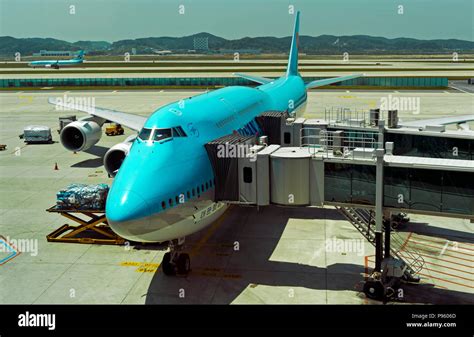
Korean Air flew 2,166 Boeing 747 passenger flights in 2025. While significantly fewer than Lufthansa, the South Korean carrier continues to deploy the 747-8I strategically across transpacific and regional routes.
The average age of Korean Air’s passenger 747-8 fleet is approximately 9.3 years, making them relatively young aircraft in aviation terms. Retirement is not imminent, but network optimization is underway.
The airline previously operated 747-8 service between Seoul Incheon and London Heathrow, marking one of the last regular passenger 747 appearances in the United Kingdom. With that route transition, 2026 will see no scheduled 747 passenger operations to the UK—an extraordinary milestone for a country that once saw dozens of daily jumbo departures from Heathrow and Gatwick.
Today, Korean Air continues 747-8 operations to Los Angeles, Hong Kong, Taipei, and Tokyo Narita. These routes balance capacity demand with premium traffic, leveraging the aircraft’s unique cabin configuration and cargo capability.
Air China and Aeroflot: Limited but Symbolic Roles
Air China operated 853 flights with the 747 last year, while Aeroflot logged 596 flights. In both cases, the aircraft plays a far smaller role in network strategy compared to Lufthansa or Korean Air.
For Air China, the 747 remains an emblem of flagship operations, deployed selectively on major trunk routes. For Aeroflot, geopolitical and operational complexities have further constrained fleet utilization, making the 747’s presence more limited.
Together, these two airlines account for less than 10% of total global 747 passenger flights in 2025—a stark contrast to decades past when dozens of carriers relied heavily on the aircraft.
The Data Behind the Decline
The total of 15,334 passenger flights may initially seem substantial. But context matters. Modern twin-engine widebodies such as the Airbus A350, Boeing 787 Dreamliner, and Boeing 777 operate hundreds of thousands of annual flights collectively.
The aviation industry has pivoted from hub-and-spoke concentration toward efficient, long-range point-to-point travel. Twin-engine aircraft offer lower fuel burn, reduced maintenance costs, and flexible deployment. Under ETOPS (Extended-range Twin-engine Operational Performance Standards), twinjets can now safely operate ultra-long-haul routes once reserved for four-engine aircraft.
Fuel efficiency has been decisive. The economics simply favor newer designs. Four engines mean higher maintenance overhead and greater fuel consumption. In an era of sustainability pressures and volatile fuel prices, airlines prioritize efficiency over nostalgia.
The Boeing 747’s operational model thrived in a different world—one defined by regulated markets, limited airport infrastructure, and centralized global hubs. That world has evolved.
The Aircraft Replacing the 747
The retirement of each 747 creates a capacity vacuum. Airlines must replace roughly 400 to 450 seats per aircraft, depending on configuration. The industry’s response is not another four-engine superjumbo. Even the Airbus A380 is no longer in production.
Instead, replacement comes from advanced twinjets.
The Airbus A350-900 and A350-1000 offer ranges of up to 9,000 nautical miles, surpassing many 747 missions. Built with composite materials and powered by Rolls-Royce Trent XWB engines, the A350 family prioritizes fuel efficiency and lower operating costs.
Airbus has delivered nearly 700 A350s, with major operators including Cathay Pacific, Qatar Airways, Delta Air Lines, and Air China.
Boeing’s counter is the 777X program, including the 777-8 and 777-9. Powered by massive GE9X engines generating 110,000 pounds of thrust, the 777-9 in particular approaches 747-level seating capacity while maintaining twin-engine efficiency.
However, certification delays have stalled entry into service. Although over 500 orders for the 777-9 exist, none have yet been delivered. Airlines awaiting the 777X—Lufthansa among them—continue operating 747s longer than originally planned due to these delays.
The industry is not replacing the 747 with something identical. It is replacing it with something economically superior.
The End of the Jumbo Era in the United Kingdom
The United Kingdom once epitomized jumbo jet operations. London Heathrow regularly hosted dozens of daily 747 arrivals from British Airways and international carriers alike. That visual identity has disappeared.
With Korean Air withdrawing its 747-8 from the Seoul–London route, no passenger 747 flights remain scheduled to the UK in 2026. British Airways retired its final 747-400s in 2020, accelerated by pandemic-era restructuring.
For aviation enthusiasts, this shift marks the end of a visual and cultural chapter. The upper deck lounge, the four-engine roar, the distinct silhouette against London’s skyline—these are now memories rather than daily occurrences.
Cargo Airlines: The 747’s Second Life
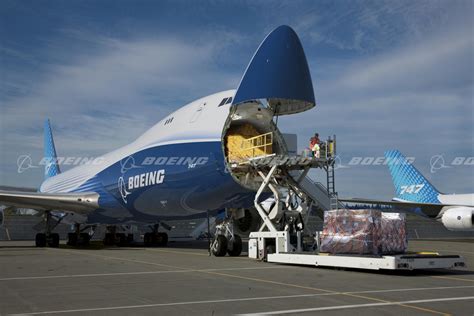
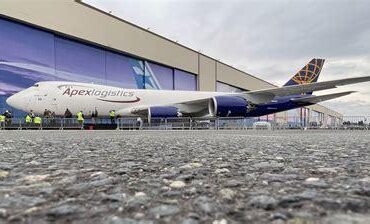
Passenger service may be fading, but cargo operators remain devoted to the 747. More than 100 Boeing 747 freighters continue active service worldwide.
The aircraft’s design always anticipated freight potential. The upward-hinged nose door, introduced on early freighter variants, allows loading of oversized cargo that cannot fit through side doors. This feature is unmatched by converted twinjets.
The original 747-200F entered service over 50 years ago, capable of lifting 200,000 pounds of cargo over 5,000 miles. Automated handling systems allowed rapid pallet loading, improving turnaround efficiency.
The 747-400F became the dominant cargo variant, combining range with capacity and nose-door flexibility. The latest iteration, the 747-8F, entered service in 2011 and can carry 140 metric tons of freight, accommodating up to 34 main-deck pallets.
Unlike passenger networks, cargo logistics still favor centralized hubs. Freight does not complain about connections or layovers. The hub-and-spoke model remains economically viable for cargo, preserving a natural role for large aircraft.
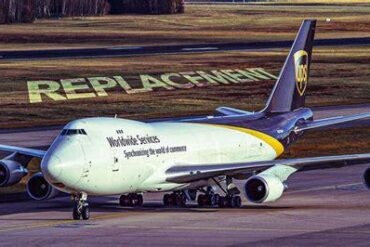
Operators such as Cargolux, Nippon Cargo Airlines, Cathay Pacific Cargo, and UPS rely heavily on the 747’s unique payload and loading capabilities. In freight service, the aircraft remains irreplaceable in certain mission profiles.
A Queen in Her Final Act
The Boeing 747 flew 15,334 passenger flights in 2025. That number encapsulates both survival and decline. The aircraft is no longer the backbone of global aviation, but neither is it extinct.
Its remaining operators deploy it deliberately—where slot constraints, premium demand, or cargo integration justify its size. Every flight now feels intentional rather than routine.
The story of the 747 is not simply about decline. It is about transformation. From revolutionary passenger icon to specialized premium flagship and cargo heavyweight, the aircraft continues adapting to a changed aviation landscape.
Eventually, passenger operations will cease entirely. The economics are clear. But the freighter fleets will extend the aircraft’s legacy for decades, carrying goods across oceans long after the last First Class cabin closes.
In aviation history, few aircraft have reshaped global travel as profoundly as the Boeing 747. The numbers from 2025 confirm its twilight—but also its resilience. The Queen of the Skies may no longer rule, yet she still flies.