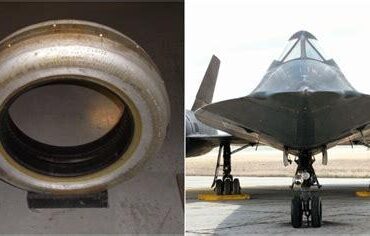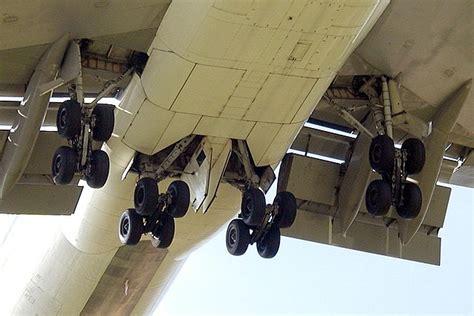
The Boeing 747, often referred to as the Queen of the Skies, is one of the most iconic aircraft ever built. First entering service in 1970 with Pan Am, this widebody giant revolutionized long-haul air travel and remained a symbol of global connectivity and aviation prowess for over five decades. While most discussions about the 747 focus on its double-deck configuration, massive range, or role in carrying everything from passengers to space shuttles, there’s a quietly remarkable feature hidden underneath its wings and fuselage — its landing gear system, and more specifically, its 16 main landing gear tires.
The Engineering Blueprint: Anatomy of the Boeing 747’s Landing Gear
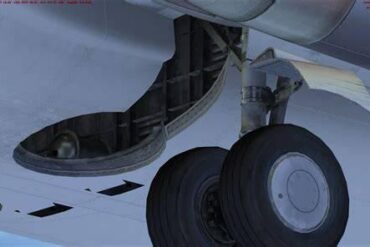
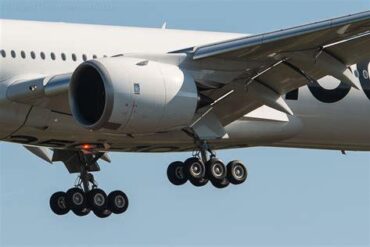
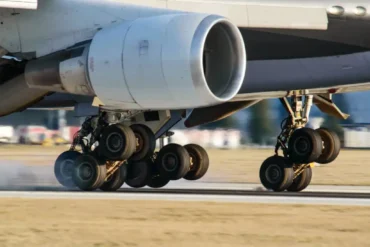
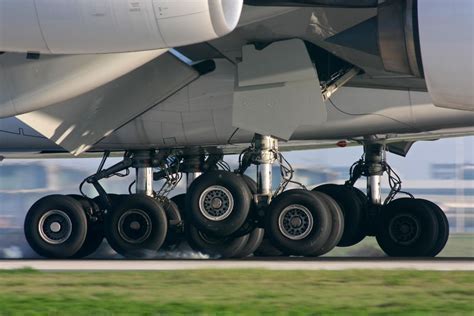
The Boeing 747 features a complex five-leg landing gear system, comprising 18 tires in total — two on the nose gear and sixteen on the main landing gear. These main tires are distributed across four bogies: two located beneath the fuselage and two under the wings near the aircraft’s body. Each bogie supports four high-pressure tires, forming a precise configuration designed to distribute extreme loads and enhance ground maneuverability.
This system isn’t just designed to carry weight — it’s crafted to absorb shock, provide stability on uneven surfaces, and retract flawlessly into the aircraft body after takeoff. The design ensures that the aircraft can support the maximum takeoff weight of nearly 987,000 pounds (447,700 kg) for the 747-8 variant without structural strain.
Load Distribution and Impact Absorption: Why 16 Tires Matter
The decision to use 16 main tires was born from necessity — not excess. Every component of the landing gear plays a role in spreading the enormous weight of the aircraft across more contact points. During landing, this configuration becomes critical. A 747 touches down at speeds approaching 160 knots, creating downward force and friction that must be absorbed almost instantly.
Each main gear bogie helps distribute that force. With four bogies, each carrying four tires, the impact load is divided evenly, reducing the pressure on any single tire. This prevents blowouts, minimizes runway damage, and boosts overall safety. Each tire is capable of supporting more than 50,000 pounds of load and is rated for speeds up to 225 mph — with some tires rated even higher.
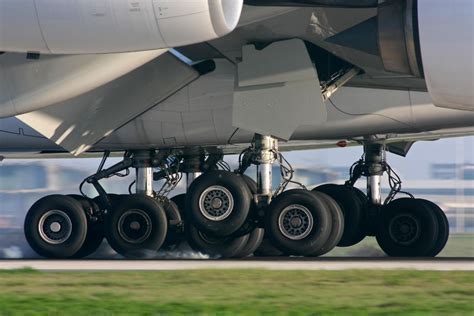
This setup also protects airport infrastructure. Without multiple tires distributing the weight, the pressure per square inch on the runway would be catastrophic, resulting in severe wear and high repair costs. By using more tires, runway fatigue is reduced, and the aircraft can land at more airports with minimal additional requirements.
Material Strength: The Science Behind Tire Design
The tires of a Boeing 747 are not your average rubber donuts. Built from reinforced rubber composites and filled with nitrogen gas — a safer alternative to oxygen under high pressure — each tire is inflated to more than 200 psi, which is about six times the pressure of a standard car tire.
These tires are uniform across all landing gear positions, simplifying maintenance and logistics. According to Dunlop Aircraft Tyres, this design uniformity makes spare part inventory more manageable and reduces downtime during repairs. Additionally, tires undergo regular inspection and wear monitoring. They are not discarded after every landing but are instead retreaded up to seven times, offering airlines a cost-effective and eco-friendly solution.
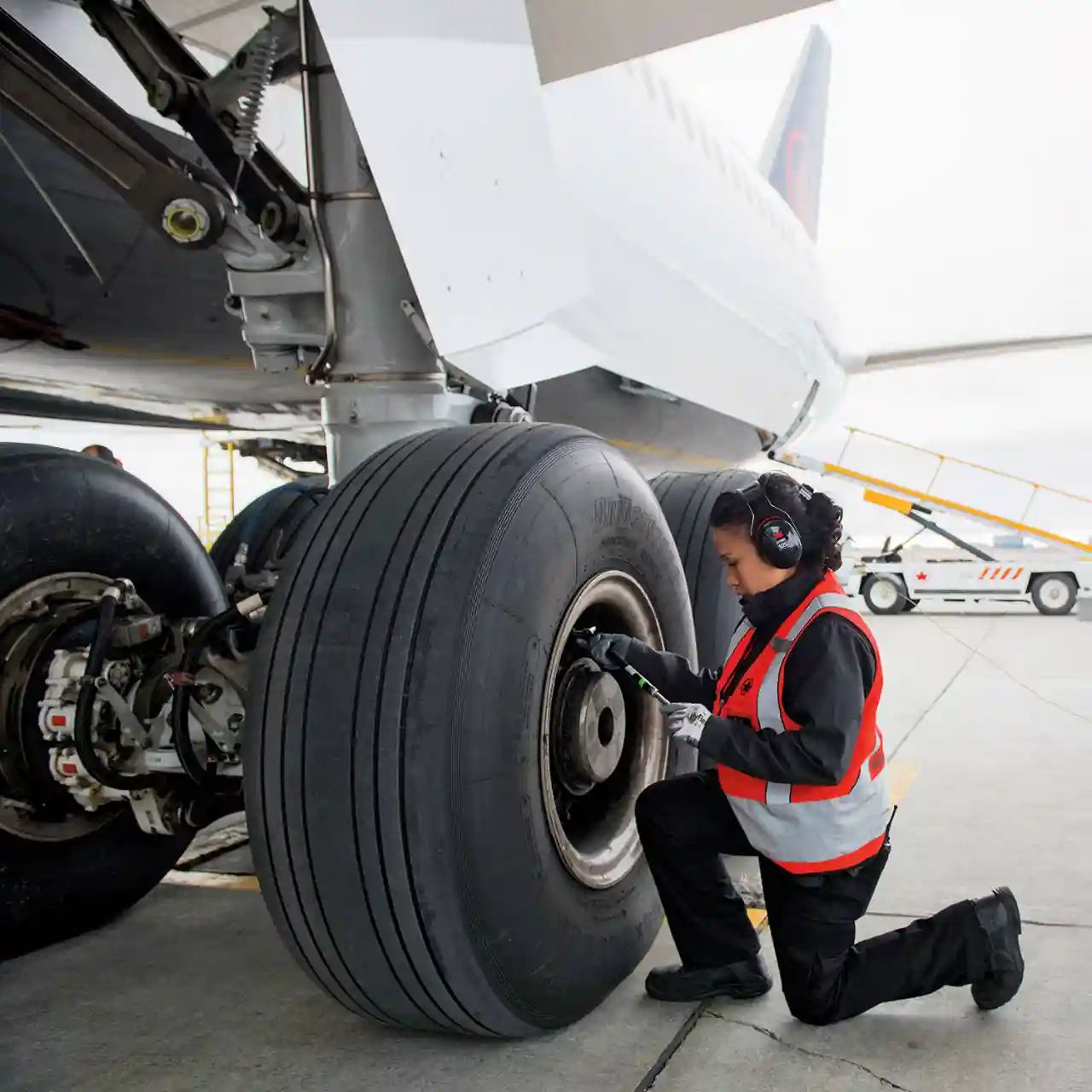
The ability to retread not only cuts cost but also aligns with sustainability efforts in the aviation sector. Given the 747’s continued use in both passenger and cargo service, minimizing waste through tire longevity has become a smart engineering practice.
Steering, Suspension, and Hydraulic Precision
Beyond simply carrying weight, the landing gear of the Boeing 747 integrates steering capabilities, shock absorption, and retraction mechanisms. The nose gear includes a tiller-controlled steering system that pilots use to taxi and make tight turns on the ground. The main gear legs, however, are designed to absorb vertical and lateral loads through oleo-pneumatic shock struts, which compress during landings and taxiing to cushion the aircraft’s structure.
The wing-mounted bogies are uniquely designed to tilt forward before retracting into the underwing cavities, ensuring aerodynamic efficiency in flight. This complex motion is managed by high-pressure hydraulic systems, which must remain functional under all weather conditions, turbulence, and potential mechanical stress. These hydraulics can also be manually overridden — allowing for a gravity drop (or “free fall”) extension in case of system failure.
Built-In Redundancy: The Safety of Having 16 Tires
Redundancy is a fundamental principle of aircraft design. The 747’s four main gear bogies and 16 tires ensure that if one tire bursts, the remaining tires can compensate by absorbing the redistributed load. This level of redundancy is not just a convenience — it’s a necessity for safety.
For instance, if a wing gear tire fails during landing, the adjacent three tires on the bogie continue to bear the weight, while the opposing gear sets maintain balance. Pilots are trained for such scenarios and follow strict post-landing inspection protocols. The structural layout also prevents major tilting or instability, allowing for safe deceleration and taxiing even after a blowout.
Moreover, the system is designed to handle partial failures of hydraulics. In rare cases when a bogie doesn’t extend properly, the aircraft can still land safely on the remaining extended gear thanks to the wide spread and sturdy design of the gear legs and tires.
How the 747 Gear Compares to Other Widebodies
While the Boeing 777 uses 12 main gear tires, and the Airbus A380 boasts a massive 20-wheel main gear system, the 747’s 16-tire configuration strikes a balance between structural necessity and operational efficiency. Unlike the A380, which requires reinforced runways and jet bridges due to its weight and footprint, the 747 is more versatile while still carrying significant loads.
This made the aircraft more cost-effective for airlines and airports, particularly during its decades-long heyday. Airports around the world could accommodate the 747 with minimal infrastructure updates — thanks, in part, to its meticulously engineered landing gear.
Legacy in the Shadows: What Lies Beneath the Wings
Beneath the iconic humpbacked fuselage and enormous wingspan of the Boeing 747 lies a landing gear system that encapsulates the genius of 20th-century aerospace engineering. It is one of the most vital yet least celebrated parts of the aircraft. Without it, the 747 could neither land nor take off safely, nor carry the payloads that made it economically revolutionary.
This system exemplifies engineering that is both elegant and robust — able to sustain decades of continuous service in commercial, military, and scientific roles. From ferrying heads of state to launching satellites and transporting endangered animals across continents, the Boeing 747 did it all — supported every inch of the way by its 16 unshakable wheels.
A Mechanical Masterpiece That Defined An Era
In the age of composite-bodied Dreamliners and AI-assisted flight decks, it’s easy to overlook the analog brilliance that defined earlier giants like the Boeing 747. But the fact that this aircraft could regularly lift almost a million pounds into the air and land it safely hundreds of times across multiple continents is nothing short of a mechanical miracle.
Whether admired from an airport fence, a window seat, or a maintenance hangar, the 747’s landing gear reminds us of the precision that makes modern air travel possible. The aircraft may no longer roll off Boeing’s production line, but the legacy of those 16 tires — and what they made possible — will endure for generations to come.