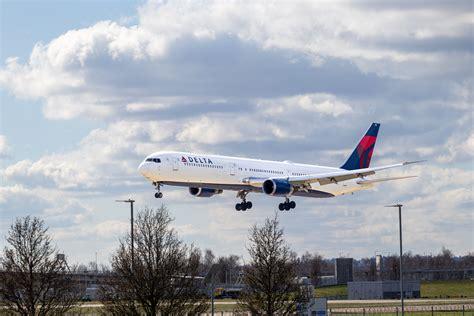
The Boeing 767 occupies a curious and respected place in commercial aviation. Neither the largest widebody nor the most technologically flamboyant, it is instead remembered for robust engineering, predictable handling, and a design philosophy that favors real-world operational safety over visual elegance. One of its most distinctive traits is also one of the least discussed outside engineering circles: the forward-tilting main landing gear. At first glance, this detail seems trivial. In reality, it reflects a precise response to spatial constraints, aerodynamic forces, and pilot workload during the most critical phase of flight—landing.
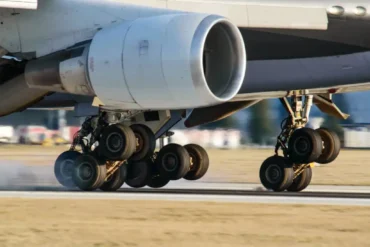
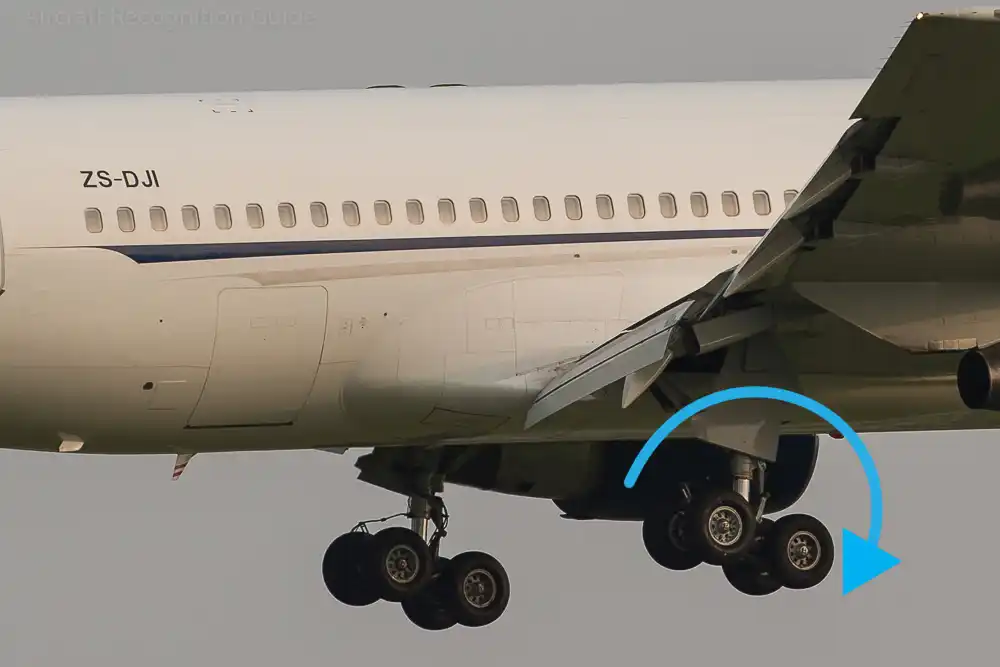
Unlike most commercial airliners with four-wheel bogies, where the landing gear tilts rearward, the Boeing 767’s landing gear tilts forward, making it the only Boeing aircraft ever produced with this configuration. This was not an aesthetic experiment or an accident of layout. It was a deliberate solution to a handling problem discovered during flight testing, combined with the ever-present challenge of fitting increasingly complex systems into an already crowded fuselage.
To understand why this decision matters, it helps to step into the mindset of the engineers who designed the aircraft at the dawn of the widebody twinjet era. The 767 was meant to be efficient, powerful, and forgiving. Its landing gear tilt tells that story in mechanical form.
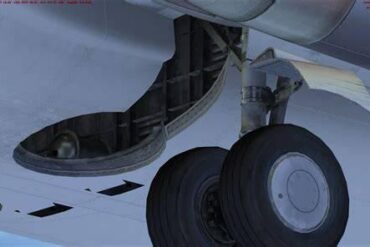
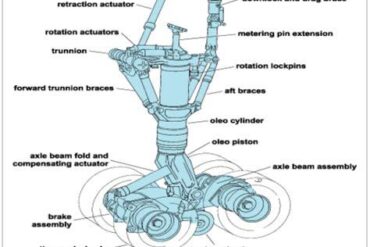
Commercial aircraft may look enormous, but from an engineering perspective, they are exercises in extreme spatial efficiency. Every cubic centimeter inside the fuselage is contested. The main landing gear does not exist in isolation; it must coexist with the wing box, center fuel tanks, cargo holds, environmental systems, and emergency equipment. Of all these components, the landing gear bay is the least productive. It generates no lift, no revenue, and no redundancy. Its sole purpose is storage.
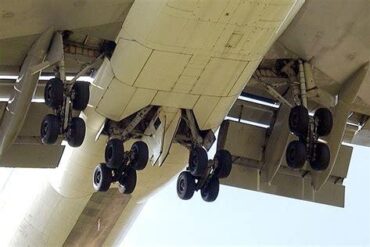
As a result, aircraft designers work relentlessly to minimize landing gear volume. Tilting a bogie allows the gear to fold into a shallower, shorter bay. By staggering the wheel axles vertically, engineers reduce the longitudinal space required for retraction. This principle applies across nearly all modern widebody aircraft, regardless of manufacturer.
Most aircraft achieve this by tilting the gear rearward, raising the front axle while lowering the rear axle. The Boeing 767, however, does the opposite. Its forward-tilted bogie raises the rear axle, compressing the geometry in a way that better suited the aircraft’s internal layout.
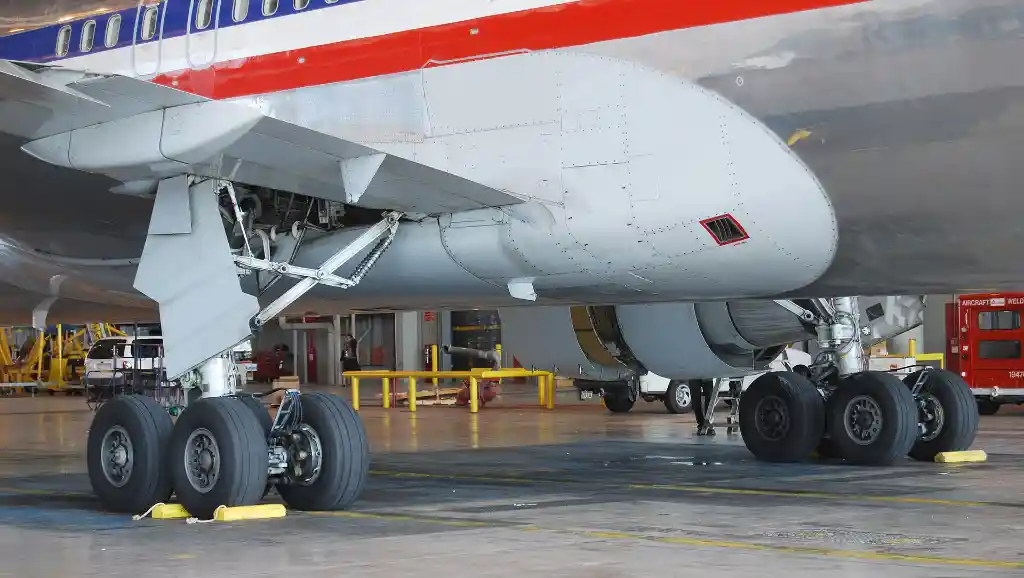
This choice allowed engineers to preserve valuable fuselage space without sacrificing structural integrity. It also accommodated the aircraft’s wing box placement, which sits immediately forward of the gear bays. In widebody aircraft, the wing box is non-negotiable—it is the backbone of the airframe. The landing gear must adapt around it, not the other way around.
Yet space efficiency alone does not explain why Boeing accepted the trade-offs of a forward tilt. The real reason lies in how the aircraft behaves during landing.
During flight testing, engineers observed that the Boeing 767 had a tendency to pitch down aggressively as the main landing gear made contact with the runway. This behavior was not catastrophic, but it was undesirable. A sudden pitch-down moment during touchdown increases the risk of nose gear overload, especially in firm landings or gusty conditions.
In extreme cases, excessive nose-down rotation can result in structural damage. This is not a theoretical concern. In 2023, a Boeing 767-300ER suffered fuselage wrinkling after its nose gear struck the runway with excessive force following a hard landing. Incidents like this underscore why pitch behavior at touchdown is taken seriously during certification.
The forward-tilted landing gear addresses this problem mechanically. By allowing the front axle to touch down first, the aircraft experiences a subtle counteracting moment that resists rapid nose-down rotation. The landing forces are distributed more progressively, buying the pilot precious milliseconds to stabilize pitch attitude.
This does not eliminate the need for proper landing technique, but it reduces the severity of unfavorable dynamics. In effect, the landing gear becomes a passive handling aid, working silently beneath the fuselage.
The Boeing 767 is often described by pilots as a “pilot’s airplane.” It shares a type rating with the Boeing 757, yet it behaves differently. Where the 757 is often compared to a sports car—high thrust, sharp responses—the 767 feels more like a grand tourer. It is powerful but smooth, stable but responsive.
That balance required compromises. Lighter control forces and high engine power made the aircraft pleasant to fly, but they also amplified pitch sensitivity during landing. The forward gear tilt was one of several design refinements introduced to ensure that handling qualities remained predictable across a wide range of weights and conditions.
It is worth noting that the goal was not to produce softer landings. In fact, forward-tilted gear often results in firmer touchdowns. What it prioritizes instead is structural protection and pilot margin. A firm landing that preserves the airframe is preferable to a smooth one that risks damage.
Landing gear tilt also plays a role in how onboard systems interpret the aircraft’s state. Modern aircraft rely on weight-on-wheels sensors to determine whether the plane is airborne or grounded. These signals influence everything from spoiler deployment to thrust reverser availability.
With tilted bogies, the aircraft can detect ground contact as soon as one axle touches down. In rear-tilted configurations, this typically occurs at the rear axle, which encourages a natural nose-lowering motion that many passengers perceive as a smoother landing. In the Boeing 767’s case, the front axle triggers this sequence, subtly altering the timing of system responses.
This difference may be imperceptible to most travelers, but it matters deeply to flight control logic and certification standards.
When comparing aircraft across manufacturers, it becomes clear that there is no single “correct” approach to landing gear tilt. Airbus, for example, has used both forward and rear tilts depending on the aircraft’s mission and design priorities.
The Airbus A330 and A340 are famous for their exceptionally smooth landings, aided in part by rear-tilted landing gear that gently lowers the nose as the bogie settles.
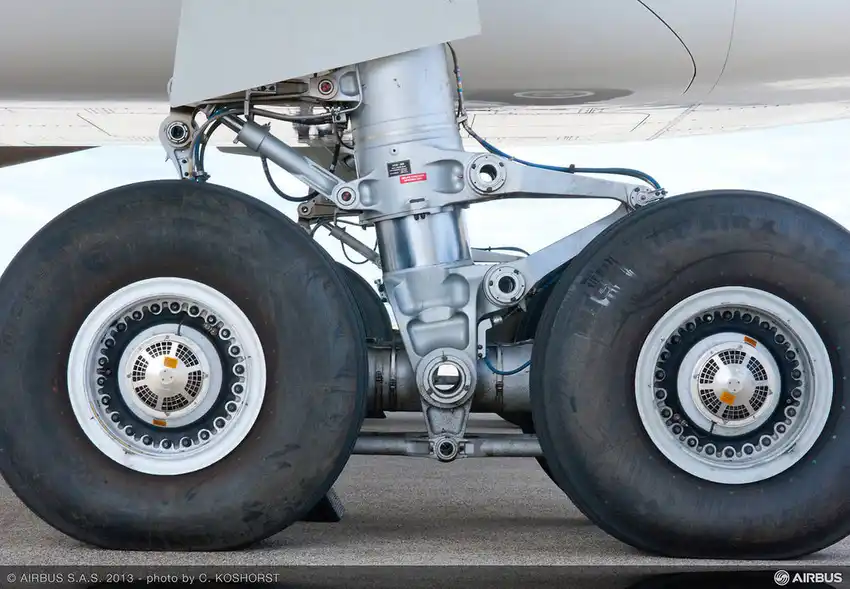
The Airbus A380 and A350-900, by contrast, use forward-tilted gear to simplify structure and reduce mechanical complexity.
Boeing’s later widebodies took yet another path. The Boeing 777 and 787 both employ variable geometry landing gear, where the bogie tilts rearward during landing but rotates forward when retracted. This adds weight and complexity, but it delivers smoother landings without compromising gear bay efficiency.
The fact that Boeing never returned to a fixed forward tilt after the 767 suggests a clear lesson learned. The solution worked, but it came with trade-offs that the company later chose to mitigate through more sophisticated mechanisms.
Looking further back, landing gear tilt itself is a relatively modern concept. Early jetliners like the Boeing 707 and Douglas DC-8 used straightforward, non-tilted bogies. As aircraft grew larger and more efficient, spatial constraints intensified, forcing designers to innovate.
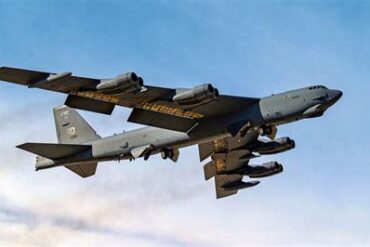
The Boeing 747 introduced extreme rear tilts on its wing-mounted gear to make room for its complex multi-bogie arrangement. Meanwhile, aircraft like the DC-10 and Lockheed L-1011 avoided tilt entirely, reflecting different structural philosophies and lower gross weights.
The Boeing 757 and 767 marked a turning point. From that generation onward, tilted landing gear became the norm rather than the exception.
Forward-tilted gear does have a downside that passengers often notice: firmer landings. When the front axle touches down first, it pulls the rear axle down rapidly, transferring the aircraft’s full weight to the runway more abruptly. This sensation is common on the Boeing 767, Airbus A350, and A380.
Rear-tilted gear, by contrast, allows the aircraft to “roll on” more gently. This difference explains why some aircraft develop reputations for buttery landings while others feel more assertive, even when flown skillfully.
Yet firmness does not equal roughness. Many pilots appreciate the clear feedback provided by forward-tilted gear. It communicates runway contact unambiguously and reduces ambiguity during crosswind landings.
From an editorial perspective, the Boeing 767’s landing gear design illustrates a broader truth about aircraft engineering. Every feature is the result of competing priorities: safety versus comfort, simplicity versus sophistication, weight versus performance. The forward tilt was not a mistake or a shortcut. It was a calculated decision based on the knowledge and tools available at the time.
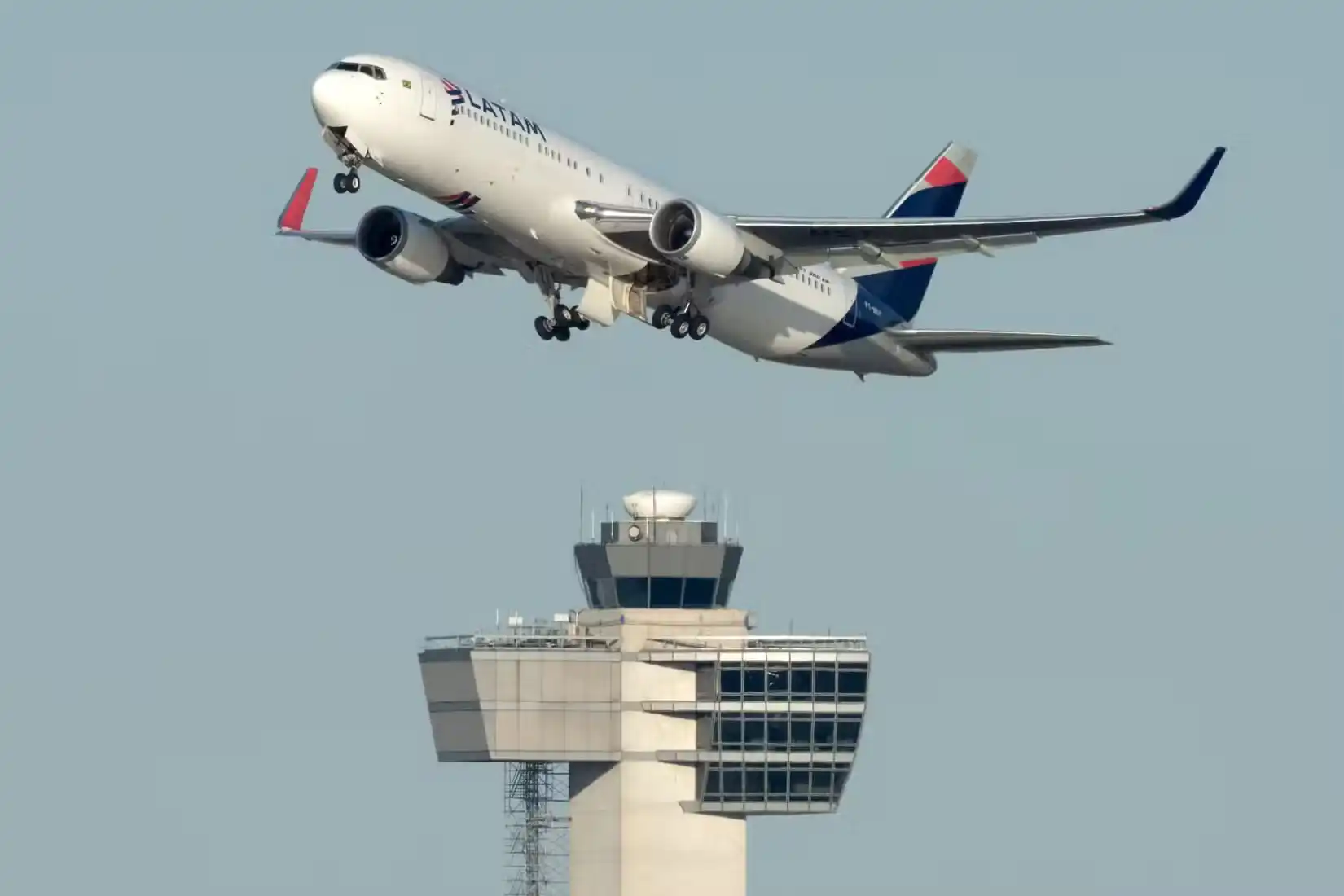
In hindsight, newer aircraft have benefited from improved materials, digital modeling, and active control systems that allow designers to avoid such trade-offs. But the 767 remains a testament to pragmatic engineering—an aircraft that solved real problems with elegant mechanical logic.
The next time a Boeing 767 touches down with a confident, unmistakable thump, that sound is not a flaw. It is the audible signature of a design that chose structural integrity and handling stability over theatrical smoothness. In aviation, that is often the wiser choice.