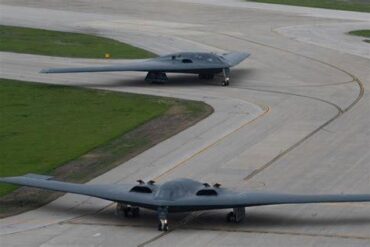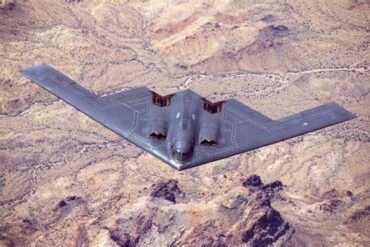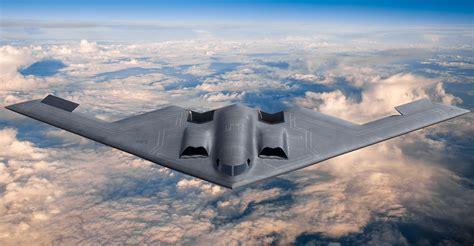
The absence of a tail on the B-2 Spirit bomber is not a stylistic flourish or a futuristic indulgence. It is a deliberate aerodynamic and stealth decision rooted in physics, radar theory, and strategic doctrine. Where most aircraft rely on vertical and horizontal stabilizers to maintain control, the B-2 abandons that tradition entirely. What remains is a pure flying wing—an aircraft that looks less like a conventional bomber and more like a shadow carved into the sky.
To understand why the Northrop B-2 Spirit has no tail, one must first understand what a tail actually does. On traditional aircraft, vertical stabilizers provide directional stability—preventing unwanted yaw, the side-to-side wobble that can turn smooth flight into a wrestling match with airflow. Horizontal stabilizers control pitch. Remove them, and you remove built-in aerodynamic stability. Engineers typically avoid that path unless there is a compelling reason.
For the B-2, that reason was stealth—extreme, uncompromising stealth.
The Flying Wing Philosophy: Stealth Over Stability
The Northrop B-2 Spirit was conceived during the Cold War as a penetrating strategic bomber capable of slipping through dense Soviet air defenses. Its mission demanded one overriding priority: minimize radar detection from every possible angle.
Vertical tails are radar reflectors by nature. They create sharp angles where surfaces intersect, forming what radar engineers call “corner reflectors.” A corner reflector bounces radar energy straight back to its source, like a mirror angled to reveal your hiding spot. For a stealth aircraft, that is unacceptable.
By eliminating the tail, designers created a smooth, continuous curvature across the aircraft’s surface. Radar waves striking the B-2 are scattered away rather than reflected back to the transmitter. The entire airframe acts like a carefully sculpted radar diffuser.
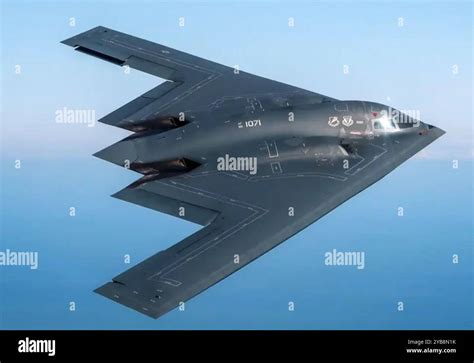
This is why the B-2 is described as a “flying wing.” The wing is the airplane. There is no fuselage-and-tail distinction. Everything is blended into a single aerodynamic form optimized for low radar cross-section (RCS).
The result is not invisibility. Stealth is not magic. It is delay and distortion. It makes detection harder, tracking slower, targeting more uncertain. In combat, seconds matter. Confusion matters more.
Radar Cross-Section: Why Tails Are a Stealth Liability
Radar cross-section is a measure of how detectable an object is by radar. It is not just about size; it is about geometry and materials. A small object with poor shaping can appear larger than a bigger object designed intelligently.
Vertical stabilizers create several problems for stealth aircraft:
- They present broad surfaces to side-aspect radar.
- They generate strong perpendicular reflections.
- They form corner junctions with the fuselage.
Even when angled outward, as seen on the Lockheed Martin F-22 Raptor, tails remain detectable elements. The F-22 mitigates this with canted stabilizers, but it cannot eliminate them entirely without sacrificing maneuverability.
The B-2 does not need to dogfight. It does not need high-angle-of-attack acrobatics. Its job is to fly long distances at subsonic speeds, penetrate airspace quietly, release precision-guided munitions, and leave before anyone fully understands what happened.
Removing the tail simplifies stealth geometry across all aspects—front, side, and rear. It also reduces drag. Less drag means greater range, and range is strategic power.
The Price of Tailless Design: Controlled Instability
Here is where the story becomes delightfully counterintuitive. Aircraft are normally designed to be aerodynamically stable. If disturbed by turbulence, they naturally return toward equilibrium. The B-2 does not.
By removing its tail stabilizers, the aircraft becomes inherently unstable in yaw. Left alone without constant correction, it would not behave politely.
The solution lies in fly-by-wire systems. Instead of mechanical linkages between pilot and control surfaces, the B-2 relies on computers that make continuous micro-adjustments—thousands per second. The aircraft is constantly being stabilized by algorithms.
This is not a gentle nudge here and there. It is an ongoing digital negotiation with physics.
Such systems did not mature until late in the 20th century. Earlier flying wing experiments like the Northrop YB-49 in the 1940s lacked the computational sophistication needed for reliable operational deployment. The B-2 succeeded where its ancestors struggled because computing power finally caught up with aerodynamic ambition.
Why the F-22 Keeps Its Tails
The contrast with the Lockheed Martin F-22 Raptor is revealing. Developed in a similar era, the F-22 is also stealthy. Yet it retains twin vertical stabilizers.
Why?
Because its mission is different. The F-22 is an air superiority fighter. It must:
- Sustain supersonic cruise.
- Execute violent high-G turns.
- Maintain control at extreme angles of attack.
- Recover from post-stall maneuvers.
Flying wing designs excel in subsonic efficiency but struggle at sustained supersonic maneuvering. Without vertical tails, directional stability at high speeds becomes extremely complex. Thrust vectoring can help, but it does not fully replace traditional surfaces for rapid, aggressive combat maneuvers.
The F-22’s canted tails represent a compromise—stealth reduced where absolutely necessary to preserve agility.
The B-2, by contrast, trades maneuverability for survivability through invisibility. It is not built to dance. It is built to disappear.
The B-21 Raider: Doubling Down on the Tailless Formula
The philosophy did not end with the B-2. The upcoming Northrop Grumman B-21 Raider retains the same tailless flying wing architecture.
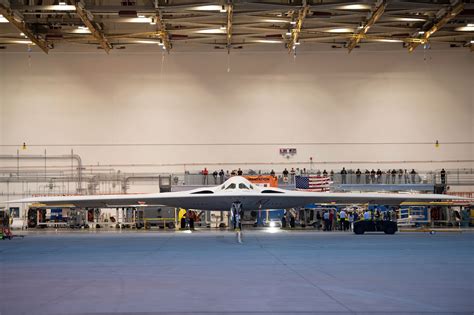
This continuity is not aesthetic nostalgia. It is strategic validation. The B-2’s design doctrine proved sound: extreme stealth, long range, and deep penetration capability remain central to U.S. strategic deterrence.
The B-21 refines the concept with improved materials, advanced avionics, and likely enhanced engine integration to further reduce infrared and radar signatures. It benefits from decades of stealth evolution and computational advances.
The Air Force plans to acquire at least 100 B-21s, restoring fleet depth lost as the B-2 force shrank to just 19 operational aircraft. Scale matters in deterrence. A handful of invisible aircraft can change a battlefield. A hundred can reshape strategy.
Emerging Tailless Fighters: The Sixth-Generation Question
The tailless concept is now migrating beyond bombers. Renderings of the rumored Boeing F-47 suggest a possible flying-wing fighter optimized for extreme all-aspect stealth. Chinese prototypes, often referred to as J-36 concepts, also appear tailless in imagery.
This signals a doctrinal shift. As long-range missiles, sensor fusion, and drone integration expand engagement distances, the need for close-range dogfighting may diminish. If a fighter can destroy targets from beyond visual range while remaining nearly undetectable, extreme maneuverability becomes less critical.
That said, not every sixth-generation fighter will abandon tails. European programs such as the BAE Systems Tempest under the GCAP partnership retain canted vertical stabilizers, suggesting a continued emphasis on agility and multirole flexibility.
Design reflects doctrine. Doctrine reflects anticipated war.
Aerodynamics Meets Strategy: The Core Trade-Off
Removing a tail is not a fashion statement. It is a physics gamble.
The B-2 sacrifices:
- Natural aerodynamic stability
- High maneuverability
- Supersonic performance
In exchange, it gains:
- Lower radar cross-section
- Reduced drag
- Greater unrefueled range
- Simplified stealth shaping
This is a strategic aircraft built around patience, precision, and penetration. It operates at high altitude, cruises subsonically, and relies on layered support—tankers, intelligence assets, electronic warfare, and escorts.
The B-2 is less a lone warrior and more a surgical instrument in a vast network.
The Evolution of Stealth Doctrine
When the B-2 entered service in 1997, it operated with near impunity in contested airspace. Over time, radar systems have improved. Low-frequency radars, networked sensors, and advanced fighter interceptors have narrowed the stealth advantage.
Stealth erodes as detection improves. It is an arms race measured in decibels of reflected energy.
The B-21’s development reflects an acknowledgment that stealth must evolve continuously. Improved materials, refined shaping, and advanced electronic warfare integration aim to restore the edge.
The tailless flying wing remains central because physics has not changed. Radar still reflects from vertical surfaces. Drag still punishes protrusions. Range still determines strategic reach.
Why the B-2 Spirit Has No Tail — In One Line
The B-2 Spirit has no tail because eliminating vertical stabilizers dramatically reduces radar visibility and drag, enabling extreme stealth and long-range penetration at the cost of natural stability and maneuverability.
It is a machine that trusts computers over aerodynamics and invisibility over agility.
In a sense, the B-2 represents a philosophical shift in air warfare. Instead of surviving by outmaneuvering threats, it survives by avoiding detection altogether. It does not outrun danger. It steps around it.
That choice—radical, expensive, technologically demanding—proved durable enough to define the next generation of strategic bombers. The flying wing is no longer an experiment. It is a doctrine etched in composite materials and controlled by relentless streams of code.
The absence of a tail is not something missing. It is something deliberately removed, like a sculptor carving away marble to reveal form. What remains is an aircraft shaped as much by radar equations as by airflow, built for a world where being unseen is often more powerful than being unstoppable.