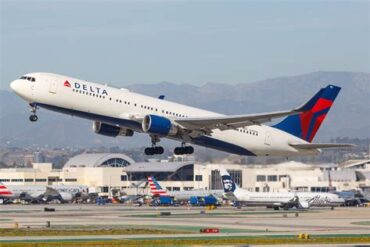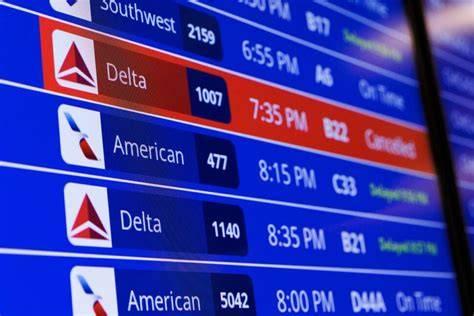
Delta Air Lines began 2026 carrying one of the strongest operational reputations in the US airline industry. The carrier had been recognized by Cirium as North America’s most punctual airline for the fifth consecutive year, creating an expectation that operational reliability would remain one of its defining strengths. Yet new US Department of Transportation data reveals a troubling contradiction. During the first half of 2026, Delta’s domestic network canceled 19,150 flights, compared with 9,696 during the same period in 2025. That represents an increase of almost 98% in just one year.
The scale of the increase is particularly striking because Delta did not dramatically expand its schedule during the same period. Scheduled domestic flights increased by only 3%, rising from 792,127 in the first six months of 2025 to 816,084 in the first half of 2026. At the same time, Delta’s cancellation rate climbed from 1.22% to 2.35%. The figures indicate that the airline’s worsening cancellation performance cannot simply be explained by operating substantially more flights.
Delta Air Lines Cancellation Rate Nearly Doubles
The deterioration affected both Delta’s mainline operation and the regional carriers operating under the Delta Connection brand. Mainline cancellations increased from 4,913 in the first half of 2025 to 10,647 in 2026, representing a remarkable 116.7% increase. The mainline cancellation rate consequently rose from 0.99% to 2.09%.
Delta’s regional partners experienced a similarly difficult period, although their increase was less severe. Delta Connection cancellations climbed from 4,783 to 8,503, an increase of 77.8%. Their cancellation rate increased from 1.62% to 2.77%. Taken together, these numbers show that the problem was not isolated to one portion of Delta’s network. Both the mainline carrier and its regional partners struggled to absorb disruptions and keep aircraft and crews moving according to schedule.
The broader US airline industry also experienced more cancellations in the first half of 2026. US carriers canceled 85,998 flights, compared with 59,244 during the same period in 2025, pushing the industry’s overall cancellation rate from 1.57% to 2.23%. Delta, however, deteriorated considerably faster than the industry as a whole. Its increase in cancellations represented more than one-third of the industry’s total increase despite Delta accounting for only roughly one-fifth of reported scheduled flights.
Delta’s On-Time Performance Tells a Different Story
Perhaps the most interesting part of the data is that Delta did not become dramatically less punctual. In fact, its network on-time rate improved from 78.70% in the first half of 2025 to 79.33% in 2026. That 0.63-percentage-point improvement placed Delta second among major US airline networks, behind Alaska Airlines at 80.51%.
Delta’s mainline operation performed even better, achieving an 80.26% on-time rate, the best result among reporting carriers. This creates an important distinction when evaluating the airline’s operational problems. Delta was not necessarily struggling to operate normal flights on time. Instead, its weakness appeared when significant disruption occurred and the airline needed to rebuild its schedule.
That distinction helps explain how an airline can simultaneously improve its punctuality while experiencing a dramatic increase in cancellations. A flight that operates can still be punctual, but a flight that disappears from the schedule entirely is recorded as a cancellation rather than a late operation. Delta’s first-half performance therefore points toward a problem with operational resilience and recovery, rather than a universal collapse in everyday punctuality.
Weather Exposed Delta’s Operational Weaknesses
Severe weather played a major role in Delta’s difficult first half of 2026. Winter Storm Fern delivered snow, freezing rain and ice across large areas of the United States in January, with particularly significant consequences for Delta’s major hubs at Atlanta, New York JFK and Boston Logan.
Delta proactively reduced its schedule as conditions deteriorated and canceled hundreds of flights. The storm contributed to more than 15,000 US flight cancellations, creating an enormous operational challenge for airlines across the country. For Delta, the impact was amplified by the importance of its major hubs. When weather disrupts a large connecting hub, the consequences can spread rapidly because aircraft, pilots and flight attendants may all end up in the wrong locations.
February brought another major disruption when a powerful Northeast blizzard struck on February 23. Delta canceled approximately 20% of its flights that day, according to the reference data. Severe weather continued to affect the eastern United States during March, creating repeated interruptions at several important airline hubs.
Delta’s monthly performance reflected the cumulative impact. Its network on-time rate fell to 74.9% in March before recovering to more than 80% during April, May and June. The recovery demonstrates that the airline could restore normal operations after individual disruptions. The bigger question was why some disruptions produced such a large number of cancellations before recovery was achieved.
Crew Availability Became a Critical Problem
Weather and air traffic control restrictions can trigger an operational crisis, but Delta’s internal staffing situation appears to have made those crises significantly harder to resolve. An internal Delta memo indicated that staffing-related cancellations had risen to more than ten times historical levels and accounted for roughly 35% of mainline cancellations.
One particularly revealing statistic involved pilots accepting open trips beyond their normal schedules. According to the supplied reference material, pilot acceptance of those additional trips fell from approximately 37% to just 2% year over year. That represents an extraordinary change in the amount of voluntary flexibility available to Delta when its schedule required additional coverage.
This matters because airline operations depend on tightly coordinated resources. When weather causes an aircraft or crew to become displaced, the airline may need another pilot to operate a replacement flight or recover a disrupted sequence. If fewer pilots are available to accept open assignments, the airline has fewer options for fixing those gaps quickly.
The problem became especially visible in early May, when Delta canceled around 500 flights over several days. The number was more than ten times the cancellation rate reported by American Airlines and United Airlines during the same period. Delta subsequently apologized and attributed the disruption to “crew resources,” reinforcing the idea that staffing and scheduling had become central components of the airline’s recovery difficulties.
Delta Is Adding More Operational Resilience
Delta has responded by changing how it manages staffing buffers. Rather than relying as heavily on pilots voluntarily accepting open trips, the airline has begun increasing pilot reserve levels and accelerating hiring.
According to the Air Line Pilots Association, Delta had hired approximately 1,200 pilots during 2026, with the union projecting around 2,200 new pilot hires for the full year. Increasing the number of available pilots should give Delta greater protection when unexpected disruptions create last-minute gaps.
The airline is also expanding its crew scheduling infrastructure. Delta says it has increased its crew tracker and scheduler workforce by 15% since summer 2025 while adding more experienced leadership to its day-of-operations team. The goal is to identify crew shortages faster, make reassignment decisions more quickly and reduce the amount of time required to recover from operational disruptions.
Artificial Intelligence Could Help Delta Recover Faster
Technology is becoming another part of Delta’s response. The airline is evaluating AI-assisted crew forecasting to help its scheduling teams anticipate where replacement crews may be needed before shortages develop.
This approach could be particularly valuable during irregular operations. Instead of waiting for a crew shortage to appear after weather or air traffic restrictions have already disrupted the network, predictive systems could identify potential gaps earlier and allow planners to position resources more effectively.
Delta is also using an AI-enabled maintenance forecasting tool through its TechOps organization. The objective is to predict maintenance requirements and improve aircraft availability. This addresses another weakness identified by Delta management: even when crews are available, aircraft availability can become a limiting factor during periods of significant disruption.
What Delta’s 2026 Cancellation Surge Really Means
The first half of 2026 does not necessarily indicate that Delta Air Lines has abandoned its reputation for reliability. The data tells a more complicated story. Delta’s on-time performance actually improved, while its cancellation rate nearly doubled. That combination suggests that the carrier’s principal weakness has been its ability to recover from major disruptions rather than its ability to execute ordinary scheduled operations.
Weather and air traffic control restrictions can create problems for any airline. What separates a resilient operation from a fragile one is what happens afterward. Delta’s experience during the first six months of 2026 suggests that its staffing buffers, crew scheduling systems and aircraft availability were not always strong enough to rebuild the network quickly once disruption began.
The second half of 2026 will therefore be an important test. Increased pilot reserves, accelerated hiring, a larger crew scheduling workforce and expanded use of predictive technology could provide Delta with the additional margin it needs. If those investments work, the airline may be able to reduce the cascading effects that turned individual weather and staffing problems into thousands of cancellations.
For passengers, the distinction is crucial. A flight being late is frustrating, but a cancellation can completely change a journey, particularly when it occurs at a major hub and alternative flights are already full. Delta’s challenge is no longer simply maintaining a strong on-time percentage. It is building an operation capable of absorbing disruption without allowing a difficult day to become a difficult week.
The first-half numbers are therefore a warning rather than a final verdict. Delta still demonstrated strong punctuality across the flights it operated, but its nearly doubled cancellation count exposes a vulnerability that the airline will need to address decisively. The success of its staffing, scheduling and technology initiatives could determine whether Delta flight cancellations remain one of the defining stories of 2026 or become a temporary operational setback.