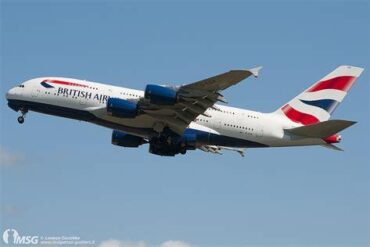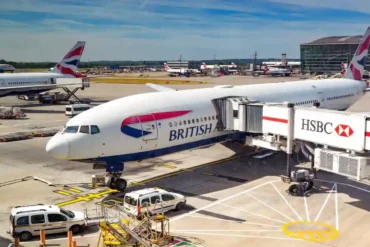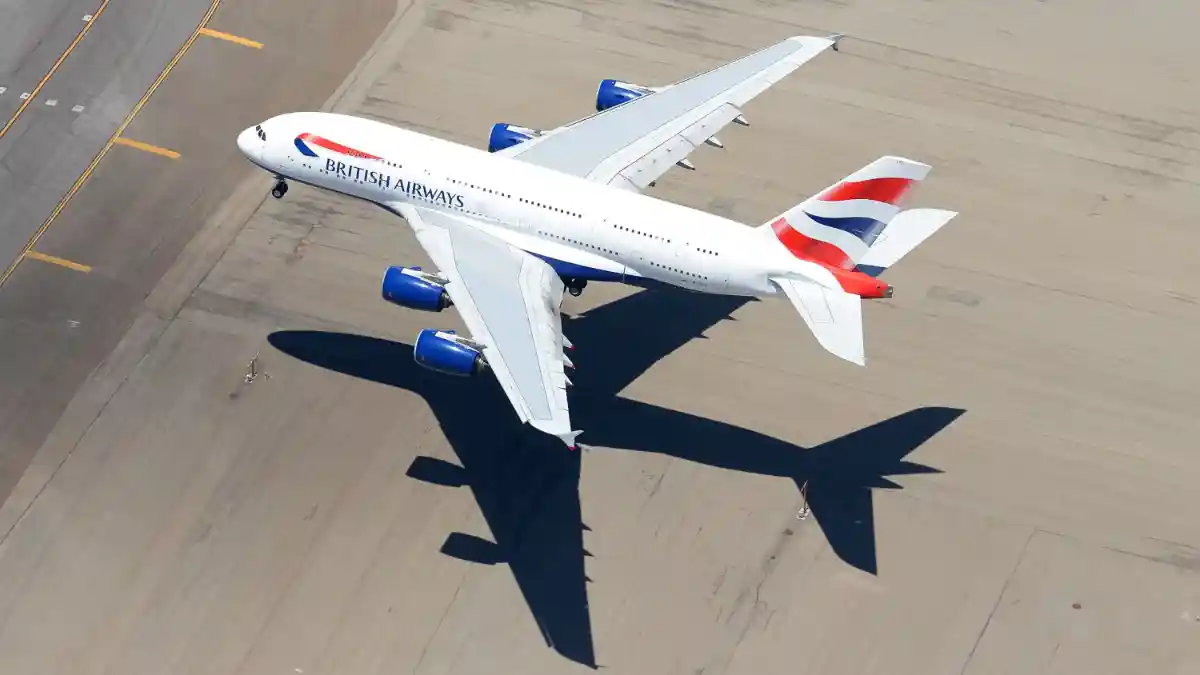
British Airways flies 12 Airbus A380s, which ties it with Singapore Airlines as the largest operator of the type outside Emirates, according to ch-aviation data. Every one of those 12 aircraft is based at London Heathrow (LHR), where the fleet lives in Terminal 5 and rotates through the same pair of runways that handle the rest of the airline’s long-haul network. The airline serves more than 200 cities worldwide across its full long-haul and short-haul network, and its largest aircraft reaches fewer than 4% of them. By the end of 2026 the A380 map had narrowed to roughly seven or eight destinations: Johannesburg (JNB), Miami (MIA), Boston (BOS), Dallas/Fort Worth (DFW), Los Angeles (LAX), San Francisco (SFO) and Singapore Changi (SIN), with the exact count moving as the schedule was rebuilt during the year. Simple Flying reported in January 2026 that British Airways planned seven long-haul A380 routes across the year, scheduling 1,247 flights and 584,843 seats with the type in the first quarter alone. Bolt Flight subsequently reported eight routes for the second half of 2026, and Washington Dulles (IAD) and Singapore lost the type entirely in some seasonal windows before being reassigned.
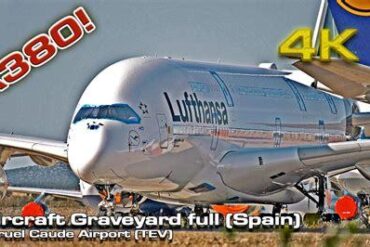
That mismatch is not a fleet in retirement. British Airways made the opposite call after the pandemic, choosing to keep and reintegrate every A380 rather than send the oldest airframes to the desert as several other operators did. The airline then doubled down, announcing on October 5, 2026 that it would retrofit the whole fleet rather than wind it down. A carrier that intends to fly an aircraft into the 2030s and still confines it to a handful of cities has not made a scheduling mistake. It has made a calculation about where the aircraft earns money and where it does not.
Heathrow’s 480,000-Movement Cap Made The A380 Necessary
The explanation begins and ends at London Heathrow, an airport operating under a legal cap of 480,000 air transport movements per year and a limit of 88 movements per hour. A UK Department for Transport research report described it as “by some measures, considered to be the most slot constrained airport in the world,” noting that the airport has run close to 99% of that cap for most of the past two decades. Aviation consultancy IBA puts current operating capacity at 99%, with slot supply running at roughly 90% of recorded demand. A single pair of takeoff and landing slots at Heathrow can trade for tens of millions of dollars.
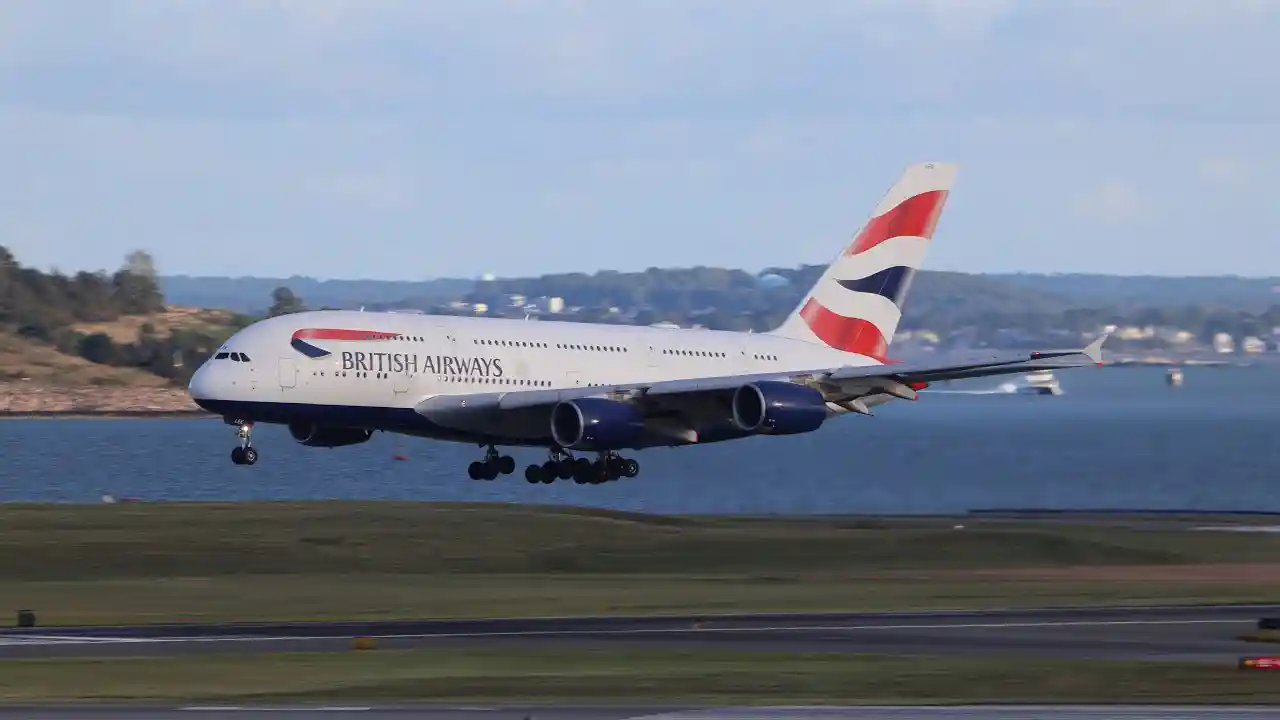
That constraint rewrites airline growth. At Heathrow, a route that fills up gets a second daily flight only if somebody sells the slot, and the price of that slot has to be absorbed by the route. British Airways therefore cannot chase demand by flying more often. It has to fly bigger. A 469-seat A380 carries roughly 50% more passengers than a Boeing 787 on the same slot, which means a single rotation to Johannesburg or Miami can carry almost 1,000 passengers a day while consuming exactly one pair of slots, the same allocation a smaller twinjet would need. In that accounting, the A380 is not a prestige machine. It is the only instrument that lets the airline extract maximum revenue from a fixed piece of concrete.
The logic also explains why the type survives while more efficient aircraft arrive. A380 seat capacity from Heathrow has remained broadly stable even as the 747-400s left and the A350-1000 and 787-10 joined the long-haul fleet. Those twins burn less fuel per seat, but they cannot absorb the volume Heathrow’s slot scarcity forces onto the densest routes. Retiring the A380 would not free up a slot for a new destination; it would simply shrink the capacity on an existing one.
The Slot-Based Route Selection: Why Johannesburg And Miami Live Twice Daily
Slot scarcity only pays off if the aircraft runs full, and full means twice daily on the right city pairs. Johannesburg (JNB) and Miami (MIA) were scheduled for exactly that in 2026, making them the most A380-intensive routes British Airways operates. A twice-daily rotation puts 938 seats on that market every day in each direction at the current 469-seat configuration. Sustaining that requires year-round demand in both directions, plus enough premium traffic to cover the cost of hauling a four-engine aircraft across the Atlantic or down to Southern Africa twice a day, all year.
Most Heathrow long-haul markets fail that exact test. A route with strong peak demand but a soft shoulder season is better served by a 787 the airline can fill year-round than by an A380 that flies half empty for four months, so the A350-1000s and 787s take the thinner or developing markets while the superjumbos concentrate on high-density, high-yield city pairs where slot scarcity makes size an advantage rather than a liability. That is a deliberate split, not an accident of scheduling.
The 2026 schedule changes mark the line. Washington Dulles (IAD) and Singapore Changi (SIN) both lost A380 service after being served in 2024 and 2025, and Boston and Dallas/Fort Worth were pushed later into the year rather than operating from January. Tech Times reported the winter reduction moved the airline from third to sixth globally by scheduled A380 departures. Those cuts were not a rejection of the aircraft. They were a correction: too many routes to sustain at the width the aircraft demands, so the fleet was pulled back to the markets where 938 seats a day can be sold reliably.
Not Every Airport Can Accept A 262-Foot Wingspan
The A380 is classified Code F by ICAO, the highest aerodrome reference category, because of its 262-foot (80-meter) wingspan and outer main landing gear span. Code F standards call for runways 197 feet (60 meters) wide, taxiway separation of 320 feet (97.5 meters), and gate boxes measuring 262 by 262 feet (80 by 80 meters). The Airbus Airport Compatibility Group negotiated relaxed figures that allowed operations on 148-foot (45-meter) runways with additional safety measures, sparing airports a full Code F reconstruction, but the aircraft still cannot use infrastructure built for a 777 or 787 without work.
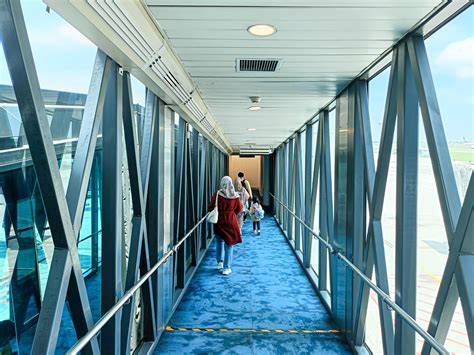
Airports that wanted it paid for it. Runways and taxiways required strengthening for a maximum takeoff weight exceeding 1.2 million lb (544,311 kg), signage and lighting had to be relocated to avoid jet blast damage, and operators installed double-deck jet bridges so passengers could leave both decks simultaneously while enlarged terminal areas processed nearly 500 arriving passengers at once. Airbus states the A380 can operate scheduled service to more than 140 airports worldwide, with up to 400 available as diversion fields.
That constraint explains why the A380 cannot become a general-purpose aircraft, but it does not explain British Airways’ narrow list. Every A380 destination is a major international hub that made the investment. Johannesburg, Miami, Boston, Dallas/Fort Worth, Los Angeles and San Francisco all handle the type without any difficulty, and dozens of other Heathrow long-haul points could too. Infrastructure limits the possible A380 routes. It does not limit British Airways to eight.
The Fleet-Wide Retrofit That Answered The Network Question
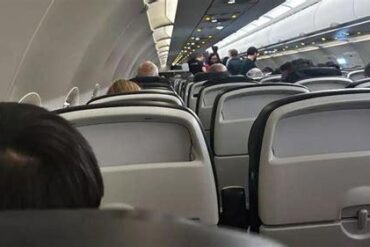
The retrofit announced on October 5, 2026 is the clearest statement of the aircraft’s purpose. The current fleet carries 469 seats across 14 First, 97 Club World, 55 World Traveller Plus and 303 World Traveller. The refurbished layout drops to 417 seats: 12 First suites, 106 Club Suites, 84 World Traveller Plus and 215 World Traveller. Economy falls by 88 seats, roughly 30%, while premium economy grows by more than half, and every stateroom in the new premium economy is a suite with its own door.
The entire upper deck becomes business class. All 106 Club Suites sit upstairs across four separate zones, which British Airways says makes it the largest business class cabin on any commercial aircraft. The A380 had been one of the last BA types still carrying the old Club World yin-yang layout, where some passengers lacked direct aisle access, and every seat in the new cabin has a closing door and direct aisle access. World Traveller Plus and the upper-deck economy cabin both move down to the main deck, and First stays forward on the lower deck. AeroTime reported each aircraft needs more than 35,000 individual parts, and the first completed aircraft is expected in service within months, with the programme running into 2027 and 2028.
That configuration choice answers the network question directly. An aircraft with 106 business seats and 215 economy seats works only on routes with deep, year-round premium demand, a shorter list than the routes that can fill 303 economy seats. British Airways is not retrofitting the A380 to fly more places. It is rebuilding the aircraft around the handful of routes where slot mathematics and premium demand both hold up, and the cabin itself becomes a constraint that reinforces the schedule: every added destination would have to justify 106 lie-flat suites twice a day, and few markets on a Heathrow map can.
Why The Comparison With Emirates Misleads
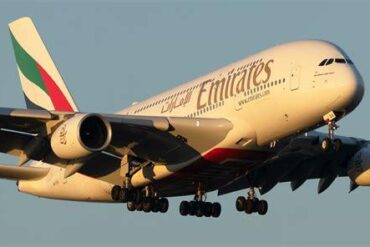
Emirates operates roughly 110 active A380s across dozens of destinations and an entirely different business model built on a Dubai hub with unrestricted growth and a state strategy to become a global connecting centre. British Airways runs a fraction of that fleet from an airport legally frozen near 480,000 movements, and the difference in scale is not a failure of ambition. Emirates sells one-stop journeys from India, Africa and Southeast Asia into Europe and North America. British Airways sells point-to-point traffic from London into markets where its own brand and its frequent flyer base can fill a 106-seat business cabin every day.
The internal comparison is the one that matters. British Airways serves a far broader long-haul network and deliberately chose to concentrate the type on its densest city pairs. A 12-ship fleet applied across 20 destinations would put the aircraft on routes that cannot absorb it year-round, and the slots used to fly half-full superjumbos would be the same slots that could be flown profitably twice a day to Johannesburg. Twelve aircraft, seven destinations and one airport is not a shrinking network. It is a slot-constrained airline using its largest asset exactly where the economics permit it.