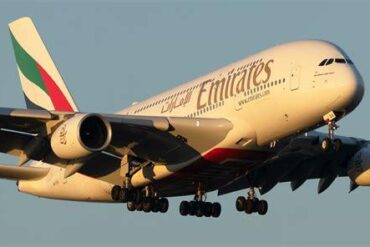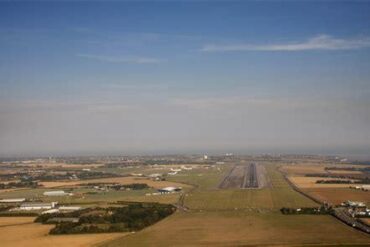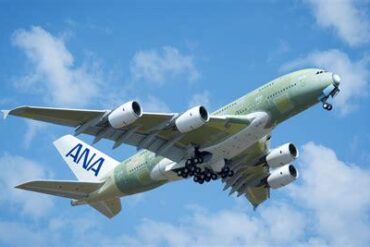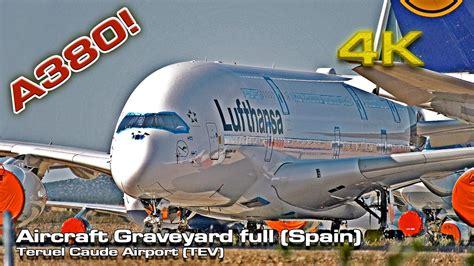
Teruel Airport does not look like the future of global aviation. There are no packed departure halls, no glowing duty-free shops, and no queues of passengers dragging suitcases toward boarding gates. Located on a dry plateau in eastern Spain’s Aragon region, the airport feels isolated, almost forgotten. Yet behind its quiet perimeter fences sits one of the most important aviation facilities in the world — a place where Airbus A380 superjumbos are simultaneously being resurrected for long-haul service and dismantled for parts.
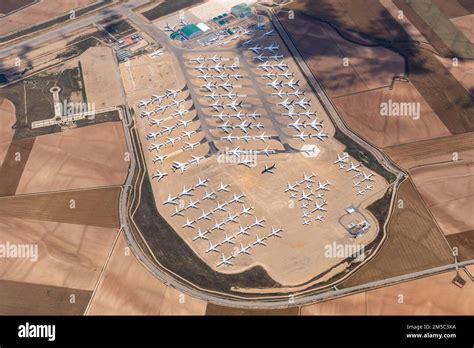
At first glance, the rows of parked aircraft resemble a conventional boneyard. Widebody jets sit motionless under the Spanish sun, engines wrapped, windows covered, and wings casting enormous shadows across the concrete apron. But Teruel is far more complex than a storage yard. Operated by Tarmac Aerosave, the facility has evolved into Europe’s most significant aircraft preservation, maintenance, and recycling center, with the Airbus A380 at the center of its operations.
The airport’s transformation mirrors the strange position of the A380 itself in 2026. The world’s largest passenger aircraft is no longer the uncontested symbol of aviation ambition it once was, yet it is far from extinct. Some airlines are investing millions to bring stored superjumbos back into service, while others are sending the same aircraft type to be stripped apart piece by piece. Teruel is where both destinies unfold side by side.
Why Teruel Became Europe’s Airbus A380 Capital
Teruel Airport’s location is not accidental. The facility sits roughly 1,000 meters above sea level in a semi-arid climate that receives more than 240 days of sunshine annually. Low humidity is the hidden advantage that made this remote Spanish plateau invaluable to the aviation industry.
Aircraft deteriorate rapidly in humid environments. Moisture infiltrates fuselage cavities, corrodes electrical systems, and damages engines during long-term storage. In Teruel, the dry air dramatically slows that process. Stable temperatures also reduce thermal expansion and contraction stresses that can gradually weaken structural materials. For airlines storing assets worth hundreds of millions of dollars, those environmental conditions are economically critical.
The site itself carries historical significance. Originally built as a military airfield during the Spanish Civil War, it remained largely underused for decades before reopening in 2013 as a commercial aircraft storage and maintenance facility. What began as a niche operation quickly expanded as airlines realized the strategic value of desert-style aircraft preservation within Europe.
Tarmac Aerosave, the company managing the facility, was founded in 2009 with backing from Airbus, Safran, and Suez. Its expertise extends beyond parking aircraft. The company specializes in end-of-life dismantling, heavy maintenance, component recovery, and aircraft transition services between operators. More than 220 aircraft have already been recycled through its operations, including the majority of retired Airbus A340s worldwide.
Today, Teruel can accommodate around 140 aircraft simultaneously alongside dozens of spare engines. The workforce has grown beyond 230 employees, with further hiring planned as global demand for A380 maintenance continues increasing. What once looked like an aviation graveyard has become an industrial ecosystem supporting airlines across multiple continents.
The Airbus A380’s Unexpected Second Life
Few aircraft experienced a more dramatic reversal of fortune than the Airbus A380. During the pandemic, the superjumbo appeared doomed. Airlines grounded fleets worldwide as international travel collapsed, and many analysts predicted the aircraft would never recover commercially.
The logic seemed unavoidable. The A380 was designed for an era of booming hub-and-spoke travel, carrying more than 500 passengers between major airports. When travel demand disappeared, airlines shifted toward smaller, more flexible twin-engine jets such as the Airbus A350 and Boeing 787. Four-engine aircraft suddenly looked expensive and inefficient.
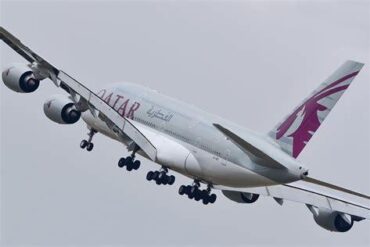
Teruel rapidly filled with parked A380s from airlines including Emirates, Lufthansa, Qatar Airways, Singapore Airlines, and British Airways. Some arrived for temporary storage. Others appeared destined never to fly again.
Then the market changed.
As international travel demand surged back faster than expected, airlines faced aircraft shortages, delivery delays, and constrained fleet availability. High-density routes once again became profitable for the A380. Suddenly, bringing parked superjumbos back into service made financial sense.
That reversal transformed Teruel into one of the aviation industry’s busiest engineering centers.
Inside The Massive A380 Hangars At Teruel
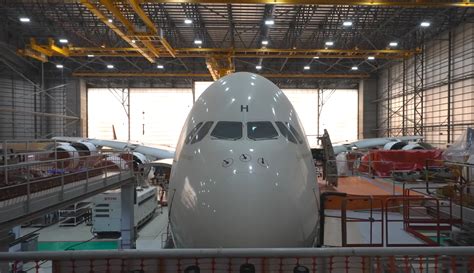
Handling an Airbus A380 is unlike servicing almost any other passenger aircraft. The superjumbo’s dimensions are staggering. Its wingspan exceeds 79 meters, its height rivals a seven-story building, and its double-deck fuselage creates unique engineering challenges during maintenance.
Traditional hangars are often too small for comprehensive indoor A380 work. Teruel responded by building specialized infrastructure dedicated specifically to the aircraft.
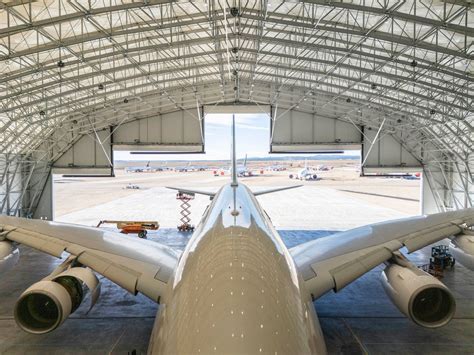
The facility’s newest A380-capable hangar opened in October 2024 after existing capacity became completely booked. Constructed in only nine months at a cost of €15 million, the structure measures 95 meters long, 85 meters wide, and 34 meters high. The hangar is large enough to house either a single A380 or several smaller Airbus A320-family aircraft simultaneously.
Its design also reflects changing industry priorities. Rather than relying on permanent heavy concrete structures, the hangar uses a demountable steel-and-aluminum frame with insulated textile materials. The approach allows flexibility if operational needs shift in the future.
The speed of expansion reveals how intense demand has become. The original A380 hangars at Teruel were fully reserved years in advance, forcing Tarmac Aerosave to rapidly increase indoor maintenance capacity. Airlines needed a place capable of conducting heavy inspections, structural repairs, cabin refurbishments, and return-to-service procedures on aircraft that had been parked for years.
Outdoor work alone is insufficient for an aircraft of this complexity. An A380 returning to airline service requires extensive controlled-environment inspections, often involving thousands of individual maintenance actions. Every hydraulic system, avionics component, structural panel, and engine assembly must be thoroughly checked before the aircraft can safely carry passengers again.
How Stored Airbus A380s Are Brought Back To Life
The preservation process begins almost immediately after an A380 arrives at Teruel. Aircraft entering storage are carefully stabilized to prevent environmental degradation during inactivity.
Engines are sealed to stop dust and moisture entering sensitive turbine components. Pitot tubes and sensors receive protective coverings. Hydraulic systems are maintained under strict monitoring schedules, while flight control surfaces are locked into position. Depending on how long the aircraft is expected to remain parked, technicians may conduct periodic engine runs, wheel rotations, and system checks to keep the aircraft airworthy.
Reviving a stored A380 is a far more demanding task.
A return-to-service project can take several months and involves one of the aviation industry’s most comprehensive maintenance procedures. Engineers conduct heavy structural inspections across the entire airframe, examining everything from landing gear assemblies to fuselage stress points. Cabin interiors are often stripped and rebuilt entirely to match updated airline configurations or modern passenger expectations.
For airlines, the economics are substantial. Refurbishing an A380 costs millions of dollars, but acquiring brand-new long-haul aircraft has become increasingly difficult due to production delays at Airbus and Boeing. Restoring stored superjumbos therefore became an attractive short-term solution for several major carriers.
Emirates remains the aircraft’s most committed operator, flying more than 100 A380s across its global network. British Airways, Lufthansa, Qatar Airways, and Singapore Airlines have also returned significant portions of their fleets to service. Teruel became the engineering bridge enabling that comeback.
The Other Fate Waiting For Retired A380s
Not every A380 parked in Teruel will ever leave under its own power again.
For older airframes with high flight hours, the cost of restoration often exceeds their operational value. In those cases, the aircraft transitions from transportation asset to parts inventory.
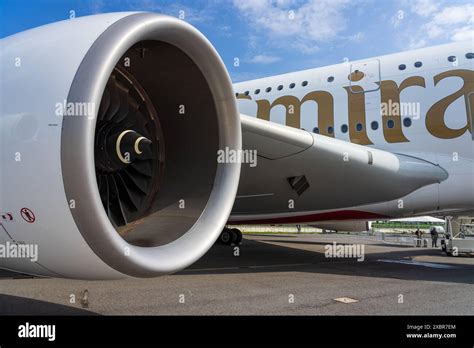
The dismantling process begins with high-value component removal. Engines are the most valuable assets aboard the aircraft, with Rolls-Royce Trent 900 and Engine Alliance GP7200 powerplants worth millions depending on condition and remaining service life. Landing gear systems, avionics equipment, auxiliary power units, cockpit electronics, actuators, and cabin components are also removed for resale.
These recycled components have become increasingly important to airlines still operating A380 fleets. Purchasing serviceable used parts from retired aircraft is dramatically cheaper than ordering new replacements directly from manufacturers. The growing supply chain emerging from dismantled superjumbos is helping reduce long-term operating costs for active operators.
Once reusable systems are removed, the enormous task of dismantling the airframe begins.
The A380’s construction makes it uniquely challenging to recycle. Unlike older aluminum-heavy aircraft, the superjumbo incorporates complex composite materials, carbon fiber reinforced polymers, and GLARE laminates — a hybrid material combining aluminum with fiberglass layers. Each material requires different cutting, sorting, and recycling techniques.
Tarmac Aerosave developed specialized tooling specifically for A380 dismantling, including advanced laser cutting systems capable of slicing through massive fuselage sections. The aircraft’s double-deck design further complicates the process, creating structural layers that do not exist in smaller jets.
Despite the complexity, up to 92 percent of the aircraft’s total weight can ultimately be recycled or repurposed.
The Strange Economics Driving The A380’s Survival
The Airbus A380 now occupies one of aviation’s most unusual market positions. It is simultaneously obsolete and indispensable.
For some airlines, the aircraft no longer fits modern network strategies. Operating a four-engine jet with massive seating capacity only works profitably on specific high-demand routes. Airlines lacking those routes have little reason to continue flying the aircraft.
Air France permanently retired its entire A380 fleet during the pandemic. Several other operators followed similar paths, deciding the economics no longer justified continued investment.
Yet for airlines built around high-volume international hubs, the A380 remains remarkably effective. Emirates, in particular, relies heavily on the aircraft’s ability to transport huge passenger numbers efficiently through Dubai. On heavily traveled routes between global megacities, filling 500 seats daily is still entirely realistic.
That split explains why Teruel’s operations feel almost contradictory. In one hangar, technicians are investing enormous resources preparing A380s for another decade of service. Outside, another aircraft may be systematically dismantled to support those same active fleets.
The situation is less a revival or collapse than a redistribution of value across the remaining global fleet.
Younger airframes with lower operational hours continue flying because they still justify the expense of maintenance and refurbishment. Older aircraft increasingly become donors, supplying engines and components that extend the operational lives of more economically viable examples.
Teruel sits directly at the center of that ecosystem.
The Future Of The Airbus A380 Runs Through The Spanish Desert
The Airbus A380 was once promoted as the future of long-haul aviation. Instead, it became a symbol of how quickly airline economics can change. Airbus officially ended A380 production in 2021 after building only 251 aircraft, far fewer than originally envisioned.
Yet the aircraft refuses to disappear.
Global passenger demand remains strong on major international corridors, airport congestion continues worsening at large hubs, and replacement aircraft deliveries remain delayed. Those conditions have unexpectedly prolonged the A380’s operational relevance.
Teruel reflects this reality more clearly than anywhere else in the world. The facility is neither an aircraft cemetery nor simply a maintenance center. It is a transition point where the A380 fleet is being reshaped for its next era.
Some aircraft arriving in Spain will return to skies over London, Dubai, Singapore, and Sydney carrying passengers for years to come. Others will never fly again, quietly surrendering engines, landing gear, and structural components so surviving superjumbos can remain operational.
In the dry silence of eastern Spain, the Airbus A380’s future is being decided one aircraft at a time.