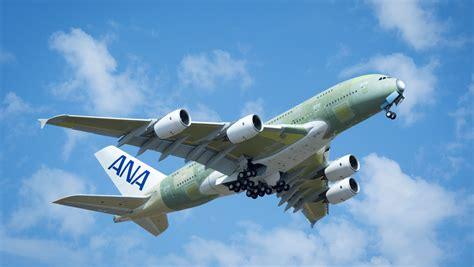
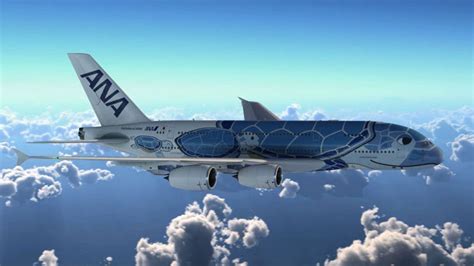
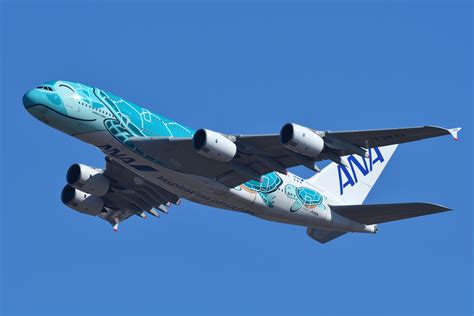
All Nippon Airways (ANA), Japan’s largest airline by revenue, is widely respected for its operational discipline, high service standards, and careful fleet planning. Yet the story of how ANA ended up with three Airbus A380s — an aircraft type it never initially wanted — reads like an industry anomaly. These massive superjumbos, lavishly adorned in turtle-themed liveries and affectionately branded as “Flying Honu,” now operate some of the emptiest long-haul flights in ANA’s network. The bizarre circumstances that led to ANA’s reluctant adoption of the A380s shine a light on the complexities of airline mergers, state intervention, and the persistent gamble of operating large aircraft in niche markets.
A380s Never Meant for ANA: The Skymark Collapse
To understand ANA’s unlikely relationship with the Airbus A380, one must rewind to the mid-2010s when Skymark Airlines, Japan’s third-largest carrier at the time, ambitiously placed an order for six A380s. Skymark envisioned itself breaking into international markets and competing on high-density routes to destinations like Hawaii and the U.S. West Coast. However, this bold move backfired spectacularly. Cost overruns, mismanagement, and a rapidly deteriorating financial picture forced Skymark to cancel the order and ultimately file for bankruptcy protection in early 2015.
This bankruptcy posed a considerable problem for Airbus. With Skymark’s A380s already partially built or committed in the production line, the European planemaker found itself in a predicament. Desperate to find a new buyer — or risk a very public loss — Airbus turned to ANA, which had previously shown no interest in the A380. Airbus reportedly lobbied both ANA and the Japanese government, knowing that saving the order could preserve its image and financial position.
A Political Deal Dressed as a Strategic Investment
When ANA stepped in to take over three of the six orphaned A380s, many in the industry raised their eyebrows. Why would a meticulous and conservative airline adopt an aircraft that it had no operational use for? Behind the scenes, the decision bore all the hallmarks of a politically influenced deal. The Japanese government was keen to support both Skymark’s restructuring and maintain good relations with the European Union — especially with regard to trade and aerospace cooperation. ANA, as the national champion, was quietly encouraged to absorb the order. It would not only serve diplomatic interests but also help ANA strengthen its hand in acquiring Skymark assets during the carrier’s restructuring.
The Honolulu Strategy: A High-Capacity Bet Gone Flat
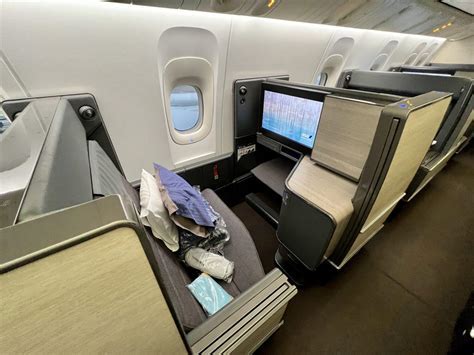
ANA’s solution to deploying the three superjumbos was simple: create a dedicated service between Tokyo Narita and Honolulu, targeting Japanese leisure travelers and honeymooners bound for Hawaii. The carrier introduced a unique product onboard, with family-friendly amenities, a multi-class configuration including first class suites, and a livery tailored for tourism appeal. The Flying Honu aircraft launched service in 2019 and initially received decent attention and media buzz.
But the economics told a different story. Even before the pandemic, demand on the Tokyo-Honolulu route was highly seasonal and not strong enough to justify daily A380 flights. Japan Airlines, Hawaiian Airlines, and Delta already saturated the market, and ANA’s decision to fly the A380 exclusively out of Narita — instead of the more convenient Haneda — further limited its appeal. Narita’s less favorable location for Tokyo residents, combined with the niche leisure focus of the route, turned the flagship Flying Honu flights into a low-yield operation from the beginning.
COVID-19 and the Grounding of Giants
The onset of the COVID-19 pandemic in 2020 further crippled ANA’s ability to make its A380 strategy work. International travel collapsed, and Hawaii tourism — so heavily dependent on Japanese visitors — ground to a halt. ANA parked all three A380s for months on end, their engines covered and fuselages wrapped to shield from corrosion.
Even as borders reopened and leisure travel gradually resumed, ANA found it difficult to fill the 520+ seats on each aircraft. Unlike Emirates or Singapore Airlines, ANA doesn’t operate a global hub model where A380s can be flexibly reassigned. The Flying Honu fleet was designed for one route, and one route only — Tokyo to Honolulu. This lack of operational flexibility effectively locked ANA into a structural disadvantage, one that became even more painful as fuel costs surged and post-pandemic travel patterns shifted.
An Expensive Public Relations Vehicle
The Flying Honu jets became more than just oversized airliners — they evolved into symbols of ANA’s PR ambitions. The aircraft were heavily marketed with limited edition merchandise, children’s books, anime-style commercials, and social media campaigns. ANA even offered domestic sightseeing flights aboard the A380 during the pandemic just to keep the brand alive and the jets in limited use.
Yet none of this masked the core financial problem: ANA was losing money on nearly every flight operated by these aircraft. Industry insiders speculate that the flights are among the lowest load factor routes in the entire ANA long-haul network, often departing with dozens of empty business and first-class seats. The airline has been tight-lipped about exact figures, but aviation analysts estimate that even a consistently 80% full A380 flight to Hawaii would still struggle to cover its fuel and crew costs — let alone amortization and maintenance.
The Cost of Sentiment and Stubborn Optimism
Despite these challenges, ANA has doubled down on its commitment to the Flying Honu program. In 2023, the airline resumed double daily A380 service to Honolulu, banking on a rebound in tourism and a possible upswing in Japan’s outbound leisure demand. This strategy has been met with skepticism, particularly as Japan’s economy remains stagnant and the yen weak against the dollar — making Hawaiian vacations less attractive to budget-conscious travelers.
The harsh truth is that the A380s ANA operates were never meant to fit into its long-term fleet strategy. ANA prefers fuel-efficient twinjets like the Boeing 787 Dreamliner and the upcoming 777X — aircraft far better suited to its real-world demand profiles and route structure. The A380, by contrast, is an emotional and diplomatic relic, adopted more as an act of statecraft than sound business.
Can ANA Exit the A380 Conundrum?
ANA’s path forward with its A380 fleet is unclear. Selling the aircraft would be virtually impossible — the secondary market for A380s is nearly non-existent, and the aircraft’s high maintenance and airport handling costs make it unattractive to most carriers. A potential wet lease or charter partnership with tour operators might offer limited relief, but these options are unlikely to materially change the aircraft’s dismal financial performance.
There’s also the reputational risk. ANA has invested heavily in branding these aircraft as icons of the airline. Any move to reduce operations or retire the fleet early could invite negative press and tarnish its image as a forward-looking, environmentally conscious carrier. After all, operating a three-deck, quad-engine aircraft to a leisure destination on a daily basis flies in the face of aviation’s ongoing push for efficiency and sustainability.
Lessons From ANA’s A380 Saga
The ANA A380 story offers a compelling case study on what happens when airlines are pressured into fleet decisions driven by politics, not economics. While ANA is a world-class airline with an impressive record of profitability and innovation, its A380 acquisition stands out as a misalignment of corporate strategy and real-world demand.
The lesson here isn’t just about aircraft size or route choice. It’s about governance, market realism, and the importance of aligning every fleet decision with core business logic. ANA may still find a way to squeeze some residual value out of the Flying Honu program through tourism recovery and clever branding — but the episode will likely remain a rare blemish in an otherwise meticulously curated airline history.
In the end, ANA’s A380s are not just heavy aircraft; they are heavy with legacy, laden with the weight of external expectations and internal contradictions. Their future remains airborne — but just barely.